

9 Accelerator Operations
561
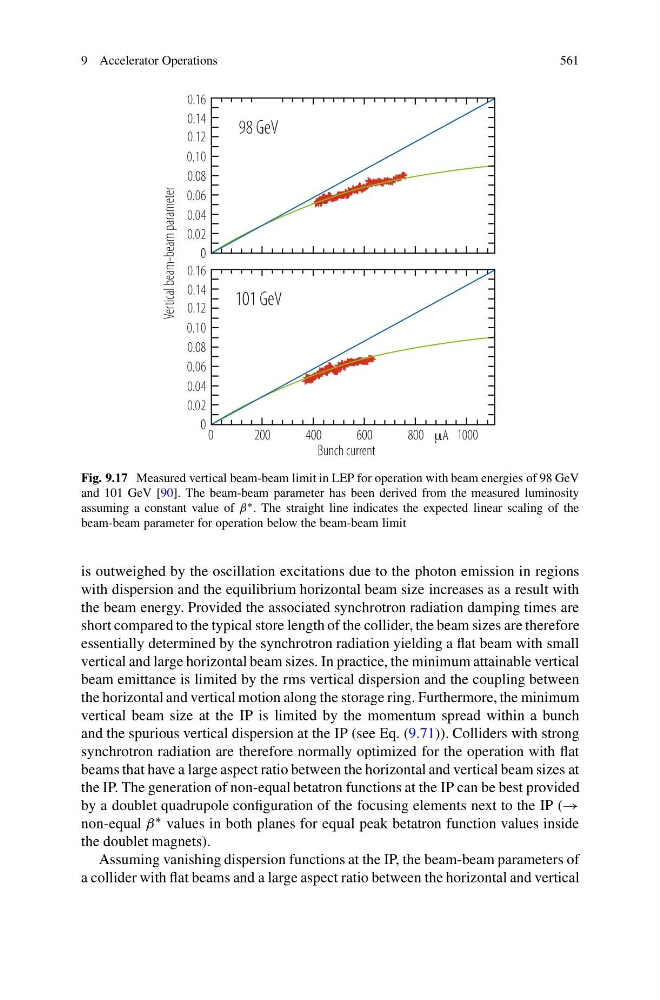
Fig. 9.17 Measured vertical beam-beam limit in LEP for operation with beam energies of 98 GeV
and 101 GeV [90]. The beam-beam parameter has been derived from the measured luminosity
assuming a constant value of β ∗ . The straight line indicates the expected linear scaling of the
beam-beam parameter for operation below the beam-beam limit
is outweighed by the oscillation excitations due to the photon emission in regions
with dispersion and the equilibrium horizontal beam size increases as a result with
the beam energy. Provided the associated synchrotron radiation damping times are
short compared to the typical store length of the collider, the beam sizes are therefore
essentially determined by the synchrotron radiation yielding a flat beam with small
vertical and large horizontal beam sizes. In practice, the minimum attainable vertical
beam emittance is limited by the rms vertical dispersion and the coupling between
the horizontal and vertical motion along the storage ring. Furthermore, the minimum
vertical beam size at the IP is limited by the momentum spread within a bunch
and the spurious vertical dispersion at the IP (see Eq. (9.71)). Colliders with strong
synchrotron radiation are therefore normally optimized for the operation with flat
beams that have a large aspect ratio between the horizontal and vertical beam sizes at
the IP. The generation of non-equal betatron functions at the IP can be best provided
by a doublet quadrupole configuration of the focusing elements next to the IP (→
non-equal β ∗ values in both planes for equal peak betatron function values inside
the doublet magnets).
Assuming vanishing dispersion functions at the IP, the beam-beam parameters of
a collider with flat beams and a large aspect ratio between the horizontal and vertical
561
Fig. 9.17 Measured vertical beam-beam limit in LEP for operation with beam energies of 98 GeV
and 101 GeV [90]. The beam-beam parameter has been derived from the measured luminosity
assuming a constant value of β ∗ . The straight line indicates the expected linear scaling of the
beam-beam parameter for operation below the beam-beam limit
is outweighed by the oscillation excitations due to the photon emission in regions
with dispersion and the equilibrium horizontal beam size increases as a result with
the beam energy. Provided the associated synchrotron radiation damping times are
short compared to the typical store length of the collider, the beam sizes are therefore
essentially determined by the synchrotron radiation yielding a flat beam with small
vertical and large horizontal beam sizes. In practice, the minimum attainable vertical
beam emittance is limited by the rms vertical dispersion and the coupling between
the horizontal and vertical motion along the storage ring. Furthermore, the minimum
vertical beam size at the IP is limited by the momentum spread within a bunch
and the spurious vertical dispersion at the IP (see Eq. (9.71)). Colliders with strong
synchrotron radiation are therefore normally optimized for the operation with flat
beams that have a large aspect ratio between the horizontal and vertical beam sizes at
the IP. The generation of non-equal betatron functions at the IP can be best provided
by a doublet quadrupole configuration of the focusing elements next to the IP (→
non-equal β ∗ values in both planes for equal peak betatron function values inside
the doublet magnets).
Assuming vanishing dispersion functions at the IP, the beam-beam parameters of
a collider with flat beams and a large aspect ratio between the horizontal and vertical