

532
M. Lamont et al.
with τ being the constant of the low-pass characteristic, ζ the damping factor and
ω 0 the eigenfrequency of the system. In an ideal world the feed-forward (M(s) = 0)
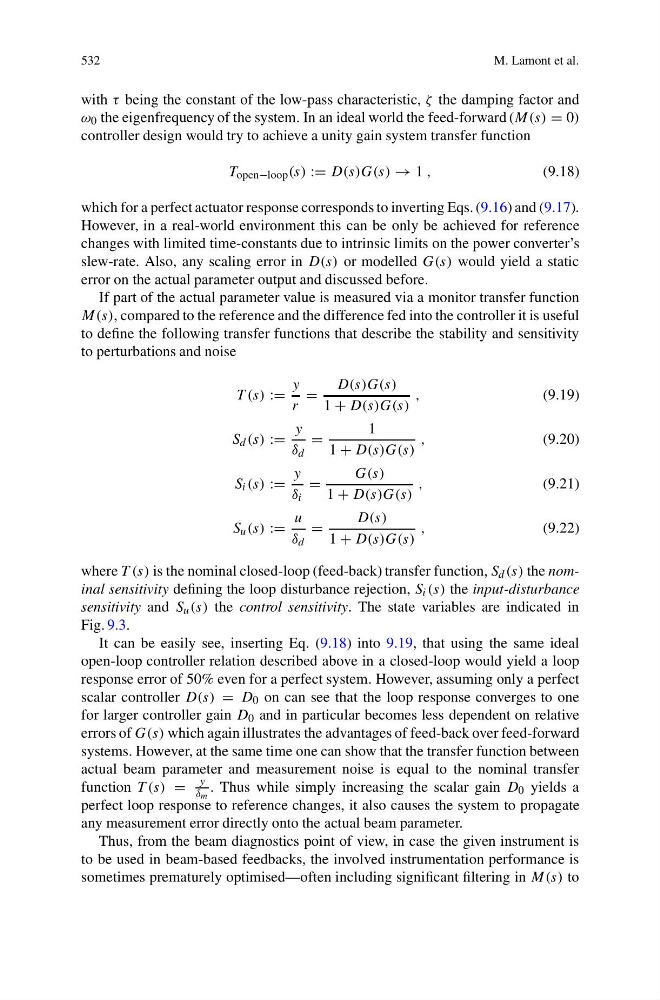
controller design would try to achieve a unity gain system transfer function
T open−loop (s) := D(s)G(s) → 1 ,
(9.18)
which for a perfect actuator response corresponds to inverting Eqs. (9.16) and (9.17).
However, in a real-world environment this can be only be achieved for reference
changes with limited time-constants due to intrinsic limits on the power converter’s
slew-rate. Also, any scaling error in D(s) or modelled G(s) would yield a static
error on the actual parameter output and discussed before.
If part of the actual parameter value is measured via a monitor transfer function
M(s), compared to the reference and the difference fed into the controller it is useful
to define the following transfer functions that describe the stability and sensitivity
to perturbations and noise
T (s) :=
y
r
=
D(s)G(s)
1 + D(s)G(s)
,
(9.19)
S d (s) :=
y
δ d
=
1
1 + D(s)G(s)
,
(9.20)
S i (s) :=
y
δ i
=
G(s)
1 + D(s)G(s)
,
(9.21)
S u (s) :=
u
δ d
=
D(s)
1 + D(s)G(s)
,
(9.22)
where T (s) is the nominal closed-loop (feed-back) transfer function, S d (s) the nominal sensitivity defining the loop disturbance rejection, S i (s) the input-disturbance
sensitivity and S u (s) the control sensitivity. The state variables are indicated in
Fig. 9.3.
It can be easily see, inserting Eq. (9.18) into 9.19, that using the same ideal
open-loop controller relation described above in a closed-loop would yield a loop
response error of 50% even for a perfect system. However, assuming only a perfect
scalar controller D(s) = D 0 on can see that the loop response converges to one
for larger controller gain D 0 and in particular becomes less dependent on relative
errors of G(s) which again illustrates the advantages of feed-back over feed-forward
systems. However, at the same time one can show that the transfer function between
actual beam parameter and measurement noise is equal to the nominal transfer
function T (s) =
y
δ m
. Thus while simply increasing the scalar gain D 0 yields a
perfect loop response to reference changes, it also causes the system to propagate
any measurement error directly onto the actual beam parameter.
Thus, from the beam diagnostics point of view, in case the given instrument is
to be used in beam-based feedbacks, the involved instrumentation performance is
sometimes prematurely optimised—often including significant filtering in M(s) to
M. Lamont et al.
with τ being the constant of the low-pass characteristic, ζ the damping factor and
ω 0 the eigenfrequency of the system. In an ideal world the feed-forward (M(s) = 0)
controller design would try to achieve a unity gain system transfer function
T open−loop (s) := D(s)G(s) → 1 ,
(9.18)
which for a perfect actuator response corresponds to inverting Eqs. (9.16) and (9.17).
However, in a real-world environment this can be only be achieved for reference
changes with limited time-constants due to intrinsic limits on the power converter’s
slew-rate. Also, any scaling error in D(s) or modelled G(s) would yield a static
error on the actual parameter output and discussed before.
If part of the actual parameter value is measured via a monitor transfer function
M(s), compared to the reference and the difference fed into the controller it is useful
to define the following transfer functions that describe the stability and sensitivity
to perturbations and noise
T (s) :=
y
r
=
D(s)G(s)
1 + D(s)G(s)
,
(9.19)
S d (s) :=
y
δ d
=
1
1 + D(s)G(s)
,
(9.20)
S i (s) :=
y
δ i
=
G(s)
1 + D(s)G(s)
,
(9.21)
S u (s) :=
u
δ d
=
D(s)
1 + D(s)G(s)
,
(9.22)
where T (s) is the nominal closed-loop (feed-back) transfer function, S d (s) the nominal sensitivity defining the loop disturbance rejection, S i (s) the input-disturbance
sensitivity and S u (s) the control sensitivity. The state variables are indicated in
Fig. 9.3.
It can be easily see, inserting Eq. (9.18) into 9.19, that using the same ideal
open-loop controller relation described above in a closed-loop would yield a loop
response error of 50% even for a perfect system. However, assuming only a perfect
scalar controller D(s) = D 0 on can see that the loop response converges to one
for larger controller gain D 0 and in particular becomes less dependent on relative
errors of G(s) which again illustrates the advantages of feed-back over feed-forward
systems. However, at the same time one can show that the transfer function between
actual beam parameter and measurement noise is equal to the nominal transfer
function T (s) =
y
δ m
. Thus while simply increasing the scalar gain D 0 yields a
perfect loop response to reference changes, it also causes the system to propagate
any measurement error directly onto the actual beam parameter.
Thus, from the beam diagnostics point of view, in case the given instrument is
to be used in beam-based feedbacks, the involved instrumentation performance is
sometimes prematurely optimised—often including significant filtering in M(s) to