

530
M. Lamont et al.
Reference = 1
Actual parameter
Norm. parameter
Time
a
Feed-Forward Response
Reference = 1
Norm. parameter
Time
1
rst
2
nd
n
th
...
Actual parameter
b
Feedback Response
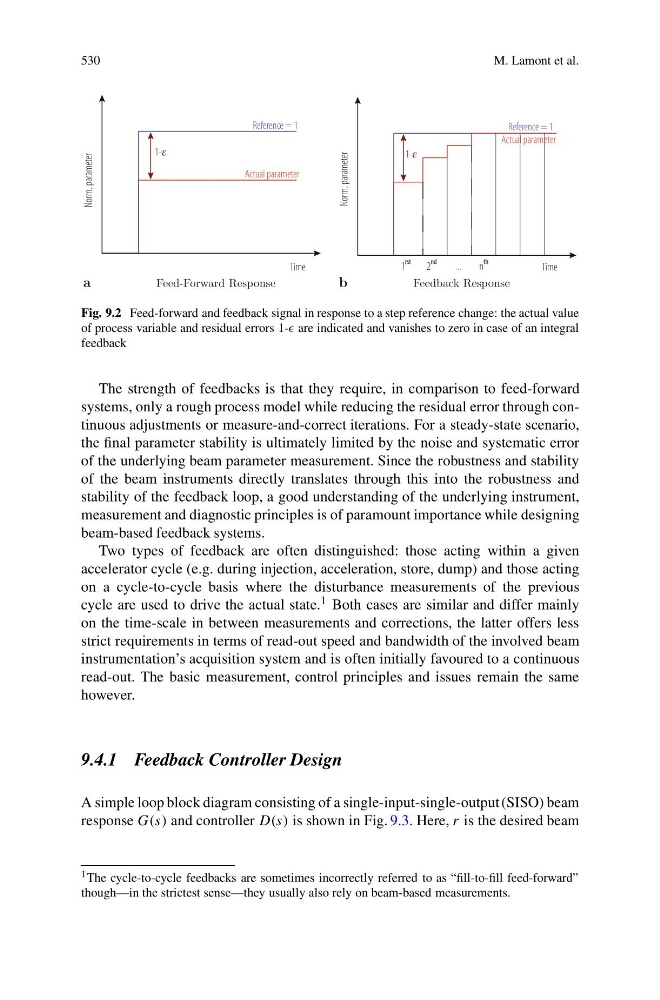
1Fig. 9.2 Feed-forward and feedback signal in response to a step reference change: the actual value
of process variable and residual errors 1- are indicated and vanishes to zero in case of an integral
feedback
The strength of feedbacks is that they require, in comparison to feed-forward
systems, only a rough process model while reducing the residual error through continuous adjustments or measure-and-correct iterations. For a steady-state scenario,
the final parameter stability is ultimately limited by the noise and systematic error
of the underlying beam parameter measurement. Since the robustness and stability
of the beam instruments directly translates through this into the robustness and
stability of the feedback loop, a good understanding of the underlying instrument,
measurement and diagnostic principles is of paramount importance while designing
beam-based feedback systems.
Two types of feedback are often distinguished: those acting within a given
accelerator cycle (e.g. during injection, acceleration, store, dump) and those acting
on a cycle-to-cycle basis where the disturbance measurements of the previous
cycle are used to drive the actual state. 1 Both cases are similar and differ mainly
on the time-scale in between measurements and corrections, the latter offers less
strict requirements in terms of read-out speed and bandwidth of the involved beam
instrumentation’s acquisition system and is often initially favoured to a continuous
read-out. The basic measurement, control principles and issues remain the same
however.
9.4.1 Feedback Controller Design
A simple loop block diagram consisting of a single-input-single-output (SISO) beam
response G(s) and controller D(s) is shown in Fig. 9.3. Here, r is the desired beam
1 The cycle-to-cycle feedbacks are sometimes incorrectly referred to as “fill-to-fill feed-forward”
though—in the strictest sense—they usually also rely on beam-based measurements.
M. Lamont et al.
Reference = 1
Actual parameter
Norm. parameter
Time
a
Feed-Forward Response
Reference = 1
Norm. parameter
Time
1
rst
2
nd
n
th
...
Actual parameter
b
Feedback Response
1Fig. 9.2 Feed-forward and feedback signal in response to a step reference change: the actual value
of process variable and residual errors 1- are indicated and vanishes to zero in case of an integral
feedback
The strength of feedbacks is that they require, in comparison to feed-forward
systems, only a rough process model while reducing the residual error through continuous adjustments or measure-and-correct iterations. For a steady-state scenario,
the final parameter stability is ultimately limited by the noise and systematic error
of the underlying beam parameter measurement. Since the robustness and stability
of the beam instruments directly translates through this into the robustness and
stability of the feedback loop, a good understanding of the underlying instrument,
measurement and diagnostic principles is of paramount importance while designing
beam-based feedback systems.
Two types of feedback are often distinguished: those acting within a given
accelerator cycle (e.g. during injection, acceleration, store, dump) and those acting
on a cycle-to-cycle basis where the disturbance measurements of the previous
cycle are used to drive the actual state. 1 Both cases are similar and differ mainly
on the time-scale in between measurements and corrections, the latter offers less
strict requirements in terms of read-out speed and bandwidth of the involved beam
instrumentation’s acquisition system and is often initially favoured to a continuous
read-out. The basic measurement, control principles and issues remain the same
however.
9.4.1 Feedback Controller Design
A simple loop block diagram consisting of a single-input-single-output (SISO) beam
response G(s) and controller D(s) is shown in Fig. 9.3. Here, r is the desired beam
1 The cycle-to-cycle feedbacks are sometimes incorrectly referred to as “fill-to-fill feed-forward”
though—in the strictest sense—they usually also rely on beam-based measurements.