

9 Accelerator Operations
525
9.3.1 Global Orbit Correction
Consider a storage ring with M beam position monitors (BPM) and N correctors.
Orbit displacements
d (M-component vector) arising from corrector kick angles
θ
(N-component vector) are determined by the M × N linear response matrix A,
A
θ =
d ,
(9.3)
A mn =
√
β m β n
2 sin πν
cos (|φ m − φ n | − πν) .
(9.4)
The elements of A may be obtained from the machine model or be determined
experimentally by measuring the deviation at each BPM resulting from exciting
each corrector individually.
The task of the orbit correction is to find a set of corrector kicks
θ that satisfy the
following relation,
d + A
θ = 0 .
(9.5)
In general the number of BPMs (M) and the number of correctors (N) are not
identical and Eq. (9.5) is either over- (M > N) or under-constrained (M < N).
In the former and most frequent case, Eq. (9.5) can not be solved exactly. Instead,
an approximate solution must be found, and commonly used least square algorithms
minimize the quadratic residual
S = =
d + A
θ
2 .
(9.6)
9.3.2 SVD Algorithm
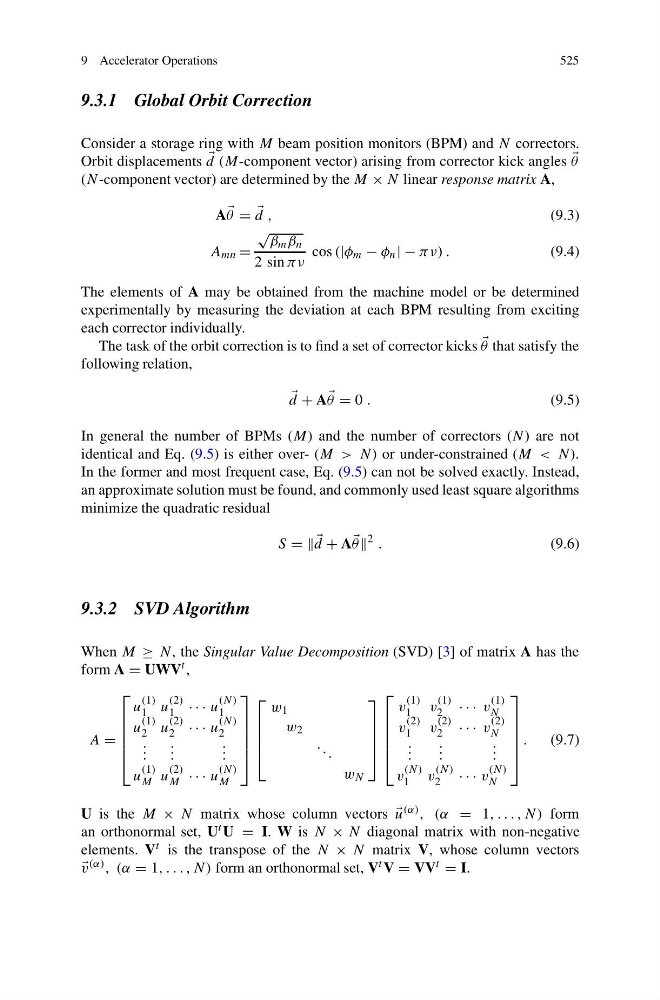
When M ≥ N, the Singular Value Decomposition (SVD) [3] of matrix A has the
form A = UWV
t ,
A =
⎡
⎢
⎢
⎢
⎢
⎣
u
(1)
1 u
(2)
1 · · · u
(N)
1
u
(1)
2 u
(2)
2 · · · u
(N)
2
. . .
. . .
. . .
u
(1)
M u
(2)
M · · · u
(N)
M
⎤
⎥
⎥
⎥
⎥
⎦
⎡
⎢
⎢
⎢
⎣
w 1
w 2
. . .
w N
⎤
⎥
⎥
⎥
⎦
⎡
⎢
⎢
⎢
⎢
⎣
v
(1)
1
v
(1)
2 · · · v
(1)
N
v
(2)
1
v
(2)
2 · · · v
(2)
N
. . .
. . .
. . .
v
(N)
1
v
(N)
2
· · · v
(N)
N
⎤
⎥
⎥
⎥
⎥
⎦
.
(9.7)
U is the M × N matrix whose column vectors
u (α) , (α = 1, . . . , N) form
an orthonormal set, U t U = I. W is N × N diagonal matrix with non-negative
elements. V t is the transpose of the N × N matrix V, whose column vectors
v (α) , (α = 1, . . . , N) form an orthonormal set, V t V = VV t = I.
525
9.3.1 Global Orbit Correction
Consider a storage ring with M beam position monitors (BPM) and N correctors.
Orbit displacements
d (M-component vector) arising from corrector kick angles
θ
(N-component vector) are determined by the M × N linear response matrix A,
A
θ =
d ,
(9.3)
A mn =
√
β m β n
2 sin πν
cos (|φ m − φ n | − πν) .
(9.4)
The elements of A may be obtained from the machine model or be determined
experimentally by measuring the deviation at each BPM resulting from exciting
each corrector individually.
The task of the orbit correction is to find a set of corrector kicks
θ that satisfy the
following relation,
d + A
θ = 0 .
(9.5)
In general the number of BPMs (M) and the number of correctors (N) are not
identical and Eq. (9.5) is either over- (M > N) or under-constrained (M < N).
In the former and most frequent case, Eq. (9.5) can not be solved exactly. Instead,
an approximate solution must be found, and commonly used least square algorithms
minimize the quadratic residual
S = =
d + A
θ
2 .
(9.6)
9.3.2 SVD Algorithm
When M ≥ N, the Singular Value Decomposition (SVD) [3] of matrix A has the
form A = UWV
t ,
A =
⎡
⎢
⎢
⎢
⎢
⎣
u
(1)
1 u
(2)
1 · · · u
(N)
1
u
(1)
2 u
(2)
2 · · · u
(N)
2
. . .
. . .
. . .
u
(1)
M u
(2)
M · · · u
(N)
M
⎤
⎥
⎥
⎥
⎥
⎦
⎡
⎢
⎢
⎢
⎣
w 1
w 2
. . .
w N
⎤
⎥
⎥
⎥
⎦
⎡
⎢
⎢
⎢
⎢
⎣
v
(1)
1
v
(1)
2 · · · v
(1)
N
v
(2)
1
v
(2)
2 · · · v
(2)
N
. . .
. . .
. . .
v
(N)
1
v
(N)
2
· · · v
(N)
N
⎤
⎥
⎥
⎥
⎥
⎦
.
(9.7)
U is the M × N matrix whose column vectors
u (α) , (α = 1, . . . , N) form
an orthonormal set, U t U = I. W is N × N diagonal matrix with non-negative
elements. V t is the transpose of the N × N matrix V, whose column vectors
v (α) , (α = 1, . . . , N) form an orthonormal set, V t V = VV t = I.