

9 Accelerator Operations
523
to pre-calculate the coefficients relating strength changes to a given tune change.
The key point here is to have on-line a rapid and easily available conversion between
a beam parameter, magnet strength and ultimately power supply current. Once
established the method can be used by on-line, off-line and real-time software.
The coefficients can either be established from standard definitions involving
Twiss parameters or by pre-calculating the corresponding coefficients using, say,
MADX, and use them with appropriate linear scaling to calculate the required
changes in quadrupole strengths. The same arguments hold for all other commonly
used operational parameters.
For chromaticity a matrix equation can be formed for the required change in
sextupole strength given a desired change in chromaticity. Operationally the matrix
coefficients can be pre-calculated either via the standard integrals or a machine
model and then used on-line. Different sextupole families are often used in colliders
to target different sources of chromaticity. Correction algorithms can be configured
to weight different families as required.
Correction of the coupling can be important for machine performance and beam
diagnostics. Sources of coupling include: tilted quadrupoles; solenoid fields; and
vertical orbit deviations in sextupoles. Anticipating these sources at the design
stage ensures that appropriately placed families of skew quadrupoles can be
used to correct all sources of coupling. In principle the coupling generated by
experimental solenoids and its correction can be pre-calculated. Correction of
coupling from random sources in the machine can either be performed empirically
or by compensating the coupling driving terms extracted from multi-turn BPM
measurements. Knobs to correct the real and imaginary part of the coupling driving
terms should be anticipated.
An effective method of measuring coupling is required. Methods range from
measurements of the cross-plane tune amplitudes; the closest tune approach; measuring the cross-plane effects of beam excitation. More sophisticated measurement
techniques can identified local sources of coupling and local correction may be
possible if dedicated elements are available e.g. correction of coupling arising from
tilts of the inner triplet magnets in the LHC. On-line methods using the transverse
damper in AC-dipole mode to obtain spectral data around ring have provided
automatic on-line correction of the real and imaginary parts of the coupling in the
LHC.
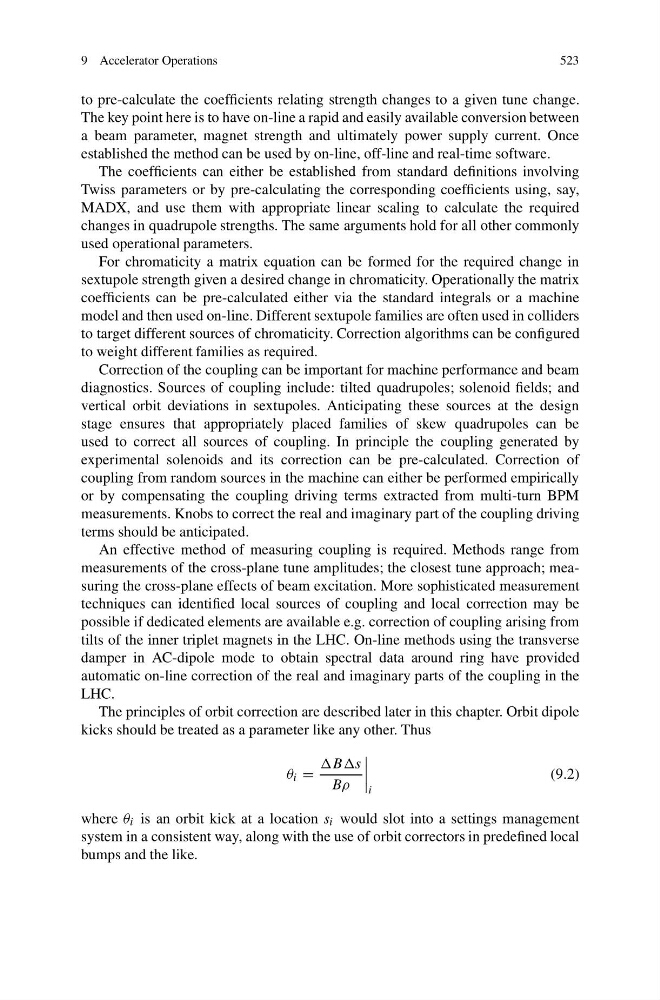
The principles of orbit correction are described later in this chapter. Orbit dipole
kicks should be treated as a parameter like any other. Thus
θ i =
BBs
Bρ
i
(9.2)
where θ i is an orbit kick at a location s i would slot into a settings management
system in a consistent way, along with the use of orbit correctors in predefined local
bumps and the like.
523
to pre-calculate the coefficients relating strength changes to a given tune change.
The key point here is to have on-line a rapid and easily available conversion between
a beam parameter, magnet strength and ultimately power supply current. Once
established the method can be used by on-line, off-line and real-time software.
The coefficients can either be established from standard definitions involving
Twiss parameters or by pre-calculating the corresponding coefficients using, say,
MADX, and use them with appropriate linear scaling to calculate the required
changes in quadrupole strengths. The same arguments hold for all other commonly
used operational parameters.
For chromaticity a matrix equation can be formed for the required change in
sextupole strength given a desired change in chromaticity. Operationally the matrix
coefficients can be pre-calculated either via the standard integrals or a machine
model and then used on-line. Different sextupole families are often used in colliders
to target different sources of chromaticity. Correction algorithms can be configured
to weight different families as required.
Correction of the coupling can be important for machine performance and beam
diagnostics. Sources of coupling include: tilted quadrupoles; solenoid fields; and
vertical orbit deviations in sextupoles. Anticipating these sources at the design
stage ensures that appropriately placed families of skew quadrupoles can be
used to correct all sources of coupling. In principle the coupling generated by
experimental solenoids and its correction can be pre-calculated. Correction of
coupling from random sources in the machine can either be performed empirically
or by compensating the coupling driving terms extracted from multi-turn BPM
measurements. Knobs to correct the real and imaginary part of the coupling driving
terms should be anticipated.
An effective method of measuring coupling is required. Methods range from
measurements of the cross-plane tune amplitudes; the closest tune approach; measuring the cross-plane effects of beam excitation. More sophisticated measurement
techniques can identified local sources of coupling and local correction may be
possible if dedicated elements are available e.g. correction of coupling arising from
tilts of the inner triplet magnets in the LHC. On-line methods using the transverse
damper in AC-dipole mode to obtain spectral data around ring have provided
automatic on-line correction of the real and imaginary parts of the coupling in the
LHC.
The principles of orbit correction are described later in this chapter. Orbit dipole
kicks should be treated as a parameter like any other. Thus
θ i =
BBs
Bρ
i
(9.2)
where θ i is an orbit kick at a location s i would slot into a settings management
system in a consistent way, along with the use of orbit correctors in predefined local
bumps and the like.