

522
M. Lamont et al.
9.2.1 Magnetic Elements
For a given machine configuration, optics programs are generally used off-line to
generate the baseline settings in normalized strength for magnetic elements. These
strengths should be imported into the settings management system and be amenable
to adjustment as required. The required beam momentum is used to calculate the
field or gradient required in a magnet or series of magnets.
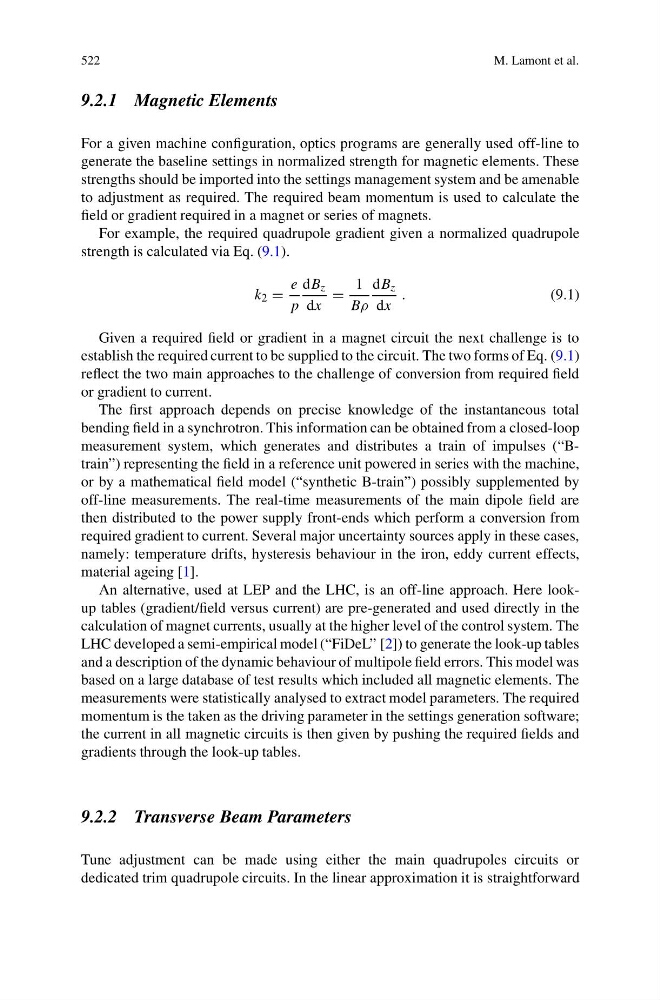
For example, the required quadrupole gradient given a normalized quadrupole
strength is calculated via Eq. (9.1).
k 2 =
e
p
dB z
dx
=
1
Bρ
dB z
dx
.
(9.1)
Given a required field or gradient in a magnet circuit the next challenge is to
establish the required current to be supplied to the circuit. The two forms of Eq. (9.1)
reflect the two main approaches to the challenge of conversion from required field
or gradient to current.
The first approach depends on precise knowledge of the instantaneous total
bending field in a synchrotron. This information can be obtained from a closed-loop
measurement system, which generates and distributes a train of impulses (“Btrain”) representing the field in a reference unit powered in series with the machine,
or by a mathematical field model (“synthetic B-train”) possibly supplemented by
off-line measurements. The real-time measurements of the main dipole field are
then distributed to the power supply front-ends which perform a conversion from
required gradient to current. Several major uncertainty sources apply in these cases,
namely: temperature drifts, hysteresis behaviour in the iron, eddy current effects,
material ageing [1].
An alternative, used at LEP and the LHC, is an off-line approach. Here lookup tables (gradient/field versus current) are pre-generated and used directly in the
calculation of magnet currents, usually at the higher level of the control system. The
LHC developed a semi-empirical model (“FiDeL” [2]) to generate the look-up tables
and a description of the dynamic behaviour of multipole field errors. This model was
based on a large database of test results which included all magnetic elements. The
measurements were statistically analysed to extract model parameters. The required
momentum is the taken as the driving parameter in the settings generation software;
the current in all magnetic circuits is then given by pushing the required fields and
gradients through the look-up tables.
9.2.2 Transverse Beam Parameters
Tune adjustment can be made using either the main quadrupoles circuits or
dedicated trim quadrupole circuits. In the linear approximation it is straightforward
M. Lamont et al.
9.2.1 Magnetic Elements
For a given machine configuration, optics programs are generally used off-line to
generate the baseline settings in normalized strength for magnetic elements. These
strengths should be imported into the settings management system and be amenable
to adjustment as required. The required beam momentum is used to calculate the
field or gradient required in a magnet or series of magnets.
For example, the required quadrupole gradient given a normalized quadrupole
strength is calculated via Eq. (9.1).
k 2 =
e
p
dB z
dx
=
1
Bρ
dB z
dx
.
(9.1)
Given a required field or gradient in a magnet circuit the next challenge is to
establish the required current to be supplied to the circuit. The two forms of Eq. (9.1)
reflect the two main approaches to the challenge of conversion from required field
or gradient to current.
The first approach depends on precise knowledge of the instantaneous total
bending field in a synchrotron. This information can be obtained from a closed-loop
measurement system, which generates and distributes a train of impulses (“Btrain”) representing the field in a reference unit powered in series with the machine,
or by a mathematical field model (“synthetic B-train”) possibly supplemented by
off-line measurements. The real-time measurements of the main dipole field are
then distributed to the power supply front-ends which perform a conversion from
required gradient to current. Several major uncertainty sources apply in these cases,
namely: temperature drifts, hysteresis behaviour in the iron, eddy current effects,
material ageing [1].
An alternative, used at LEP and the LHC, is an off-line approach. Here lookup tables (gradient/field versus current) are pre-generated and used directly in the
calculation of magnet currents, usually at the higher level of the control system. The
LHC developed a semi-empirical model (“FiDeL” [2]) to generate the look-up tables
and a description of the dynamic behaviour of multipole field errors. This model was
based on a large database of test results which included all magnetic elements. The
measurements were statistically analysed to extract model parameters. The required
momentum is the taken as the driving parameter in the settings generation software;
the current in all magnetic circuits is then given by pushing the required fields and
gradients through the look-up tables.
9.2.2 Transverse Beam Parameters
Tune adjustment can be made using either the main quadrupoles circuits or
dedicated trim quadrupole circuits. In the linear approximation it is straightforward