

8 Accelerator Engineering and Technology: Accelerator Technology
503
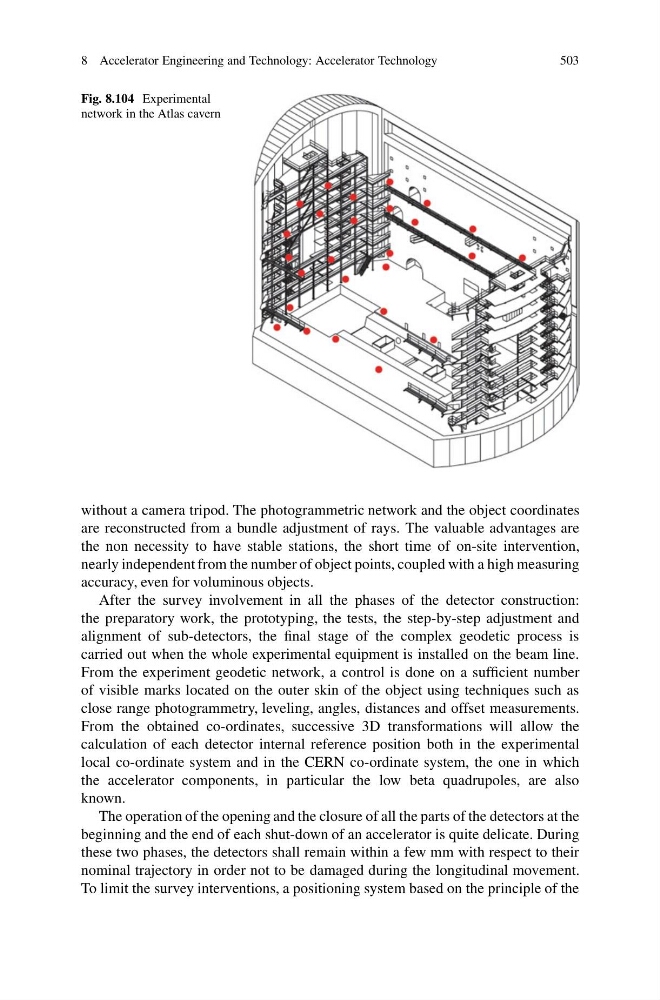
Fig. 8.104 Experimental
network in the Atlas cavern
without a camera tripod. The photogrammetric network and the object coordinates
are reconstructed from a bundle adjustment of rays. The valuable advantages are
the non necessity to have stable stations, the short time of on-site intervention,
nearly independent from the number of object points, coupled with a high measuring
accuracy, even for voluminous objects.
After the survey involvement in all the phases of the detector construction:
the preparatory work, the prototyping, the tests, the step-by-step adjustment and
alignment of sub-detectors, the final stage of the complex geodetic process is
carried out when the whole experimental equipment is installed on the beam line.
From the experiment geodetic network, a control is done on a sufficient number
of visible marks located on the outer skin of the object using techniques such as
close range photogrammetry, leveling, angles, distances and offset measurements.
From the obtained co-ordinates, successive 3D transformations will allow the
calculation of each detector internal reference position both in the experimental
local co-ordinate system and in the CERN co-ordinate system, the one in which
the accelerator components, in particular the low beta quadrupoles, are also
known.
The operation of the opening and the closure of all the parts of the detectors at the
beginning and the end of each shut-down of an accelerator is quite delicate. During
these two phases, the detectors shall remain within a few mm with respect to their
nominal trajectory in order not to be damaged during the longitudinal movement.
To limit the survey interventions, a positioning system based on the principle of the
503
Fig. 8.104 Experimental
network in the Atlas cavern
without a camera tripod. The photogrammetric network and the object coordinates
are reconstructed from a bundle adjustment of rays. The valuable advantages are
the non necessity to have stable stations, the short time of on-site intervention,
nearly independent from the number of object points, coupled with a high measuring
accuracy, even for voluminous objects.
After the survey involvement in all the phases of the detector construction:
the preparatory work, the prototyping, the tests, the step-by-step adjustment and
alignment of sub-detectors, the final stage of the complex geodetic process is
carried out when the whole experimental equipment is installed on the beam line.
From the experiment geodetic network, a control is done on a sufficient number
of visible marks located on the outer skin of the object using techniques such as
close range photogrammetry, leveling, angles, distances and offset measurements.
From the obtained co-ordinates, successive 3D transformations will allow the
calculation of each detector internal reference position both in the experimental
local co-ordinate system and in the CERN co-ordinate system, the one in which
the accelerator components, in particular the low beta quadrupoles, are also
known.
The operation of the opening and the closure of all the parts of the detectors at the
beginning and the end of each shut-down of an accelerator is quite delicate. During
these two phases, the detectors shall remain within a few mm with respect to their
nominal trajectory in order not to be damaged during the longitudinal movement.
To limit the survey interventions, a positioning system based on the principle of the