

488
F. Bordry et al.
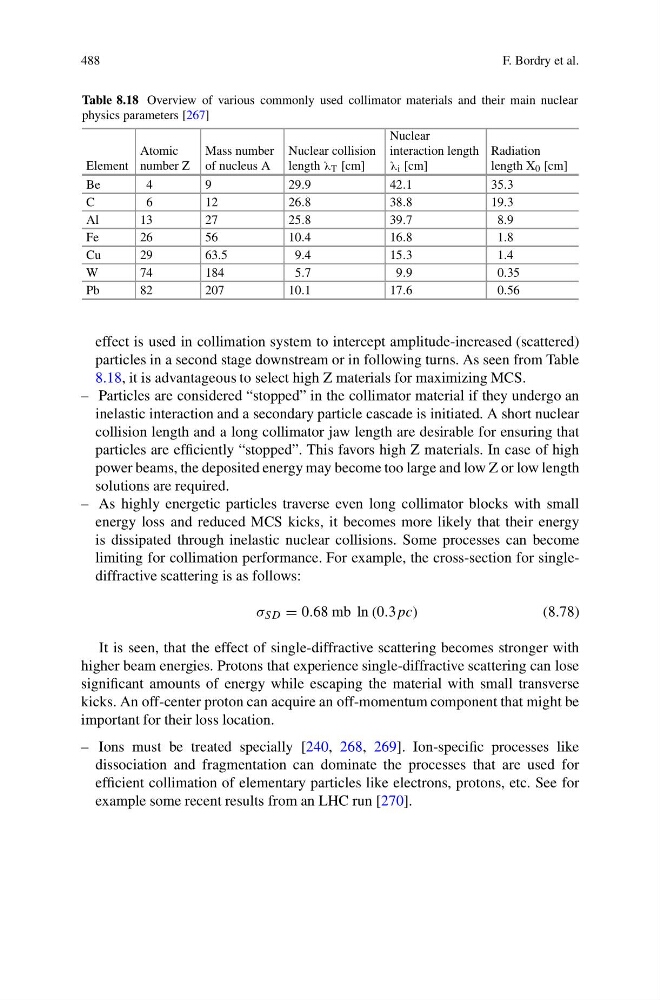
Table 8.18 Overview of various commonly used collimator materials and their main nuclear
physics parameters [267]
Element
Atomic
number Z
Mass number
of nucleus A
Nuclear collision
length λ T [cm]
Nuclear
interaction length
λ i [cm]
Radiation
length X 0 [cm]
Be
4
9
29.9
42.1
35.3
C
6
12
26.8
38.8
19.3
Al
13
27
25.8
39.7
8.9
Fe
26
56
10.4
16.8
1.8
Cu
29
63.5
9.4
15.3
1.4
W
74
184
5.7
9.9
0.35
Pb
82
207
10.1
17.6
0.56
effect is used in collimation system to intercept amplitude-increased (scattered)
particles in a second stage downstream or in following turns. As seen from Table
8.18, it is advantageous to select high Z materials for maximizing MCS.
– Particles are considered “stopped” in the collimator material if they undergo an
inelastic interaction and a secondary particle cascade is initiated. A short nuclear
collision length and a long collimator jaw length are desirable for ensuring that
particles are efficiently “stopped”. This favors high Z materials. In case of high
power beams, the deposited energy may become too large and low Z or low length
solutions are required.
– As highly energetic particles traverse even long collimator blocks with small
energy loss and reduced MCS kicks, it becomes more likely that their energy
is dissipated through inelastic nuclear collisions. Some processes can become
limiting for collimation performance. For example, the cross-section for singlediffractive scattering is as follows:
σ SD = 0.68 mb ln (0.3pc)
(8.78)
It is seen, that the effect of single-diffractive scattering becomes stronger with
higher beam energies. Protons that experience single-diffractive scattering can lose
significant amounts of energy while escaping the material with small transverse
kicks. An off-center proton can acquire an off-momentum component that might be
important for their loss location.
– Ions must be treated specially [240, 268, 269]. Ion-specific processes like
dissociation and fragmentation can dominate the processes that are used for
efficient collimation of elementary particles like electrons, protons, etc. See for
example some recent results from an LHC run [270].
F. Bordry et al.
Table 8.18 Overview of various commonly used collimator materials and their main nuclear
physics parameters [267]
Element
Atomic
number Z
Mass number
of nucleus A
Nuclear collision
length λ T [cm]
Nuclear
interaction length
λ i [cm]
Radiation
length X 0 [cm]
Be
4
9
29.9
42.1
35.3
C
6
12
26.8
38.8
19.3
Al
13
27
25.8
39.7
8.9
Fe
26
56
10.4
16.8
1.8
Cu
29
63.5
9.4
15.3
1.4
W
74
184
5.7
9.9
0.35
Pb
82
207
10.1
17.6
0.56
effect is used in collimation system to intercept amplitude-increased (scattered)
particles in a second stage downstream or in following turns. As seen from Table
8.18, it is advantageous to select high Z materials for maximizing MCS.
– Particles are considered “stopped” in the collimator material if they undergo an
inelastic interaction and a secondary particle cascade is initiated. A short nuclear
collision length and a long collimator jaw length are desirable for ensuring that
particles are efficiently “stopped”. This favors high Z materials. In case of high
power beams, the deposited energy may become too large and low Z or low length
solutions are required.
– As highly energetic particles traverse even long collimator blocks with small
energy loss and reduced MCS kicks, it becomes more likely that their energy
is dissipated through inelastic nuclear collisions. Some processes can become
limiting for collimation performance. For example, the cross-section for singlediffractive scattering is as follows:
σ SD = 0.68 mb ln (0.3pc)
(8.78)
It is seen, that the effect of single-diffractive scattering becomes stronger with
higher beam energies. Protons that experience single-diffractive scattering can lose
significant amounts of energy while escaping the material with small transverse
kicks. An off-center proton can acquire an off-momentum component that might be
important for their loss location.
– Ions must be treated specially [240, 268, 269]. Ion-specific processes like
dissociation and fragmentation can dominate the processes that are used for
efficient collimation of elementary particles like electrons, protons, etc. See for
example some recent results from an LHC run [270].