

8 Accelerator Engineering and Technology: Accelerator Technology
487
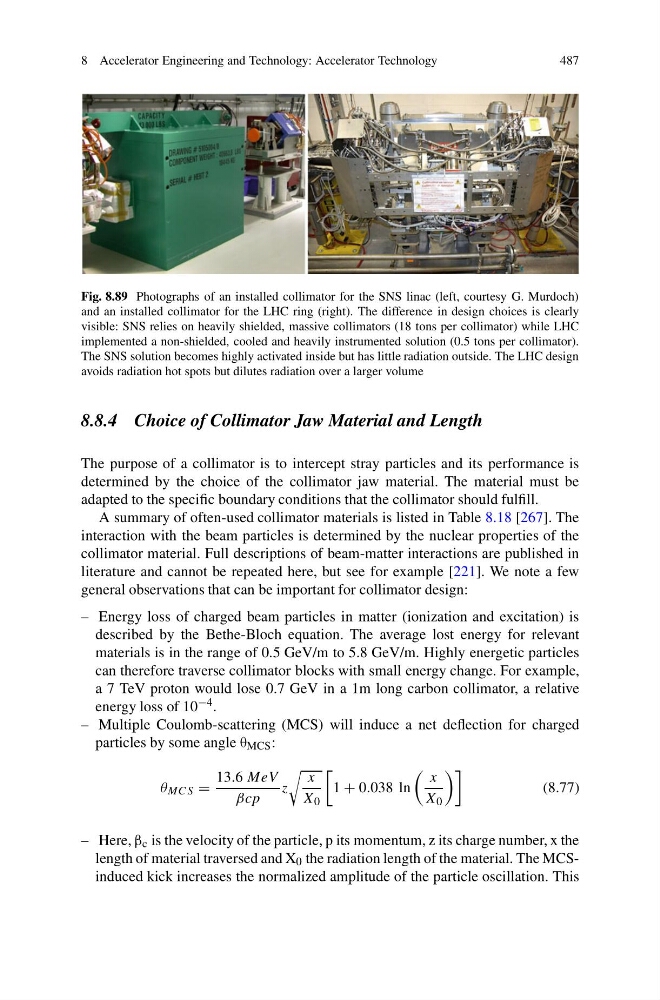
Fig. 8.89 Photographs of an installed collimator for the SNS linac (left, courtesy G. Murdoch)
and an installed collimator for the LHC ring (right). The difference in design choices is clearly
visible: SNS relies on heavily shielded, massive collimators (18 tons per collimator) while LHC
implemented a non-shielded, cooled and heavily instrumented solution (0.5 tons per collimator).
The SNS solution becomes highly activated inside but has little radiation outside. The LHC design
avoids radiation hot spots but dilutes radiation over a larger volume
8.8.4 Choice of Collimator Jaw Material and Length
The purpose of a collimator is to intercept stray particles and its performance is
determined by the choice of the collimator jaw material. The material must be
adapted to the specific boundary conditions that the collimator should fulfill.
A summary of often-used collimator materials is listed in Table 8.18 [267]. The
interaction with the beam particles is determined by the nuclear properties of the
collimator material. Full descriptions of beam-matter interactions are published in
literature and cannot be repeated here, but see for example [221]. We note a few
general observations that can be important for collimator design:
– Energy loss of charged beam particles in matter (ionization and excitation) is
described by the Bethe-Bloch equation. The average lost energy for relevant
materials is in the range of 0.5 GeV/m to 5.8 GeV/m. Highly energetic particles
can therefore traverse collimator blocks with small energy change. For example,
a 7 TeV proton would lose 0.7 GeV in a 1m long carbon collimator, a relative
energy loss of 10 −4 .
– Multiple Coulomb-scattering (MCS) will induce a net deflection for charged
particles by some angle θ MCS :
θ MCS =
13.6 MeV
βcp
z
x
X 0
1 + 0.038 ln
x
X 0
(8.77)
– Here, β c is the velocity of the particle, p its momentum, z its charge number, x the
length of material traversed and X 0 the radiation length of the material. The MCSinduced kick increases the normalized amplitude of the particle oscillation. This
487
Fig. 8.89 Photographs of an installed collimator for the SNS linac (left, courtesy G. Murdoch)
and an installed collimator for the LHC ring (right). The difference in design choices is clearly
visible: SNS relies on heavily shielded, massive collimators (18 tons per collimator) while LHC
implemented a non-shielded, cooled and heavily instrumented solution (0.5 tons per collimator).
The SNS solution becomes highly activated inside but has little radiation outside. The LHC design
avoids radiation hot spots but dilutes radiation over a larger volume
8.8.4 Choice of Collimator Jaw Material and Length
The purpose of a collimator is to intercept stray particles and its performance is
determined by the choice of the collimator jaw material. The material must be
adapted to the specific boundary conditions that the collimator should fulfill.
A summary of often-used collimator materials is listed in Table 8.18 [267]. The
interaction with the beam particles is determined by the nuclear properties of the
collimator material. Full descriptions of beam-matter interactions are published in
literature and cannot be repeated here, but see for example [221]. We note a few
general observations that can be important for collimator design:
– Energy loss of charged beam particles in matter (ionization and excitation) is
described by the Bethe-Bloch equation. The average lost energy for relevant
materials is in the range of 0.5 GeV/m to 5.8 GeV/m. Highly energetic particles
can therefore traverse collimator blocks with small energy change. For example,
a 7 TeV proton would lose 0.7 GeV in a 1m long carbon collimator, a relative
energy loss of 10 −4 .
– Multiple Coulomb-scattering (MCS) will induce a net deflection for charged
particles by some angle θ MCS :
θ MCS =
13.6 MeV
βcp
z
x
X 0
1 + 0.038 ln
x
X 0
(8.77)
– Here, β c is the velocity of the particle, p its momentum, z its charge number, x the
length of material traversed and X 0 the radiation length of the material. The MCSinduced kick increases the normalized amplitude of the particle oscillation. This