

482
F. Bordry et al.
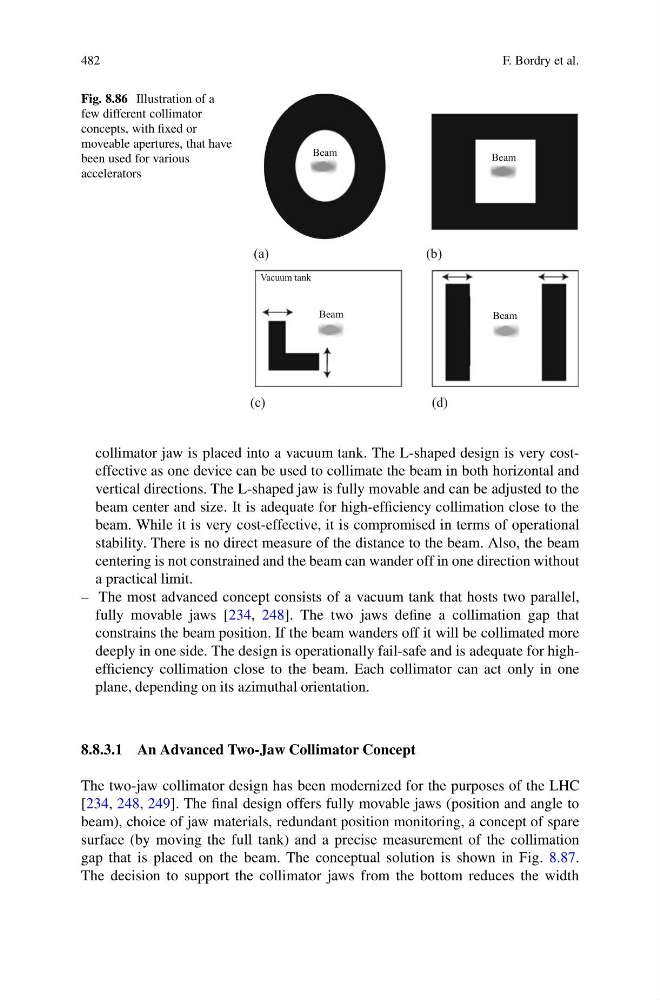
Fig. 8.86 Illustration of a
few different collimator
concepts, with fixed or
moveable apertures, that have
been used for various
accelerators
(a)
(b)
(c)
(d)
Beam
Beam
Beam
Beam
Vacuum tank
collimator jaw is placed into a vacuum tank. The L-shaped design is very costeffective as one device can be used to collimate the beam in both horizontal and
vertical directions. The L-shaped jaw is fully movable and can be adjusted to the
beam center and size. It is adequate for high-efficiency collimation close to the
beam. While it is very cost-effective, it is compromised in terms of operational
stability. There is no direct measure of the distance to the beam. Also, the beam
centering is not constrained and the beam can wander off in one direction without
a practical limit.
– The most advanced concept consists of a vacuum tank that hosts two parallel,
fully movable jaws [234, 248]. The two jaws define a collimation gap that
constrains the beam position. If the beam wanders off it will be collimated more
deeply in one side. The design is operationally fail-safe and is adequate for highefficiency collimation close to the beam. Each collimator can act only in one
plane, depending on its azimuthal orientation.
8.8.3.1 An Advanced Two-Jaw Collimator Concept
The two-jaw collimator design has been modernized for the purposes of the LHC
[234, 248, 249]. The final design offers fully movable jaws (position and angle to
beam), choice of jaw materials, redundant position monitoring, a concept of spare
surface (by moving the full tank) and a precise measurement of the collimation
gap that is placed on the beam. The conceptual solution is shown in Fig. 8.87.
The decision to support the collimator jaws from the bottom reduces the width
F. Bordry et al.
Fig. 8.86 Illustration of a
few different collimator
concepts, with fixed or
moveable apertures, that have
been used for various
accelerators
(a)
(b)
(c)
(d)
Beam
Beam
Beam
Beam
Vacuum tank
collimator jaw is placed into a vacuum tank. The L-shaped design is very costeffective as one device can be used to collimate the beam in both horizontal and
vertical directions. The L-shaped jaw is fully movable and can be adjusted to the
beam center and size. It is adequate for high-efficiency collimation close to the
beam. While it is very cost-effective, it is compromised in terms of operational
stability. There is no direct measure of the distance to the beam. Also, the beam
centering is not constrained and the beam can wander off in one direction without
a practical limit.
– The most advanced concept consists of a vacuum tank that hosts two parallel,
fully movable jaws [234, 248]. The two jaws define a collimation gap that
constrains the beam position. If the beam wanders off it will be collimated more
deeply in one side. The design is operationally fail-safe and is adequate for highefficiency collimation close to the beam. Each collimator can act only in one
plane, depending on its azimuthal orientation.
8.8.3.1 An Advanced Two-Jaw Collimator Concept
The two-jaw collimator design has been modernized for the purposes of the LHC
[234, 248, 249]. The final design offers fully movable jaws (position and angle to
beam), choice of jaw materials, redundant position monitoring, a concept of spare
surface (by moving the full tank) and a precise measurement of the collimation
gap that is placed on the beam. The conceptual solution is shown in Fig. 8.87.
The decision to support the collimator jaws from the bottom reduces the width