

480
F. Bordry et al.
The stored energy densities are compared in Fig. 8.84 for several facilities,
the beam size taken at typical collimator locations. It is noted that this parameter
is directly proportional to relevant performance parameters like luminosity and
therefore is usually maximized.
The stored energy densities range from 10 kJ/mm 2 to 4 GJ/mm 2 for operating
accelerators but exceeds 100 GJ/mm 2 for future studies like the FCC-hh. Damage
limits depend on the type and length of material that is hit by beam. Typical values
for metals are around 50 kJ/mm 2 . Very robust materials like fiber-reinforced carbon
can survive an impacting proton energy density of around 5 MJ/mm 2 for 1 m long
blocks. In many cases, collimators can only survive fractions of the collimated beam
[233, 245]. A full beam impact must be avoided and collimators must be designed
for maximum robustness, non-catastrophic failure in case of beam impact and insitu handling of damaged surfaces.
8.8.2.3 Precision Tolerances
Precision requirements arise from various issues. Collimator settings are given in
normalized distance to the beam center. Movable collimators are often designed to
be placed as close as possible to the beam. Typical desired settings for half gaps are
in the range of 5σ z to 10σ z . As transverse beam sizes at collimators are reduced to
sub-mm (as small as 0.14 mm in the LHC), collimator full gaps can be as small as
1 mm in existing accelerators. Maintaining the correct full gap over long collimators
(e.g. 1 m long parallel jaws) introduces tolerances on jaw flatness, deformation
during power impact, reproducibility, parallelism, angular alignment, etc. that are
all in the order of 50 μm (μrad) or lower [234].
Other requirements arise in the case that several collimators are combined to
form a multi-stage collimation system. The collimators then belong to different
stages (families), where all collimators of a given stage sit at the same setting
(in normalized coordinates). Most notably, in colliders where the performance is
maximized by reducing the transverse spot sizes of colliding beams, limitations
often occur from the aperture of the triplet quadrupole magnets, n triplet , that are
used to squeeze the beams [246, 247]. The system will only work correctly if the
collimators fulfill the hierarchy requirement. For the example illustrated in Fig. 8.85
the following condition would apply:
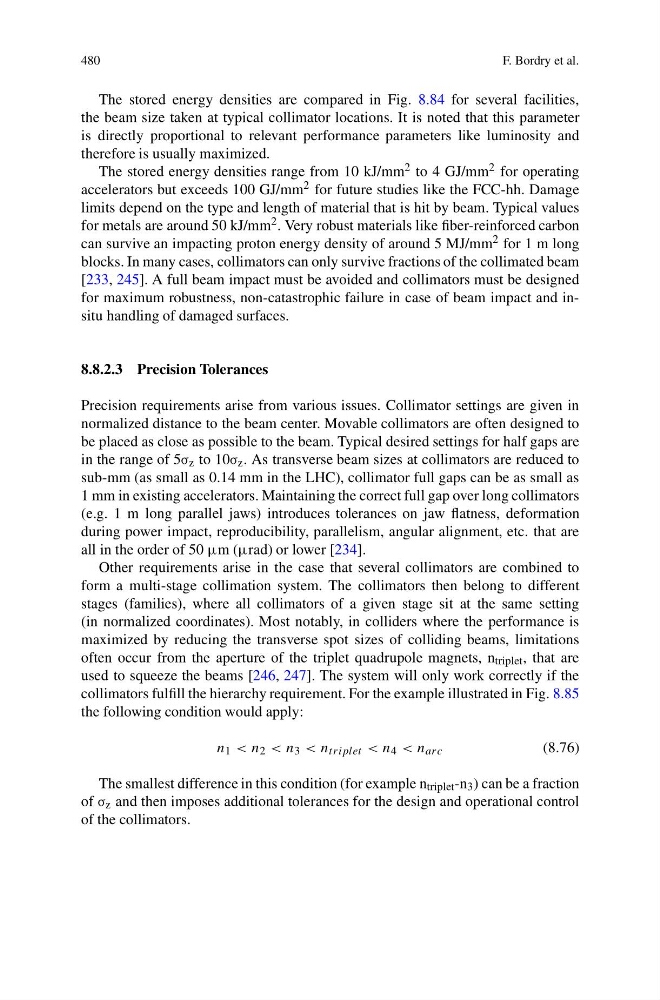
n 1 < n 2 < n 3 < n triplet < n 4 < n arc
(8.76)
The smallest difference in this condition (for example n triplet -n 3 ) can be a fraction
of σ z and then imposes additional tolerances for the design and operational control
of the collimators.
F. Bordry et al.
The stored energy densities are compared in Fig. 8.84 for several facilities,
the beam size taken at typical collimator locations. It is noted that this parameter
is directly proportional to relevant performance parameters like luminosity and
therefore is usually maximized.
The stored energy densities range from 10 kJ/mm 2 to 4 GJ/mm 2 for operating
accelerators but exceeds 100 GJ/mm 2 for future studies like the FCC-hh. Damage
limits depend on the type and length of material that is hit by beam. Typical values
for metals are around 50 kJ/mm 2 . Very robust materials like fiber-reinforced carbon
can survive an impacting proton energy density of around 5 MJ/mm 2 for 1 m long
blocks. In many cases, collimators can only survive fractions of the collimated beam
[233, 245]. A full beam impact must be avoided and collimators must be designed
for maximum robustness, non-catastrophic failure in case of beam impact and insitu handling of damaged surfaces.
8.8.2.3 Precision Tolerances
Precision requirements arise from various issues. Collimator settings are given in
normalized distance to the beam center. Movable collimators are often designed to
be placed as close as possible to the beam. Typical desired settings for half gaps are
in the range of 5σ z to 10σ z . As transverse beam sizes at collimators are reduced to
sub-mm (as small as 0.14 mm in the LHC), collimator full gaps can be as small as
1 mm in existing accelerators. Maintaining the correct full gap over long collimators
(e.g. 1 m long parallel jaws) introduces tolerances on jaw flatness, deformation
during power impact, reproducibility, parallelism, angular alignment, etc. that are
all in the order of 50 μm (μrad) or lower [234].
Other requirements arise in the case that several collimators are combined to
form a multi-stage collimation system. The collimators then belong to different
stages (families), where all collimators of a given stage sit at the same setting
(in normalized coordinates). Most notably, in colliders where the performance is
maximized by reducing the transverse spot sizes of colliding beams, limitations
often occur from the aperture of the triplet quadrupole magnets, n triplet , that are
used to squeeze the beams [246, 247]. The system will only work correctly if the
collimators fulfill the hierarchy requirement. For the example illustrated in Fig. 8.85
the following condition would apply:
n 1 < n 2 < n 3 < n triplet < n 4 < n arc
(8.76)
The smallest difference in this condition (for example n triplet -n 3 ) can be a fraction
of σ z and then imposes additional tolerances for the design and operational control
of the collimators.