

476
F. Bordry et al.
– Collimators are special accelerator devices that place scattering or absorbing
blocks of materials around the beam. They can be fixed or movable with respect
to the beam.
– The collimator jaws are the blocks of material that are placed close to the
beam. The jaw material is characterized by its nuclear properties, its thermal
conductivity, its electrical resistivity, mechanical properties (surface roughness
and flatness) and vacuum properties (residual outgassing rates).
– A collimation system is an ensemble of collimators that is integrated into the
accelerator layout to intercept stray particles and to protect the accelerator.
– The impact parameter b is the typical transverse offset from the edge of a
collimator jaw for particles impacting the collimator. It is measured in m and
can be as small as a few hundred nano-meters for the collimator jaws that are
closest to the beam to intercept primary beam losses.
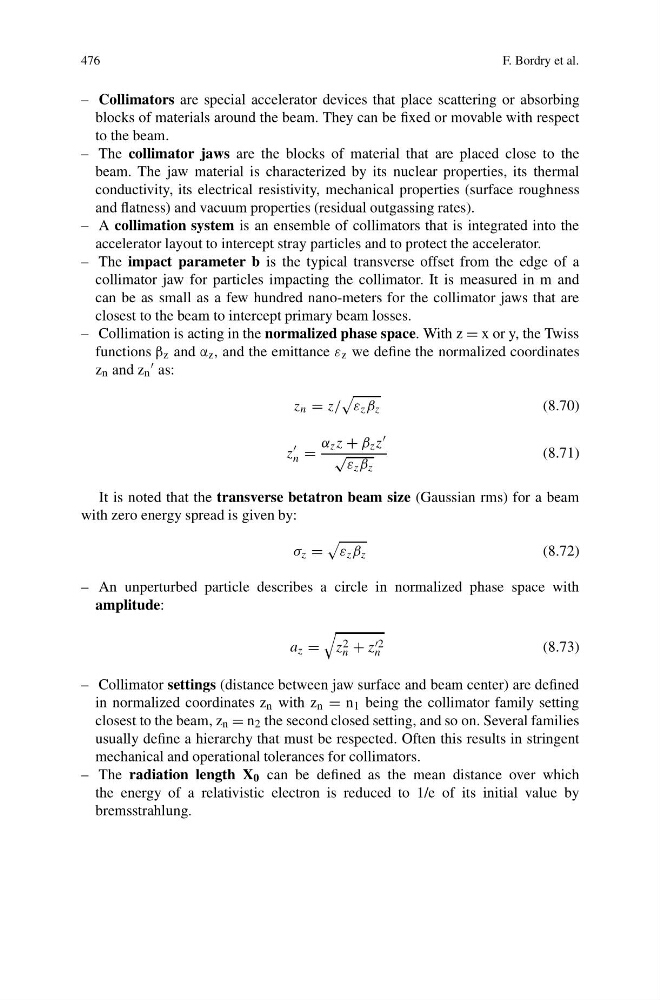
– Collimation is acting in the normalized phase space. With z = x or y, the Twiss
functions β z and α z , and the emittance ε z we define the normalized coordinates
z n and z n
as:
z n = z/
ε z β z
(8.70)
z
n =
α z z + β z z
√
ε z β z
(8.71)
It is noted that the transverse betatron beam size (Gaussian rms) for a beam
with zero energy spread is given by:
σ z =
ε z β z
(8.72)
– An unperturbed particle describes a circle in normalized phase space with
amplitude:
a z =
z 2
n + z
n
(8.73)
– Collimator settings (distance between jaw surface and beam center) are defined
in normalized coordinates z n with z n = n 1 being the collimator family setting
closest to the beam, z n = n 2 the second closed setting, and so on. Several families
usually define a hierarchy that must be respected. Often this results in stringent
mechanical and operational tolerances for collimators.
– The radiation length X 0 can be defined as the mean distance over which
the energy of a relativistic electron is reduced to 1/e of its initial value by
bremsstrahlung.
F. Bordry et al.
– Collimators are special accelerator devices that place scattering or absorbing
blocks of materials around the beam. They can be fixed or movable with respect
to the beam.
– The collimator jaws are the blocks of material that are placed close to the
beam. The jaw material is characterized by its nuclear properties, its thermal
conductivity, its electrical resistivity, mechanical properties (surface roughness
and flatness) and vacuum properties (residual outgassing rates).
– A collimation system is an ensemble of collimators that is integrated into the
accelerator layout to intercept stray particles and to protect the accelerator.
– The impact parameter b is the typical transverse offset from the edge of a
collimator jaw for particles impacting the collimator. It is measured in m and
can be as small as a few hundred nano-meters for the collimator jaws that are
closest to the beam to intercept primary beam losses.
– Collimation is acting in the normalized phase space. With z = x or y, the Twiss
functions β z and α z , and the emittance ε z we define the normalized coordinates
z n and z n
as:
z n = z/
ε z β z
(8.70)
z
n =
α z z + β z z
√
ε z β z
(8.71)
It is noted that the transverse betatron beam size (Gaussian rms) for a beam
with zero energy spread is given by:
σ z =
ε z β z
(8.72)
– An unperturbed particle describes a circle in normalized phase space with
amplitude:
a z =
z 2
n + z
n
(8.73)
– Collimator settings (distance between jaw surface and beam center) are defined
in normalized coordinates z n with z n = n 1 being the collimator family setting
closest to the beam, z n = n 2 the second closed setting, and so on. Several families
usually define a hierarchy that must be respected. Often this results in stringent
mechanical and operational tolerances for collimators.
– The radiation length X 0 can be defined as the mean distance over which
the energy of a relativistic electron is reduced to 1/e of its initial value by
bremsstrahlung.