

8 Accelerator Engineering and Technology: Accelerator Technology
473
Coil
Beam Screen
Coil
Yoke
Yoke
Eddy Current
Septum
Magnetic Screen
Gap
Orbiting
Beam
y
z
x
Return box
I
I
I
I
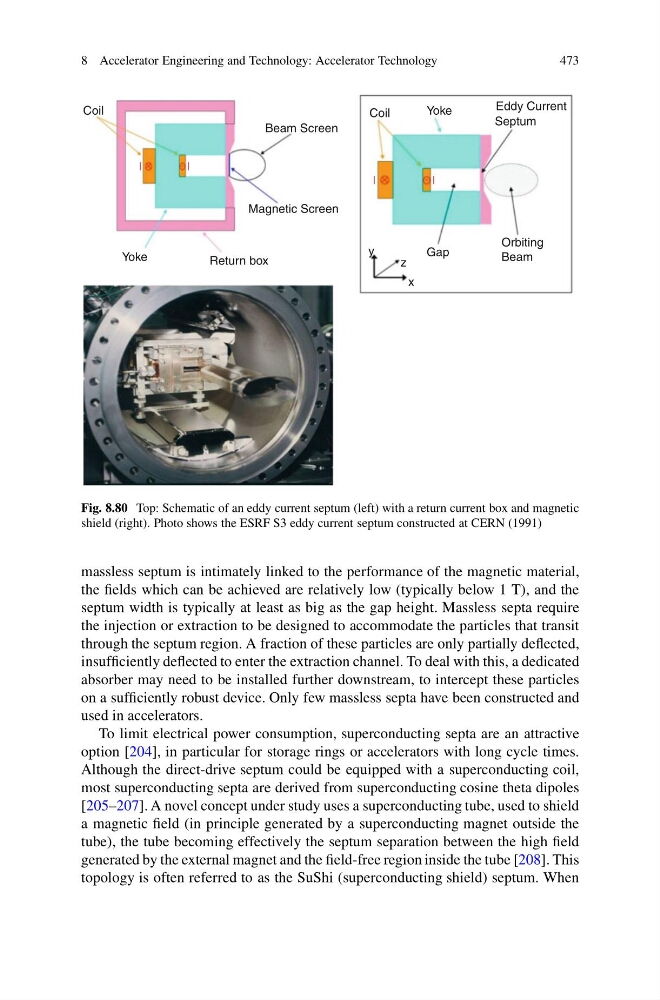
Fig. 8.80 Top: Schematic of an eddy current septum (left) with a return current box and magnetic
shield (right). Photo shows the ESRF S3 eddy current septum constructed at CERN (1991)
massless septum is intimately linked to the performance of the magnetic material,
the fields which can be achieved are relatively low (typically below 1 T), and the
septum width is typically at least as big as the gap height. Massless septa require
the injection or extraction to be designed to accommodate the particles that transit
through the septum region. A fraction of these particles are only partially deflected,
insufficiently deflected to enter the extraction channel. To deal with this, a dedicated
absorber may need to be installed further downstream, to intercept these particles
on a sufficiently robust device. Only few massless septa have been constructed and
used in accelerators.
To limit electrical power consumption, superconducting septa are an attractive
option [204], in particular for storage rings or accelerators with long cycle times.
Although the direct-drive septum could be equipped with a superconducting coil,
most superconducting septa are derived from superconducting cosine theta dipoles
[205–207]. A novel concept under study uses a superconducting tube, used to shield
a magnetic field (in principle generated by a superconducting magnet outside the
tube), the tube becoming effectively the septum separation between the high field
generated by the external magnet and the field-free region inside the tube [208]. This
topology is often referred to as the SuShi (superconducting shield) septum. When
473
Coil
Beam Screen
Coil
Yoke
Yoke
Eddy Current
Septum
Magnetic Screen
Gap
Orbiting
Beam
y
z
x
Return box
I
I
I
I
Fig. 8.80 Top: Schematic of an eddy current septum (left) with a return current box and magnetic
shield (right). Photo shows the ESRF S3 eddy current septum constructed at CERN (1991)
massless septum is intimately linked to the performance of the magnetic material,
the fields which can be achieved are relatively low (typically below 1 T), and the
septum width is typically at least as big as the gap height. Massless septa require
the injection or extraction to be designed to accommodate the particles that transit
through the septum region. A fraction of these particles are only partially deflected,
insufficiently deflected to enter the extraction channel. To deal with this, a dedicated
absorber may need to be installed further downstream, to intercept these particles
on a sufficiently robust device. Only few massless septa have been constructed and
used in accelerators.
To limit electrical power consumption, superconducting septa are an attractive
option [204], in particular for storage rings or accelerators with long cycle times.
Although the direct-drive septum could be equipped with a superconducting coil,
most superconducting septa are derived from superconducting cosine theta dipoles
[205–207]. A novel concept under study uses a superconducting tube, used to shield
a magnetic field (in principle generated by a superconducting magnet outside the
tube), the tube becoming effectively the septum separation between the high field
generated by the external magnet and the field-free region inside the tube [208]. This
topology is often referred to as the SuShi (superconducting shield) septum. When