

8 Accelerator Engineering and Technology: Accelerator Technology
469
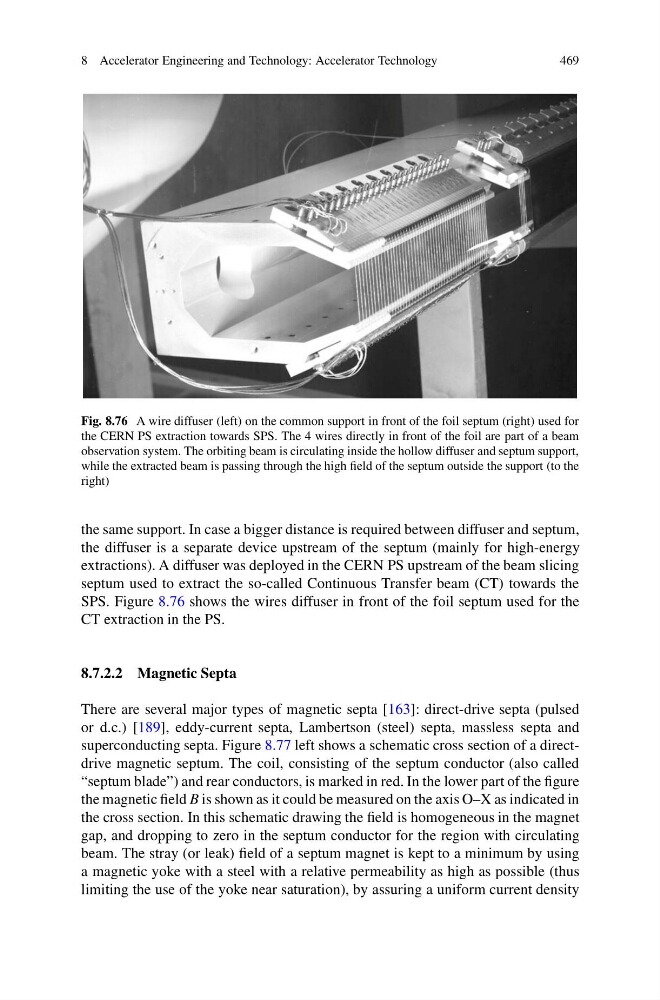
Fig. 8.76 A wire diffuser (left) on the common support in front of the foil septum (right) used for
the CERN PS extraction towards SPS. The 4 wires directly in front of the foil are part of a beam
observation system. The orbiting beam is circulating inside the hollow diffuser and septum support,
while the extracted beam is passing through the high field of the septum outside the support (to the
right)
the same support. In case a bigger distance is required between diffuser and septum,
the diffuser is a separate device upstream of the septum (mainly for high-energy
extractions). A diffuser was deployed in the CERN PS upstream of the beam slicing
septum used to extract the so-called Continuous Transfer beam (CT) towards the
SPS. Figure 8.76 shows the wires diffuser in front of the foil septum used for the
CT extraction in the PS.
8.7.2.2 Magnetic Septa
There are several major types of magnetic septa [163]: direct-drive septa (pulsed
or d.c.) [189], eddy-current septa, Lambertson (steel) septa, massless septa and
superconducting septa. Figure 8.77 left shows a schematic cross section of a directdrive magnetic septum. The coil, consisting of the septum conductor (also called
“septum blade”) and rear conductors, is marked in red. In the lower part of the figure
the magnetic field B is shown as it could be measured on the axis O–X as indicated in
the cross section. In this schematic drawing the field is homogeneous in the magnet
gap, and dropping to zero in the septum conductor for the region with circulating
beam. The stray (or leak) field of a septum magnet is kept to a minimum by using
a magnetic yoke with a steel with a relative permeability as high as possible (thus
limiting the use of the yoke near saturation), by assuring a uniform current density
469
Fig. 8.76 A wire diffuser (left) on the common support in front of the foil septum (right) used for
the CERN PS extraction towards SPS. The 4 wires directly in front of the foil are part of a beam
observation system. The orbiting beam is circulating inside the hollow diffuser and septum support,
while the extracted beam is passing through the high field of the septum outside the support (to the
right)
the same support. In case a bigger distance is required between diffuser and septum,
the diffuser is a separate device upstream of the septum (mainly for high-energy
extractions). A diffuser was deployed in the CERN PS upstream of the beam slicing
septum used to extract the so-called Continuous Transfer beam (CT) towards the
SPS. Figure 8.76 shows the wires diffuser in front of the foil septum used for the
CT extraction in the PS.
8.7.2.2 Magnetic Septa
There are several major types of magnetic septa [163]: direct-drive septa (pulsed
or d.c.) [189], eddy-current septa, Lambertson (steel) septa, massless septa and
superconducting septa. Figure 8.77 left shows a schematic cross section of a directdrive magnetic septum. The coil, consisting of the septum conductor (also called
“septum blade”) and rear conductors, is marked in red. In the lower part of the figure
the magnetic field B is shown as it could be measured on the axis O–X as indicated in
the cross section. In this schematic drawing the field is homogeneous in the magnet
gap, and dropping to zero in the septum conductor for the region with circulating
beam. The stray (or leak) field of a septum magnet is kept to a minimum by using
a magnetic yoke with a steel with a relative permeability as high as possible (thus
limiting the use of the yoke near saturation), by assuring a uniform current density