

466
F. Bordry et al.
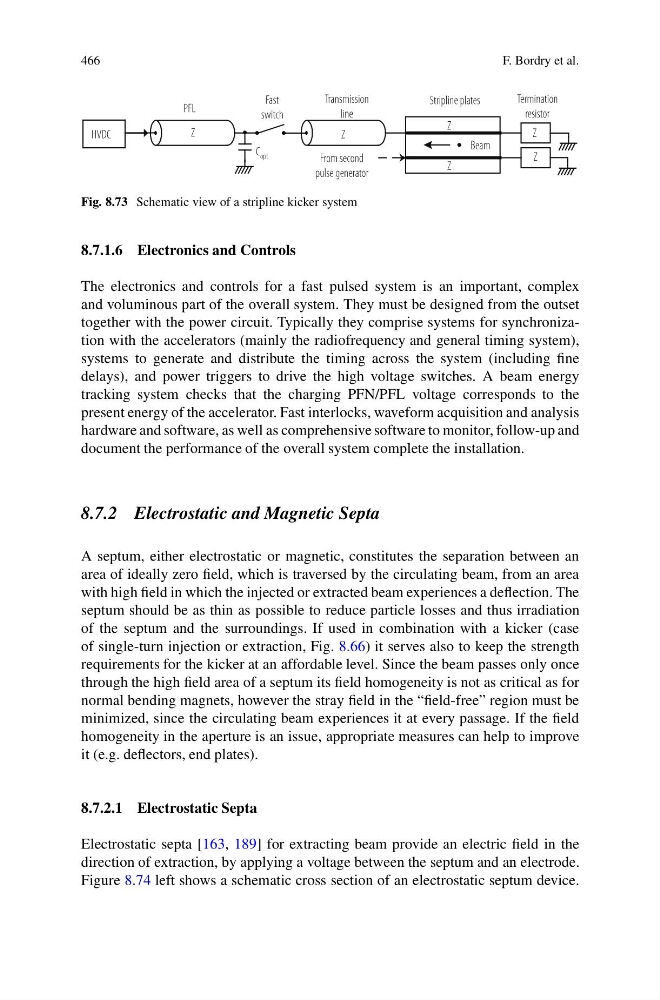
Fig. 8.73 Schematic view of a stripline kicker system
8.7.1.6 Electronics and Controls
The electronics and controls for a fast pulsed system is an important, complex
and voluminous part of the overall system. They must be designed from the outset
together with the power circuit. Typically they comprise systems for synchronization with the accelerators (mainly the radiofrequency and general timing system),
systems to generate and distribute the timing across the system (including fine
delays), and power triggers to drive the high voltage switches. A beam energy
tracking system checks that the charging PFN/PFL voltage corresponds to the
present energy of the accelerator. Fast interlocks, waveform acquisition and analysis
hardware and software, as well as comprehensive software to monitor, follow-up and
document the performance of the overall system complete the installation.
8.7.2 Electrostatic and Magnetic Septa
A septum, either electrostatic or magnetic, constitutes the separation between an
area of ideally zero field, which is traversed by the circulating beam, from an area
with high field in which the injected or extracted beam experiences a deflection. The
septum should be as thin as possible to reduce particle losses and thus irradiation
of the septum and the surroundings. If used in combination with a kicker (case
of single-turn injection or extraction, Fig. 8.66) it serves also to keep the strength
requirements for the kicker at an affordable level. Since the beam passes only once
through the high field area of a septum its field homogeneity is not as critical as for
normal bending magnets, however the stray field in the “field-free” region must be
minimized, since the circulating beam experiences it at every passage. If the field
homogeneity in the aperture is an issue, appropriate measures can help to improve
it (e.g. deflectors, end plates).
8.7.2.1 Electrostatic Septa
Electrostatic septa [163, 189] for extracting beam provide an electric field in the
direction of extraction, by applying a voltage between the septum and an electrode.
Figure 8.74 left shows a schematic cross section of an electrostatic septum device.
F. Bordry et al.
Fig. 8.73 Schematic view of a stripline kicker system
8.7.1.6 Electronics and Controls
The electronics and controls for a fast pulsed system is an important, complex
and voluminous part of the overall system. They must be designed from the outset
together with the power circuit. Typically they comprise systems for synchronization with the accelerators (mainly the radiofrequency and general timing system),
systems to generate and distribute the timing across the system (including fine
delays), and power triggers to drive the high voltage switches. A beam energy
tracking system checks that the charging PFN/PFL voltage corresponds to the
present energy of the accelerator. Fast interlocks, waveform acquisition and analysis
hardware and software, as well as comprehensive software to monitor, follow-up and
document the performance of the overall system complete the installation.
8.7.2 Electrostatic and Magnetic Septa
A septum, either electrostatic or magnetic, constitutes the separation between an
area of ideally zero field, which is traversed by the circulating beam, from an area
with high field in which the injected or extracted beam experiences a deflection. The
septum should be as thin as possible to reduce particle losses and thus irradiation
of the septum and the surroundings. If used in combination with a kicker (case
of single-turn injection or extraction, Fig. 8.66) it serves also to keep the strength
requirements for the kicker at an affordable level. Since the beam passes only once
through the high field area of a septum its field homogeneity is not as critical as for
normal bending magnets, however the stray field in the “field-free” region must be
minimized, since the circulating beam experiences it at every passage. If the field
homogeneity in the aperture is an issue, appropriate measures can help to improve
it (e.g. deflectors, end plates).
8.7.2.1 Electrostatic Septa
Electrostatic septa [163, 189] for extracting beam provide an electric field in the
direction of extraction, by applying a voltage between the septum and an electrode.
Figure 8.74 left shows a schematic cross section of an electrostatic septum device.