

8 Accelerator Engineering and Technology: Accelerator Technology
461
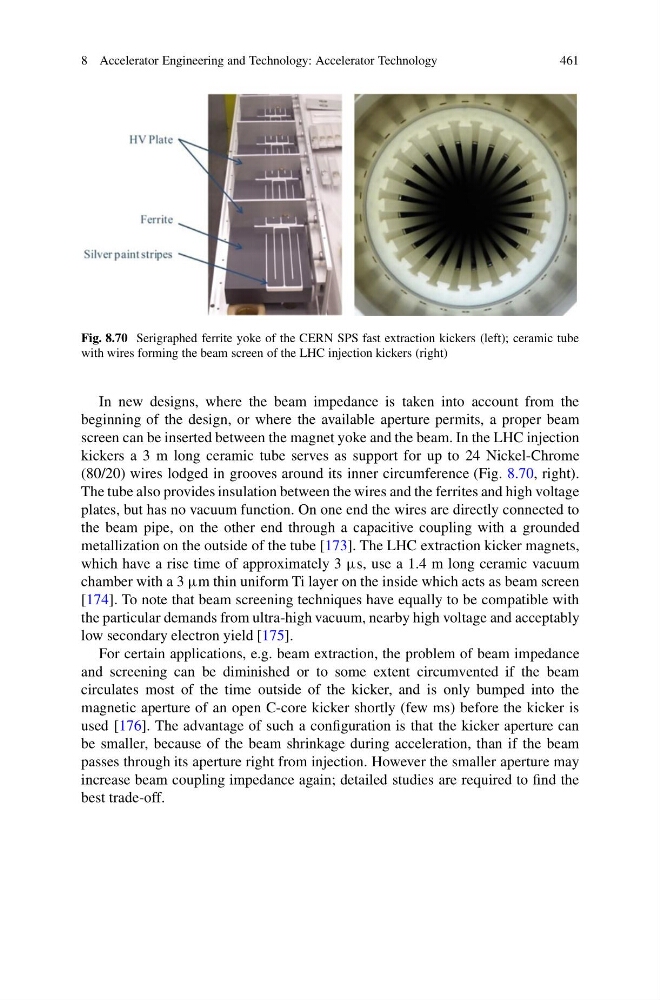
Fig. 8.70 Serigraphed ferrite yoke of the CERN SPS fast extraction kickers (left); ceramic tube
with wires forming the beam screen of the LHC injection kickers (right)
In new designs, where the beam impedance is taken into account from the
beginning of the design, or where the available aperture permits, a proper beam
screen can be inserted between the magnet yoke and the beam. In the LHC injection
kickers a 3 m long ceramic tube serves as support for up to 24 Nickel-Chrome
(80/20) wires lodged in grooves around its inner circumference (Fig. 8.70, right).
The tube also provides insulation between the wires and the ferrites and high voltage
plates, but has no vacuum function. On one end the wires are directly connected to
the beam pipe, on the other end through a capacitive coupling with a grounded
metallization on the outside of the tube [173]. The LHC extraction kicker magnets,
which have a rise time of approximately 3 μs, use a 1.4 m long ceramic vacuum
chamber with a 3 μm thin uniform Ti layer on the inside which acts as beam screen
[174]. To note that beam screening techniques have equally to be compatible with
the particular demands from ultra-high vacuum, nearby high voltage and acceptably
low secondary electron yield [175].
For certain applications, e.g. beam extraction, the problem of beam impedance
and screening can be diminished or to some extent circumvented if the beam
circulates most of the time outside of the kicker, and is only bumped into the
magnetic aperture of an open C-core kicker shortly (few ms) before the kicker is
used [176]. The advantage of such a configuration is that the kicker aperture can
be smaller, because of the beam shrinkage during acceleration, than if the beam
passes through its aperture right from injection. However the smaller aperture may
increase beam coupling impedance again; detailed studies are required to find the
best trade-off.
461
Fig. 8.70 Serigraphed ferrite yoke of the CERN SPS fast extraction kickers (left); ceramic tube
with wires forming the beam screen of the LHC injection kickers (right)
In new designs, where the beam impedance is taken into account from the
beginning of the design, or where the available aperture permits, a proper beam
screen can be inserted between the magnet yoke and the beam. In the LHC injection
kickers a 3 m long ceramic tube serves as support for up to 24 Nickel-Chrome
(80/20) wires lodged in grooves around its inner circumference (Fig. 8.70, right).
The tube also provides insulation between the wires and the ferrites and high voltage
plates, but has no vacuum function. On one end the wires are directly connected to
the beam pipe, on the other end through a capacitive coupling with a grounded
metallization on the outside of the tube [173]. The LHC extraction kicker magnets,
which have a rise time of approximately 3 μs, use a 1.4 m long ceramic vacuum
chamber with a 3 μm thin uniform Ti layer on the inside which acts as beam screen
[174]. To note that beam screening techniques have equally to be compatible with
the particular demands from ultra-high vacuum, nearby high voltage and acceptably
low secondary electron yield [175].
For certain applications, e.g. beam extraction, the problem of beam impedance
and screening can be diminished or to some extent circumvented if the beam
circulates most of the time outside of the kicker, and is only bumped into the
magnetic aperture of an open C-core kicker shortly (few ms) before the kicker is
used [176]. The advantage of such a configuration is that the kicker aperture can
be smaller, because of the beam shrinkage during acceleration, than if the beam
passes through its aperture right from injection. However the smaller aperture may
increase beam coupling impedance again; detailed studies are required to find the
best trade-off.