

8 Accelerator Engineering and Technology: Accelerator Technology
459
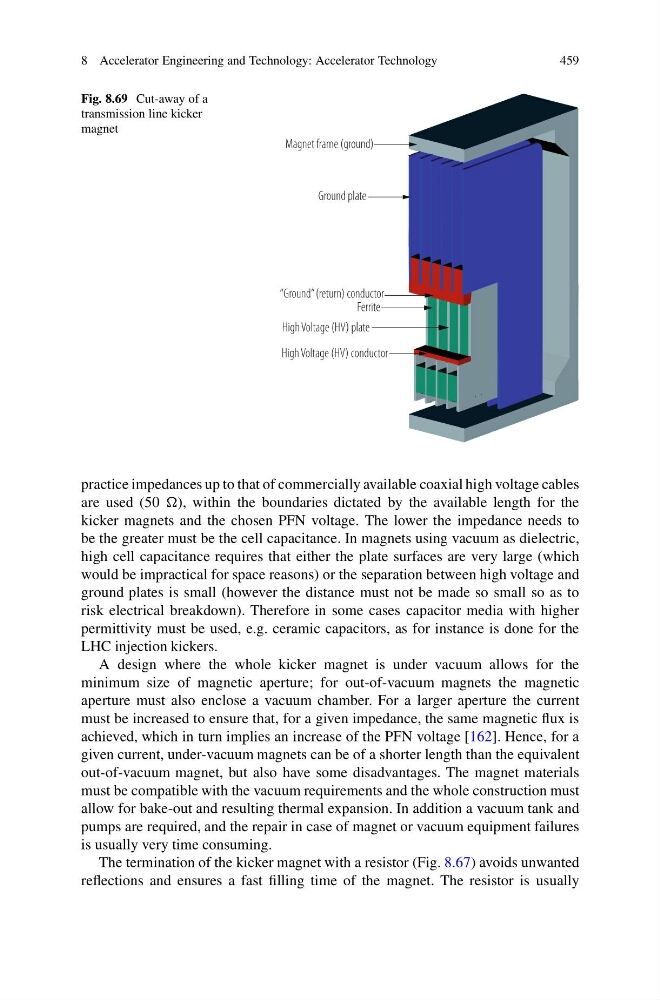
Fig. 8.69 Cut-away of a
transmission line kicker
magnet
practice impedances up to that of commercially available coaxial high voltage cables
are used (50 ), within the boundaries dictated by the available length for the
kicker magnets and the chosen PFN voltage. The lower the impedance needs to
be the greater must be the cell capacitance. In magnets using vacuum as dielectric,
high cell capacitance requires that either the plate surfaces are very large (which
would be impractical for space reasons) or the separation between high voltage and
ground plates is small (however the distance must not be made so small so as to
risk electrical breakdown). Therefore in some cases capacitor media with higher
permittivity must be used, e.g. ceramic capacitors, as for instance is done for the
LHC injection kickers.
A design where the whole kicker magnet is under vacuum allows for the
minimum size of magnetic aperture; for out-of-vacuum magnets the magnetic
aperture must also enclose a vacuum chamber. For a larger aperture the current
must be increased to ensure that, for a given impedance, the same magnetic flux is
achieved, which in turn implies an increase of the PFN voltage [162]. Hence, for a
given current, under-vacuum magnets can be of a shorter length than the equivalent
out-of-vacuum magnet, but also have some disadvantages. The magnet materials
must be compatible with the vacuum requirements and the whole construction must
allow for bake-out and resulting thermal expansion. In addition a vacuum tank and
pumps are required, and the repair in case of magnet or vacuum equipment failures
is usually very time consuming.
The termination of the kicker magnet with a resistor (Fig. 8.67) avoids unwanted
reflections and ensures a fast filling time of the magnet. The resistor is usually
459
Fig. 8.69 Cut-away of a
transmission line kicker
magnet
practice impedances up to that of commercially available coaxial high voltage cables
are used (50 ), within the boundaries dictated by the available length for the
kicker magnets and the chosen PFN voltage. The lower the impedance needs to
be the greater must be the cell capacitance. In magnets using vacuum as dielectric,
high cell capacitance requires that either the plate surfaces are very large (which
would be impractical for space reasons) or the separation between high voltage and
ground plates is small (however the distance must not be made so small so as to
risk electrical breakdown). Therefore in some cases capacitor media with higher
permittivity must be used, e.g. ceramic capacitors, as for instance is done for the
LHC injection kickers.
A design where the whole kicker magnet is under vacuum allows for the
minimum size of magnetic aperture; for out-of-vacuum magnets the magnetic
aperture must also enclose a vacuum chamber. For a larger aperture the current
must be increased to ensure that, for a given impedance, the same magnetic flux is
achieved, which in turn implies an increase of the PFN voltage [162]. Hence, for a
given current, under-vacuum magnets can be of a shorter length than the equivalent
out-of-vacuum magnet, but also have some disadvantages. The magnet materials
must be compatible with the vacuum requirements and the whole construction must
allow for bake-out and resulting thermal expansion. In addition a vacuum tank and
pumps are required, and the repair in case of magnet or vacuum equipment failures
is usually very time consuming.
The termination of the kicker magnet with a resistor (Fig. 8.67) avoids unwanted
reflections and ensures a fast filling time of the magnet. The resistor is usually