

454
F. Bordry et al.
8.6.6.3 Radio-Frequency and Electro-optic Sampling Techniques
These techniques rely on encoding the longitudinal bunch length information
into spatial or optical information. Radio-frequency manipulation makes use of a
transverse RF deflecting cavity [158] to kick the head of the bunch in one direction
and the tail of the bunch in the opposite direction. By measuring the transverse beam
size downstream, it is then possible to reconstruct the longitudinal bunch profile.
This technique is the standard method for measurement of femtosecond bunches,
with the drawbacks being its destructive nature and cost.
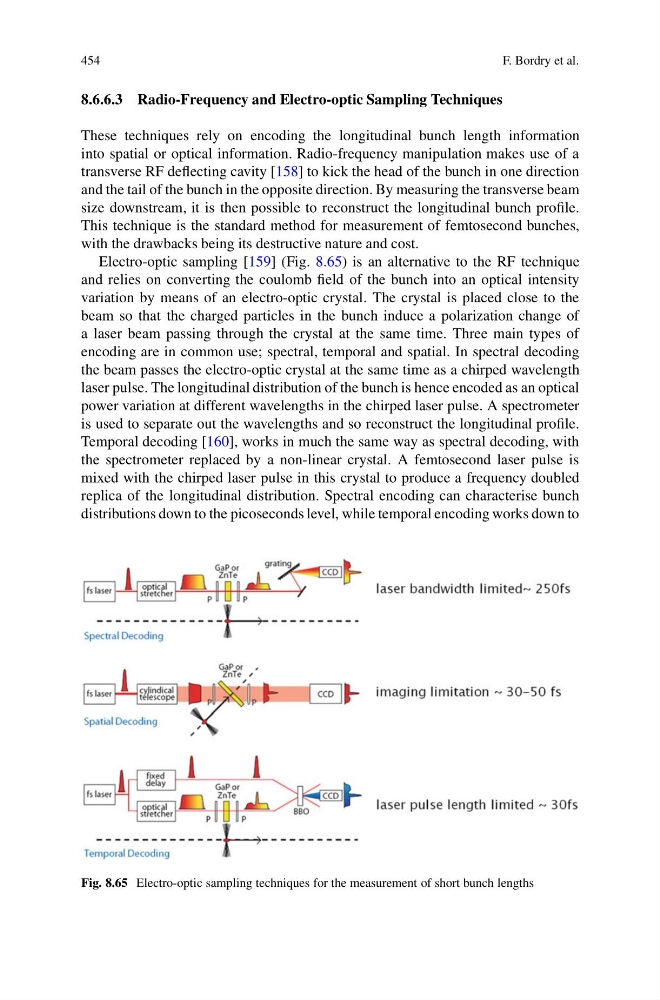
Electro-optic sampling [159] (Fig. 8.65) is an alternative to the RF technique
and relies on converting the coulomb field of the bunch into an optical intensity
variation by means of an electro-optic crystal. The crystal is placed close to the
beam so that the charged particles in the bunch induce a polarization change of
a laser beam passing through the crystal at the same time. Three main types of
encoding are in common use; spectral, temporal and spatial. In spectral decoding
the beam passes the electro-optic crystal at the same time as a chirped wavelength
laser pulse. The longitudinal distribution of the bunch is hence encoded as an optical
power variation at different wavelengths in the chirped laser pulse. A spectrometer
is used to separate out the wavelengths and so reconstruct the longitudinal profile.
Temporal decoding [160], works in much the same way as spectral decoding, with
the spectrometer replaced by a non-linear crystal. A femtosecond laser pulse is
mixed with the chirped laser pulse in this crystal to produce a frequency doubled
replica of the longitudinal distribution. Spectral encoding can characterise bunch
distributions down to the picoseconds level, while temporal encoding works down to
Fig. 8.65 Electro-optic sampling techniques for the measurement of short bunch lengths
F. Bordry et al.
8.6.6.3 Radio-Frequency and Electro-optic Sampling Techniques
These techniques rely on encoding the longitudinal bunch length information
into spatial or optical information. Radio-frequency manipulation makes use of a
transverse RF deflecting cavity [158] to kick the head of the bunch in one direction
and the tail of the bunch in the opposite direction. By measuring the transverse beam
size downstream, it is then possible to reconstruct the longitudinal bunch profile.
This technique is the standard method for measurement of femtosecond bunches,
with the drawbacks being its destructive nature and cost.
Electro-optic sampling [159] (Fig. 8.65) is an alternative to the RF technique
and relies on converting the coulomb field of the bunch into an optical intensity
variation by means of an electro-optic crystal. The crystal is placed close to the
beam so that the charged particles in the bunch induce a polarization change of
a laser beam passing through the crystal at the same time. Three main types of
encoding are in common use; spectral, temporal and spatial. In spectral decoding
the beam passes the electro-optic crystal at the same time as a chirped wavelength
laser pulse. The longitudinal distribution of the bunch is hence encoded as an optical
power variation at different wavelengths in the chirped laser pulse. A spectrometer
is used to separate out the wavelengths and so reconstruct the longitudinal profile.
Temporal decoding [160], works in much the same way as spectral decoding, with
the spectrometer replaced by a non-linear crystal. A femtosecond laser pulse is
mixed with the chirped laser pulse in this crystal to produce a frequency doubled
replica of the longitudinal distribution. Spectral encoding can characterise bunch
distributions down to the picoseconds level, while temporal encoding works down to
Fig. 8.65 Electro-optic sampling techniques for the measurement of short bunch lengths