

8 Accelerator Engineering and Technology: Accelerator Technology
453
8.6.6 Short Bunch Length Diagnostics
Recent developments for Free Electron Laser (FEL) accelerators and studies for
linear colliders in the TeV range are driving the typical bunch length of accelerated
lepton beams down to the 10–100 femtosecond level. To measure the longitudinal
behaviour of such beams is not trivial and a lot research has been carried out over the
last decade to develop instruments that allow their characterisation. They broadly
fall into three categories: direct beam observation; coherent radiation techniques;
radio-frequency and electro-optic sampling techniques.
8.6.6.1 Direct Beam Observation
Direct Beam Observation, as its name suggests, relies on the direct measurement
of longitudinal beam structure by means of fast detectors. Wall Current Monitors
followed by fast sampling oscilloscopes are able to probe time structures down to
well below the nanosecond, while streak cameras can reach some 200 femtoseconds
[156]. The latter relies on analysing an optical replica of the longitudinal bunch
distribution obtained by means of synchrotron, transition, diffraction or Cherenkov
radiation.
8.6.6.2 Coherent Radiation
For wavelengths shorter than the bunch length, the particles within the bunch
radiate incoherently, with the power emitted proportional to the number of particles.
However, for wavelengths equal to or longer than the bunch length, the particles
emit radiation in a coherent way with the emitted power dependent on the bunch
length and scaling as the square of the number of particles.
incoherent term
⇓
S (ω) = S p (ω) [N + N (N − 1) F (ω)] ,
coherent term
⇓
F (ω) =
∞
−∞
ρ(s)e
−i
ω
c s ds
2
(8.69)
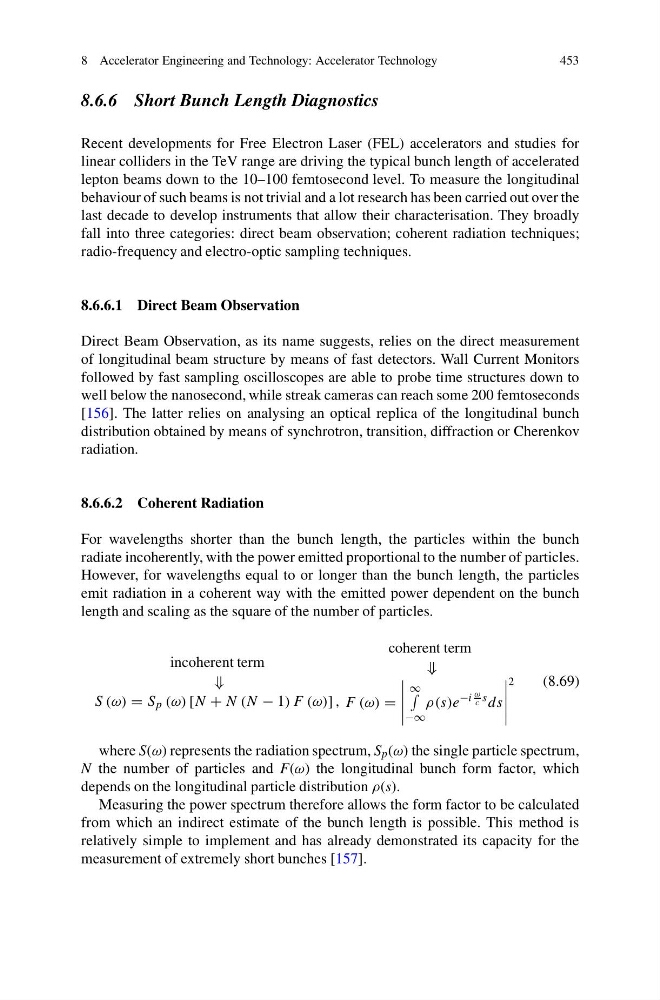
where S(ω) represents the radiation spectrum, S p (ω) the single particle spectrum,
N the number of particles and F(ω) the longitudinal bunch form factor, which
depends on the longitudinal particle distribution ρ(s).
Measuring the power spectrum therefore allows the form factor to be calculated
from which an indirect estimate of the bunch length is possible. This method is
relatively simple to implement and has already demonstrated its capacity for the
measurement of extremely short bunches [157].
453
8.6.6 Short Bunch Length Diagnostics
Recent developments for Free Electron Laser (FEL) accelerators and studies for
linear colliders in the TeV range are driving the typical bunch length of accelerated
lepton beams down to the 10–100 femtosecond level. To measure the longitudinal
behaviour of such beams is not trivial and a lot research has been carried out over the
last decade to develop instruments that allow their characterisation. They broadly
fall into three categories: direct beam observation; coherent radiation techniques;
radio-frequency and electro-optic sampling techniques.
8.6.6.1 Direct Beam Observation
Direct Beam Observation, as its name suggests, relies on the direct measurement
of longitudinal beam structure by means of fast detectors. Wall Current Monitors
followed by fast sampling oscilloscopes are able to probe time structures down to
well below the nanosecond, while streak cameras can reach some 200 femtoseconds
[156]. The latter relies on analysing an optical replica of the longitudinal bunch
distribution obtained by means of synchrotron, transition, diffraction or Cherenkov
radiation.
8.6.6.2 Coherent Radiation
For wavelengths shorter than the bunch length, the particles within the bunch
radiate incoherently, with the power emitted proportional to the number of particles.
However, for wavelengths equal to or longer than the bunch length, the particles
emit radiation in a coherent way with the emitted power dependent on the bunch
length and scaling as the square of the number of particles.
incoherent term
⇓
S (ω) = S p (ω) [N + N (N − 1) F (ω)] ,
coherent term
⇓
F (ω) =
∞
−∞
ρ(s)e
−i
ω
c s ds
2
(8.69)
where S(ω) represents the radiation spectrum, S p (ω) the single particle spectrum,
N the number of particles and F(ω) the longitudinal bunch form factor, which
depends on the longitudinal particle distribution ρ(s).
Measuring the power spectrum therefore allows the form factor to be calculated
from which an indirect estimate of the bunch length is possible. This method is
relatively simple to implement and has already demonstrated its capacity for the
measurement of extremely short bunches [157].