

8 Accelerator Engineering and Technology: Accelerator Technology
423
temperature is avoided others are the cryogenic implications and magneto-resistance
of the beam-pipe materials.
8.5.2.2 Gas Laws and Gas Densities
The vacuum system of an accelerator will behave as the gas it contains. The major
Laws of interest to predict the behaviour of gasses are Boyle’s Law, Charles’s Law,
Gay-Lussac Law and the General Gas Law which resulted from the combination of
Boyle’s and Charles’ Laws.
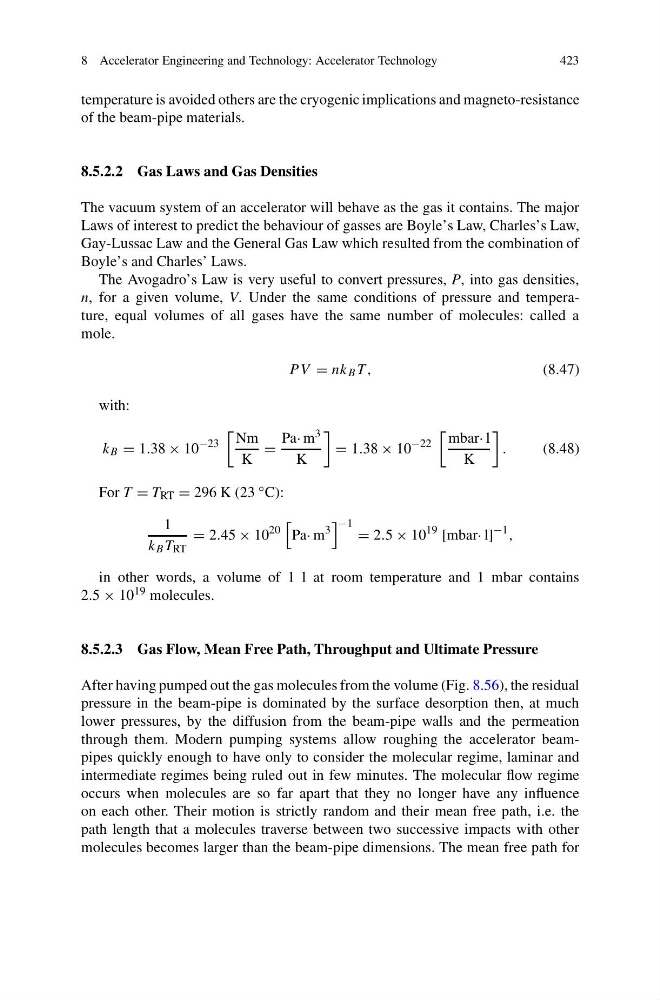
The Avogadro’s Law is very useful to convert pressures, P, into gas densities,
n, for a given volume, V. Under the same conditions of pressure and temperature, equal volumes of all gases have the same number of molecules: called a
mole.
P V = nk B T ,
(8.47)
with:
k B = 1.38 × 10
−23
Nm
K
=
Pa· m 3
K
= 1.38 × 10
−22
mbar· l
K
.
(8.48)
For T = T RT = 296 K (23 ◦ C):
1
k B T RT
= 2.45 × 10
20
Pa· m
3
−1 = 2.5 × 10
19 [mbar· l]
−1 ,
in other words, a volume of 1 l at room temperature and 1 mbar contains
2.5 × 10 19 molecules.
8.5.2.3 Gas Flow, Mean Free Path, Throughput and Ultimate Pressure
After having pumped out the gas molecules from the volume (Fig. 8.56), the residual
pressure in the beam-pipe is dominated by the surface desorption then, at much
lower pressures, by the diffusion from the beam-pipe walls and the permeation
through them. Modern pumping systems allow roughing the accelerator beampipes quickly enough to have only to consider the molecular regime, laminar and
intermediate regimes being ruled out in few minutes. The molecular flow regime
occurs when molecules are so far apart that they no longer have any influence
on each other. Their motion is strictly random and their mean free path, i.e. the
path length that a molecules traverse between two successive impacts with other
molecules becomes larger than the beam-pipe dimensions. The mean free path for
423
temperature is avoided others are the cryogenic implications and magneto-resistance
of the beam-pipe materials.
8.5.2.2 Gas Laws and Gas Densities
The vacuum system of an accelerator will behave as the gas it contains. The major
Laws of interest to predict the behaviour of gasses are Boyle’s Law, Charles’s Law,
Gay-Lussac Law and the General Gas Law which resulted from the combination of
Boyle’s and Charles’ Laws.
The Avogadro’s Law is very useful to convert pressures, P, into gas densities,
n, for a given volume, V. Under the same conditions of pressure and temperature, equal volumes of all gases have the same number of molecules: called a
mole.
P V = nk B T ,
(8.47)
with:
k B = 1.38 × 10
−23
Nm
K
=
Pa· m 3
K
= 1.38 × 10
−22
mbar· l
K
.
(8.48)
For T = T RT = 296 K (23 ◦ C):
1
k B T RT
= 2.45 × 10
20
Pa· m
3
−1 = 2.5 × 10
19 [mbar· l]
−1 ,
in other words, a volume of 1 l at room temperature and 1 mbar contains
2.5 × 10 19 molecules.
8.5.2.3 Gas Flow, Mean Free Path, Throughput and Ultimate Pressure
After having pumped out the gas molecules from the volume (Fig. 8.56), the residual
pressure in the beam-pipe is dominated by the surface desorption then, at much
lower pressures, by the diffusion from the beam-pipe walls and the permeation
through them. Modern pumping systems allow roughing the accelerator beampipes quickly enough to have only to consider the molecular regime, laminar and
intermediate regimes being ruled out in few minutes. The molecular flow regime
occurs when molecules are so far apart that they no longer have any influence
on each other. Their motion is strictly random and their mean free path, i.e. the
path length that a molecules traverse between two successive impacts with other
molecules becomes larger than the beam-pipe dimensions. The mean free path for