

422
F. Bordry et al.
atmosphere, the enclosed space is defined to be under vacuum. Hence, vacuum is
obtained by removing molecules of gas from an enclosed space to the necessary
level required for a specific process or experiment. A gas in an enclosed space can
be physically described by its volume, its temperature and the amount of molecules
or the pressure.
8.5.2.1 Total, Partial and Vapor Pressures
The residual gas is usually composed of several types of molecules (ex: air, gas in
vacuum systems). The total pressure, P tot , is the sum of all the partial pressure, P i ,
as shown by the Dalton law:
P tot =
P i = kT
n i .
(8.46)
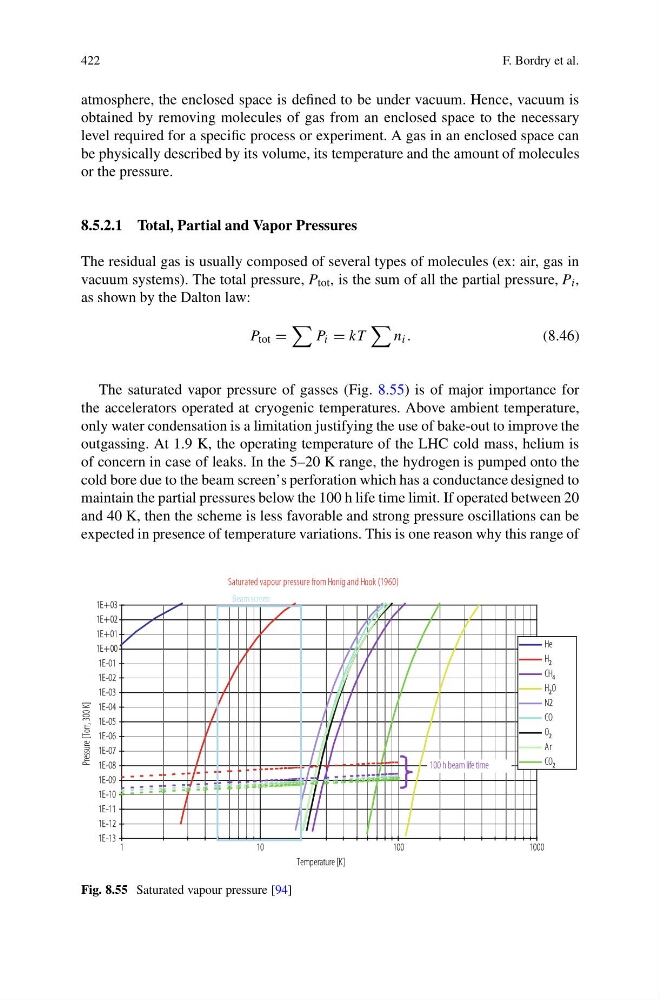
The saturated vapor pressure of gasses (Fig. 8.55) is of major importance for
the accelerators operated at cryogenic temperatures. Above ambient temperature,
only water condensation is a limitation justifying the use of bake-out to improve the
outgassing. At 1.9 K, the operating temperature of the LHC cold mass, helium is
of concern in case of leaks. In the 5–20 K range, the hydrogen is pumped onto the
cold bore due to the beam screen’s perforation which has a conductance designed to
maintain the partial pressures below the 100 h life time limit. If operated between 20
and 40 K, then the scheme is less favorable and strong pressure oscillations can be
expected in presence of temperature variations. This is one reason why this range of
Fig. 8.55 Saturated vapour pressure [94]
F. Bordry et al.
atmosphere, the enclosed space is defined to be under vacuum. Hence, vacuum is
obtained by removing molecules of gas from an enclosed space to the necessary
level required for a specific process or experiment. A gas in an enclosed space can
be physically described by its volume, its temperature and the amount of molecules
or the pressure.
8.5.2.1 Total, Partial and Vapor Pressures
The residual gas is usually composed of several types of molecules (ex: air, gas in
vacuum systems). The total pressure, P tot , is the sum of all the partial pressure, P i ,
as shown by the Dalton law:
P tot =
P i = kT
n i .
(8.46)
The saturated vapor pressure of gasses (Fig. 8.55) is of major importance for
the accelerators operated at cryogenic temperatures. Above ambient temperature,
only water condensation is a limitation justifying the use of bake-out to improve the
outgassing. At 1.9 K, the operating temperature of the LHC cold mass, helium is
of concern in case of leaks. In the 5–20 K range, the hydrogen is pumped onto the
cold bore due to the beam screen’s perforation which has a conductance designed to
maintain the partial pressures below the 100 h life time limit. If operated between 20
and 40 K, then the scheme is less favorable and strong pressure oscillations can be
expected in presence of temperature variations. This is one reason why this range of
Fig. 8.55 Saturated vapour pressure [94]