

380
F. Bordry et al.
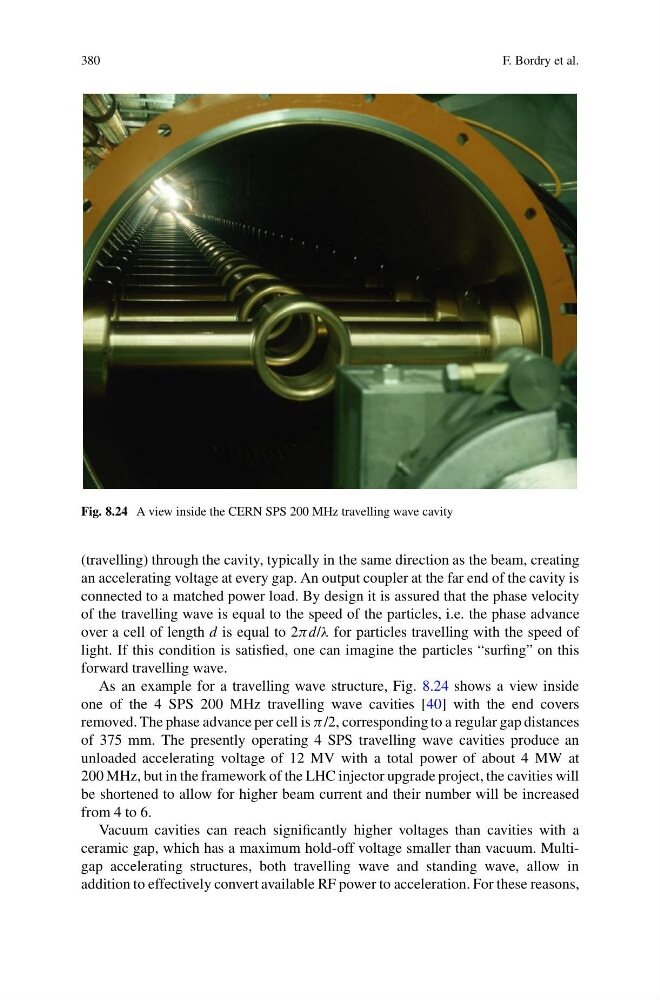
Fig. 8.24 A view inside the CERN SPS 200 MHz travelling wave cavity
(travelling) through the cavity, typically in the same direction as the beam, creating
an accelerating voltage at every gap. An output coupler at the far end of the cavity is
connected to a matched power load. By design it is assured that the phase velocity
of the travelling wave is equal to the speed of the particles, i.e. the phase advance
over a cell of length d is equal to 2πd/λ for particles travelling with the speed of
light. If this condition is satisfied, one can imagine the particles “surfing” on this
forward travelling wave.
As an example for a travelling wave structure, Fig. 8.24 shows a view inside
one of the 4 SPS 200 MHz travelling wave cavities [40] with the end covers
removed. The phase advance per cell is π/2, corresponding to a regular gap distances
of 375 mm. The presently operating 4 SPS travelling wave cavities produce an
unloaded accelerating voltage of 12 MV with a total power of about 4 MW at
200 MHz, but in the framework of the LHC injector upgrade project, the cavities will
be shortened to allow for higher beam current and their number will be increased
from 4 to 6.
Vacuum cavities can reach significantly higher voltages than cavities with a
ceramic gap, which has a maximum hold-off voltage smaller than vacuum. Multigap accelerating structures, both travelling wave and standing wave, allow in
addition to effectively convert available RF power to acceleration. For these reasons,
F. Bordry et al.
Fig. 8.24 A view inside the CERN SPS 200 MHz travelling wave cavity
(travelling) through the cavity, typically in the same direction as the beam, creating
an accelerating voltage at every gap. An output coupler at the far end of the cavity is
connected to a matched power load. By design it is assured that the phase velocity
of the travelling wave is equal to the speed of the particles, i.e. the phase advance
over a cell of length d is equal to 2πd/λ for particles travelling with the speed of
light. If this condition is satisfied, one can imagine the particles “surfing” on this
forward travelling wave.
As an example for a travelling wave structure, Fig. 8.24 shows a view inside
one of the 4 SPS 200 MHz travelling wave cavities [40] with the end covers
removed. The phase advance per cell is π/2, corresponding to a regular gap distances
of 375 mm. The presently operating 4 SPS travelling wave cavities produce an
unloaded accelerating voltage of 12 MV with a total power of about 4 MW at
200 MHz, but in the framework of the LHC injector upgrade project, the cavities will
be shortened to allow for higher beam current and their number will be increased
from 4 to 6.
Vacuum cavities can reach significantly higher voltages than cavities with a
ceramic gap, which has a maximum hold-off voltage smaller than vacuum. Multigap accelerating structures, both travelling wave and standing wave, allow in
addition to effectively convert available RF power to acceleration. For these reasons,