

370
F. Bordry et al.
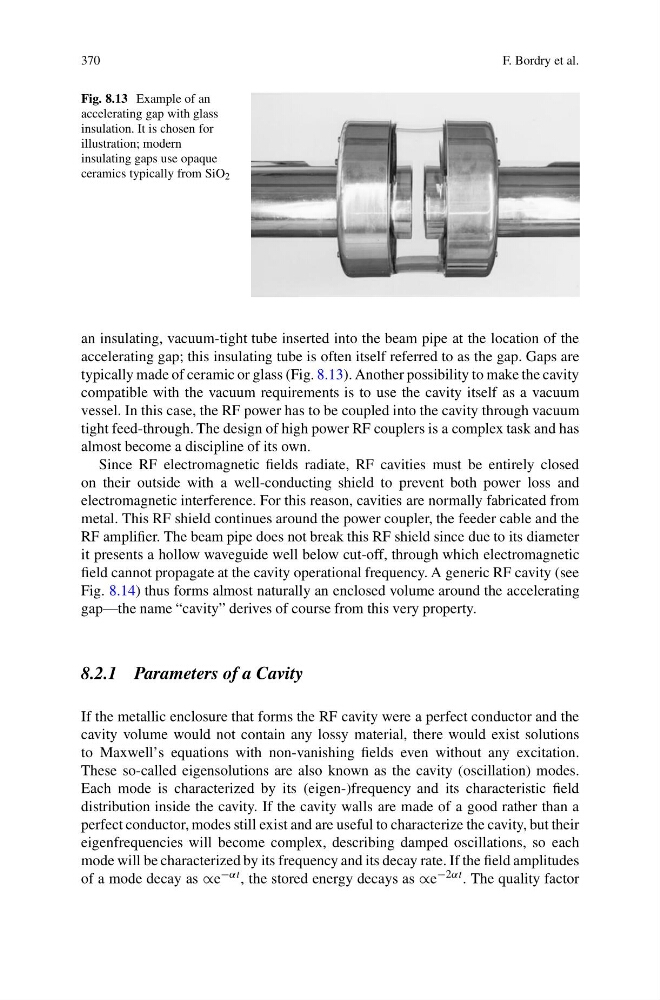
Fig. 8.13 Example of an
accelerating gap with glass
insulation. It is chosen for
illustration; modern
insulating gaps use opaque
ceramics typically from SiO 2
an insulating, vacuum-tight tube inserted into the beam pipe at the location of the
accelerating gap; this insulating tube is often itself referred to as the gap. Gaps are
typically made of ceramic or glass (Fig. 8.13). Another possibility to make the cavity
compatible with the vacuum requirements is to use the cavity itself as a vacuum
vessel. In this case, the RF power has to be coupled into the cavity through vacuum
tight feed-through. The design of high power RF couplers is a complex task and has
almost become a discipline of its own.
Since RF electromagnetic fields radiate, RF cavities must be entirely closed
on their outside with a well-conducting shield to prevent both power loss and
electromagnetic interference. For this reason, cavities are normally fabricated from
metal. This RF shield continues around the power coupler, the feeder cable and the
RF amplifier. The beam pipe does not break this RF shield since due to its diameter
it presents a hollow waveguide well below cut-off, through which electromagnetic
field cannot propagate at the cavity operational frequency. A generic RF cavity (see
Fig. 8.14) thus forms almost naturally an enclosed volume around the accelerating
gap—the name “cavity” derives of course from this very property.
8.2.1 Parameters of a Cavity
If the metallic enclosure that forms the RF cavity were a perfect conductor and the
cavity volume would not contain any lossy material, there would exist solutions
to Maxwell’s equations with non-vanishing fields even without any excitation.
These so-called eigensolutions are also known as the cavity (oscillation) modes.
Each mode is characterized by its (eigen-)frequency and its characteristic field
distribution inside the cavity. If the cavity walls are made of a good rather than a
perfect conductor, modes still exist and are useful to characterize the cavity, but their
eigenfrequencies will become complex, describing damped oscillations, so each
mode will be characterized by its frequency and its decay rate. If the field amplitudes
of a mode decay as ∝e −αt , the stored energy decays as ∝e −2αt . The quality factor
F. Bordry et al.
Fig. 8.13 Example of an
accelerating gap with glass
insulation. It is chosen for
illustration; modern
insulating gaps use opaque
ceramics typically from SiO 2
an insulating, vacuum-tight tube inserted into the beam pipe at the location of the
accelerating gap; this insulating tube is often itself referred to as the gap. Gaps are
typically made of ceramic or glass (Fig. 8.13). Another possibility to make the cavity
compatible with the vacuum requirements is to use the cavity itself as a vacuum
vessel. In this case, the RF power has to be coupled into the cavity through vacuum
tight feed-through. The design of high power RF couplers is a complex task and has
almost become a discipline of its own.
Since RF electromagnetic fields radiate, RF cavities must be entirely closed
on their outside with a well-conducting shield to prevent both power loss and
electromagnetic interference. For this reason, cavities are normally fabricated from
metal. This RF shield continues around the power coupler, the feeder cable and the
RF amplifier. The beam pipe does not break this RF shield since due to its diameter
it presents a hollow waveguide well below cut-off, through which electromagnetic
field cannot propagate at the cavity operational frequency. A generic RF cavity (see
Fig. 8.14) thus forms almost naturally an enclosed volume around the accelerating
gap—the name “cavity” derives of course from this very property.
8.2.1 Parameters of a Cavity
If the metallic enclosure that forms the RF cavity were a perfect conductor and the
cavity volume would not contain any lossy material, there would exist solutions
to Maxwell’s equations with non-vanishing fields even without any excitation.
These so-called eigensolutions are also known as the cavity (oscillation) modes.
Each mode is characterized by its (eigen-)frequency and its characteristic field
distribution inside the cavity. If the cavity walls are made of a good rather than a
perfect conductor, modes still exist and are useful to characterize the cavity, but their
eigenfrequencies will become complex, describing damped oscillations, so each
mode will be characterized by its frequency and its decay rate. If the field amplitudes
of a mode decay as ∝e −αt , the stored energy decays as ∝e −2αt . The quality factor