

8 Accelerator Engineering and Technology: Accelerator Technology
359
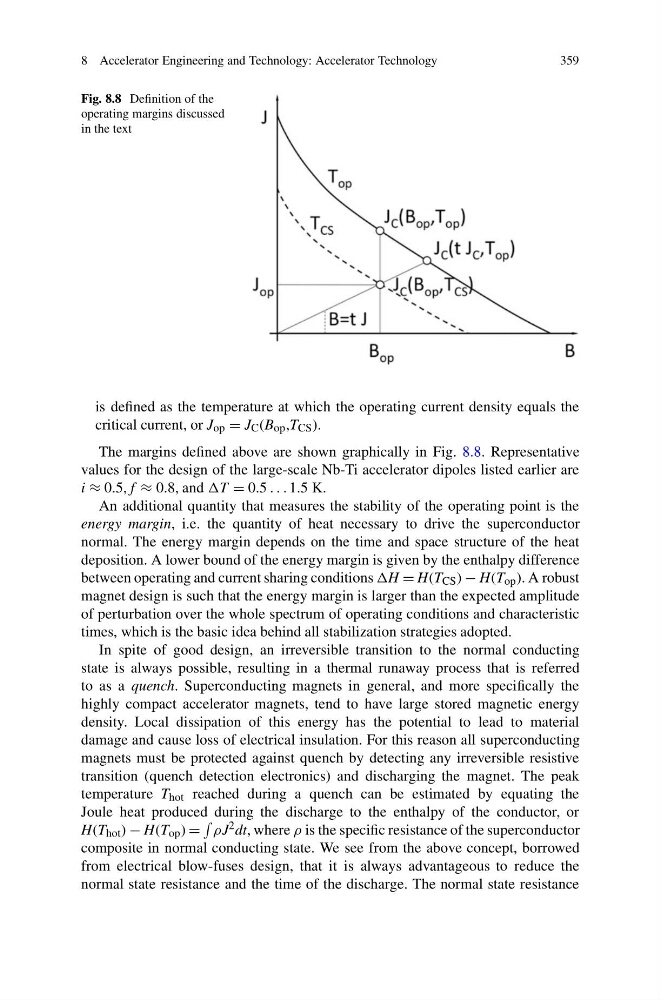
Fig. 8.8 Definition of the
operating margins discussed
in the text
is defined as the temperature at which the operating current density equals the
critical current, or J op = J C (B op ,T CS ).
The margins defined above are shown graphically in Fig. 8.8. Representative
values for the design of the large-scale Nb-Ti accelerator dipoles listed earlier are
i ≈ 0.5, f ≈ 0.8, and = 0.5 . . . 1.5 K.
An additional quantity that measures the stability of the operating point is the
energy margin, i.e. the quantity of heat necessary to drive the superconductor
normal. The energy margin depends on the time and space structure of the heat
deposition. A lower bound of the energy margin is given by the enthalpy difference
between operating and current sharing conditions = H(T CS ) − H(T op ). A robust
magnet design is such that the energy margin is larger than the expected amplitude
of perturbation over the whole spectrum of operating conditions and characteristic
times, which is the basic idea behind all stabilization strategies adopted.
In spite of good design, an irreversible transition to the normal conducting
state is always possible, resulting in a thermal runaway process that is referred
to as a quench. Superconducting magnets in general, and more specifically the
highly compact accelerator magnets, tend to have large stored magnetic energy
density. Local dissipation of this energy has the potential to lead to material
damage and cause loss of electrical insulation. For this reason all superconducting
magnets must be protected against quench by detecting any irreversible resistive
transition (quench detection electronics) and discharging the magnet. The peak
temperature T hot reached during a quench can be estimated by equating the
Joule heat produced during the discharge to the enthalpy of the conductor, or
H(T hot ) − H(T op ) =
ρJ 2 dt, where ρ is the specific resistance of the superconductor
composite in normal conducting state. We see from the above concept, borrowed
from electrical blow-fuses design, that it is always advantageous to reduce the
normal state resistance and the time of the discharge. The normal state resistance
359
Fig. 8.8 Definition of the
operating margins discussed
in the text
is defined as the temperature at which the operating current density equals the
critical current, or J op = J C (B op ,T CS ).
The margins defined above are shown graphically in Fig. 8.8. Representative
values for the design of the large-scale Nb-Ti accelerator dipoles listed earlier are
i ≈ 0.5, f ≈ 0.8, and = 0.5 . . . 1.5 K.
An additional quantity that measures the stability of the operating point is the
energy margin, i.e. the quantity of heat necessary to drive the superconductor
normal. The energy margin depends on the time and space structure of the heat
deposition. A lower bound of the energy margin is given by the enthalpy difference
between operating and current sharing conditions = H(T CS ) − H(T op ). A robust
magnet design is such that the energy margin is larger than the expected amplitude
of perturbation over the whole spectrum of operating conditions and characteristic
times, which is the basic idea behind all stabilization strategies adopted.
In spite of good design, an irreversible transition to the normal conducting
state is always possible, resulting in a thermal runaway process that is referred
to as a quench. Superconducting magnets in general, and more specifically the
highly compact accelerator magnets, tend to have large stored magnetic energy
density. Local dissipation of this energy has the potential to lead to material
damage and cause loss of electrical insulation. For this reason all superconducting
magnets must be protected against quench by detecting any irreversible resistive
transition (quench detection electronics) and discharging the magnet. The peak
temperature T hot reached during a quench can be estimated by equating the
Joule heat produced during the discharge to the enthalpy of the conductor, or
H(T hot ) − H(T op ) =
ρJ 2 dt, where ρ is the specific resistance of the superconductor
composite in normal conducting state. We see from the above concept, borrowed
from electrical blow-fuses design, that it is always advantageous to reduce the
normal state resistance and the time of the discharge. The normal state resistance