

8 Accelerator Engineering and Technology: Accelerator Technology
357
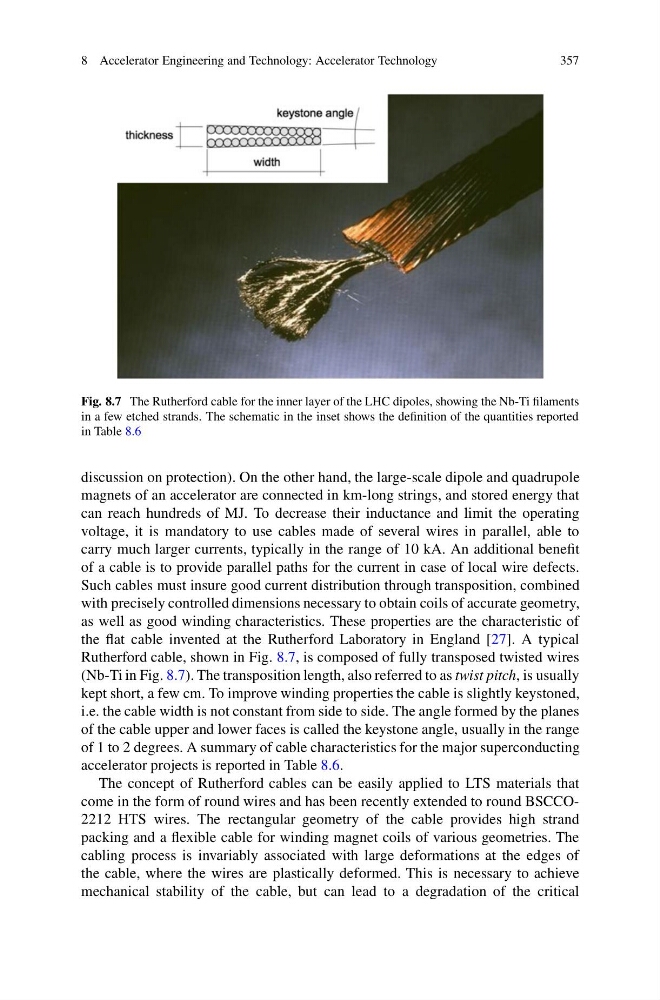
Fig. 8.7 The Rutherford cable for the inner layer of the LHC dipoles, showing the Nb-Ti filaments
in a few etched strands. The schematic in the inset shows the definition of the quantities reported
in Table 8.6
discussion on protection). On the other hand, the large-scale dipole and quadrupole
magnets of an accelerator are connected in km-long strings, and stored energy that
can reach hundreds of MJ. To decrease their inductance and limit the operating
voltage, it is mandatory to use cables made of several wires in parallel, able to
carry much larger currents, typically in the range of 10 kA. An additional benefit
of a cable is to provide parallel paths for the current in case of local wire defects.
Such cables must insure good current distribution through transposition, combined
with precisely controlled dimensions necessary to obtain coils of accurate geometry,
as well as good winding characteristics. These properties are the characteristic of
the flat cable invented at the Rutherford Laboratory in England [27]. A typical
Rutherford cable, shown in Fig. 8.7, is composed of fully transposed twisted wires
(Nb-Ti in Fig. 8.7). The transposition length, also referred to as twist pitch, is usually
kept short, a few cm. To improve winding properties the cable is slightly keystoned,
i.e. the cable width is not constant from side to side. The angle formed by the planes
of the cable upper and lower faces is called the keystone angle, usually in the range
of 1 to 2 degrees. A summary of cable characteristics for the major superconducting
accelerator projects is reported in Table 8.6.
The concept of Rutherford cables can be easily applied to LTS materials that
come in the form of round wires and has been recently extended to round BSCCO2212 HTS wires. The rectangular geometry of the cable provides high strand
packing and a flexible cable for winding magnet coils of various geometries. The
cabling process is invariably associated with large deformations at the edges of
the cable, where the wires are plastically deformed. This is necessary to achieve
mechanical stability of the cable, but can lead to a degradation of the critical
357
Fig. 8.7 The Rutherford cable for the inner layer of the LHC dipoles, showing the Nb-Ti filaments
in a few etched strands. The schematic in the inset shows the definition of the quantities reported
in Table 8.6
discussion on protection). On the other hand, the large-scale dipole and quadrupole
magnets of an accelerator are connected in km-long strings, and stored energy that
can reach hundreds of MJ. To decrease their inductance and limit the operating
voltage, it is mandatory to use cables made of several wires in parallel, able to
carry much larger currents, typically in the range of 10 kA. An additional benefit
of a cable is to provide parallel paths for the current in case of local wire defects.
Such cables must insure good current distribution through transposition, combined
with precisely controlled dimensions necessary to obtain coils of accurate geometry,
as well as good winding characteristics. These properties are the characteristic of
the flat cable invented at the Rutherford Laboratory in England [27]. A typical
Rutherford cable, shown in Fig. 8.7, is composed of fully transposed twisted wires
(Nb-Ti in Fig. 8.7). The transposition length, also referred to as twist pitch, is usually
kept short, a few cm. To improve winding properties the cable is slightly keystoned,
i.e. the cable width is not constant from side to side. The angle formed by the planes
of the cable upper and lower faces is called the keystone angle, usually in the range
of 1 to 2 degrees. A summary of cable characteristics for the major superconducting
accelerator projects is reported in Table 8.6.
The concept of Rutherford cables can be easily applied to LTS materials that
come in the form of round wires and has been recently extended to round BSCCO2212 HTS wires. The rectangular geometry of the cable provides high strand
packing and a flexible cable for winding magnet coils of various geometries. The
cabling process is invariably associated with large deformations at the edges of
the cable, where the wires are plastically deformed. This is necessary to achieve
mechanical stability of the cable, but can lead to a degradation of the critical