

354
F. Bordry et al.
Though exciting and promising, these recent developments are still far from
being ripe for applications. In the following sections we will focus on the main
characteristics of the technical superconductors of Table 8.5, which are at present
the only ones available in sufficient quantity and quality for magnet applications.
8.1.3.1.1 Nb-Ti
The alloy of Nb-47%Ti [19] is undoubtedly the most successful practical superconductor, and has been used in all superconducting particle accelerators built to
date. Nb-Ti is a ductile and tough material, easily available in long lengths (a few
km piece length) in the form of multi-filamentary wires where the superconductor
is dispersed in a copper matrix of high purity and low electrical resistivity. NbTi at 4.2 K has a critical current density of about 1500 A/mm 2 at 7.5 T. Cooling
it to 1.9 K shifts this point up to 10.5 T. This field range represents the upper
(quench) limit for the use of Nb-Ti in accelerator magnets. Standard industrial
production yields filament size of a few μm (5 to 10), which is beneficial to
reduce the field perturbations induced by persistent currents (see later). Smaller
filaments (1 to 3 μm) have been produced to reduce magnetization and losses, but
this R&D products are not industrial standards. Homogeneity of the production is
at the level of few % for key parameters such as critical current, magnetization,
wire composition and geometry, which demonstrates the maturity of the technology.
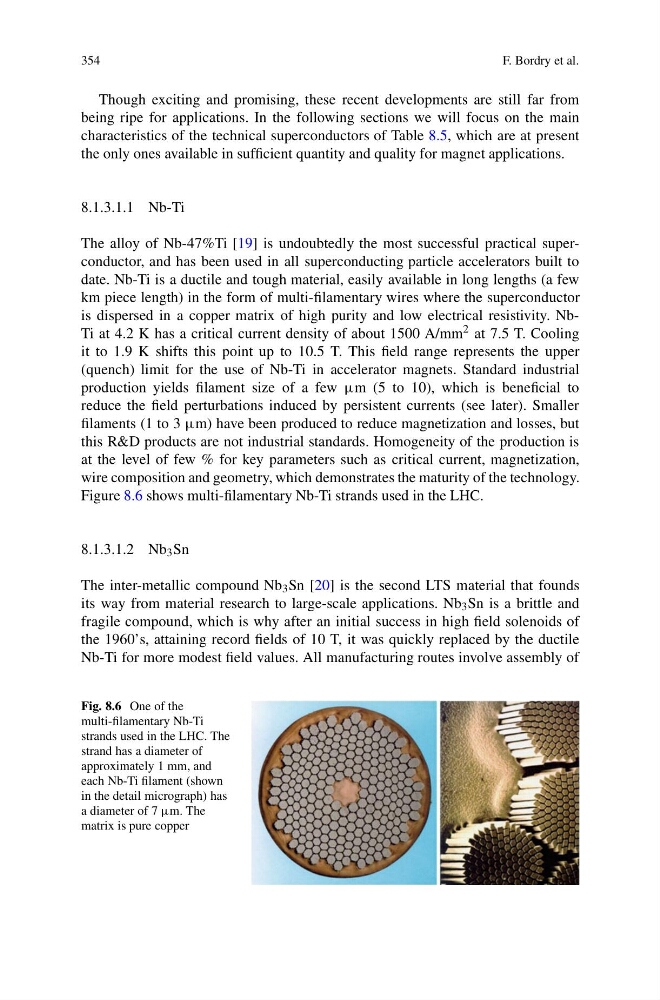
Figure 8.6 shows multi-filamentary Nb-Ti strands used in the LHC.
8.1.3.1.2 Nb 3 Sn
The inter-metallic compound Nb 3 Sn [20] is the second LTS material that founds
its way from material research to large-scale applications. Nb 3 Sn is a brittle and
fragile compound, which is why after an initial success in high field solenoids of
the 1960’s, attaining record fields of 10 T, it was quickly replaced by the ductile
Nb-Ti for more modest field values. All manufacturing routes involve assembly of
Fig. 8.6 One of the
multi-filamentary Nb-Ti
strands used in the LHC. The
strand has a diameter of
approximately 1 mm, and
each Nb-Ti filament (shown
in the detail micrograph) has
a diameter of 7 μm. The
matrix is pure copper
F. Bordry et al.
Though exciting and promising, these recent developments are still far from
being ripe for applications. In the following sections we will focus on the main
characteristics of the technical superconductors of Table 8.5, which are at present
the only ones available in sufficient quantity and quality for magnet applications.
8.1.3.1.1 Nb-Ti
The alloy of Nb-47%Ti [19] is undoubtedly the most successful practical superconductor, and has been used in all superconducting particle accelerators built to
date. Nb-Ti is a ductile and tough material, easily available in long lengths (a few
km piece length) in the form of multi-filamentary wires where the superconductor
is dispersed in a copper matrix of high purity and low electrical resistivity. NbTi at 4.2 K has a critical current density of about 1500 A/mm 2 at 7.5 T. Cooling
it to 1.9 K shifts this point up to 10.5 T. This field range represents the upper
(quench) limit for the use of Nb-Ti in accelerator magnets. Standard industrial
production yields filament size of a few μm (5 to 10), which is beneficial to
reduce the field perturbations induced by persistent currents (see later). Smaller
filaments (1 to 3 μm) have been produced to reduce magnetization and losses, but
this R&D products are not industrial standards. Homogeneity of the production is
at the level of few % for key parameters such as critical current, magnetization,
wire composition and geometry, which demonstrates the maturity of the technology.
Figure 8.6 shows multi-filamentary Nb-Ti strands used in the LHC.
8.1.3.1.2 Nb 3 Sn
The inter-metallic compound Nb 3 Sn [20] is the second LTS material that founds
its way from material research to large-scale applications. Nb 3 Sn is a brittle and
fragile compound, which is why after an initial success in high field solenoids of
the 1960’s, attaining record fields of 10 T, it was quickly replaced by the ductile
Nb-Ti for more modest field values. All manufacturing routes involve assembly of
Fig. 8.6 One of the
multi-filamentary Nb-Ti
strands used in the LHC. The
strand has a diameter of
approximately 1 mm, and
each Nb-Ti filament (shown
in the detail micrograph) has
a diameter of 7 μm. The
matrix is pure copper