

8 Accelerator Engineering and Technology: Accelerator Technology
353
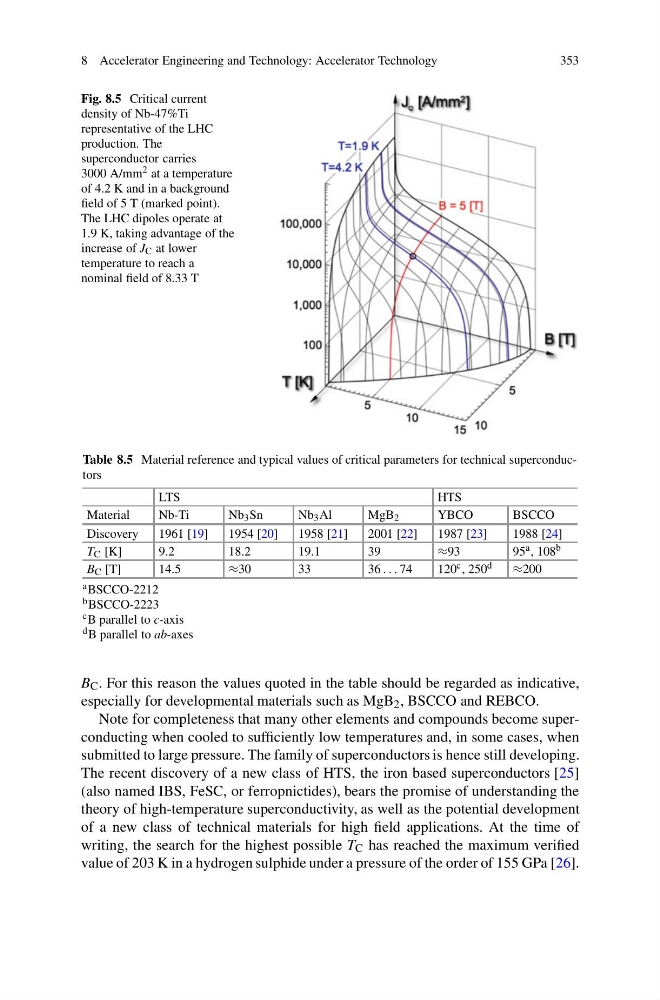
Fig. 8.5 Critical current
density of Nb-47%Ti
representative of the LHC
production. The
superconductor carries
3000 A/mm 2 at a temperature
of 4.2 K and in a background
field of 5 T (marked point).
The LHC dipoles operate at
1.9 K, taking advantage of the
increase of J C at lower
temperature to reach a
nominal field of 8.33 T
Table 8.5 Material reference and typical values of critical parameters for technical superconductors
LTS
HTS
Material
Nb-Ti
Nb 3 Sn
Nb 3 Al
MgB 2
YBCO
BSCCO
Discovery
1961 [19]
1954 [20]
1958 [21]
2001 [22]
1987 [23]
1988 [24]
T C [K]
9.2
18.2
19.1
39
≈93
95 a , 108 b
B C [T]
14.5
≈30
33
36 . . . 74
120 c , 250 d
≈200
a BSCCO-2212
b BSCCO-2223
c B parallel to c-axis
d B parallel to ab-axes
B C . For this reason the values quoted in the table should be regarded as indicative,
especially for developmental materials such as MgB 2 , BSCCO and REBCO.
Note for completeness that many other elements and compounds become superconducting when cooled to sufficiently low temperatures and, in some cases, when
submitted to large pressure. The family of superconductors is hence still developing.
The recent discovery of a new class of HTS, the iron based superconductors [25]
(also named IBS, FeSC, or ferropnictides), bears the promise of understanding the
theory of high-temperature superconductivity, as well as the potential development
of a new class of technical materials for high field applications. At the time of
writing, the search for the highest possible T C has reached the maximum verified
value of 203 K in a hydrogen sulphide under a pressure of the order of 155 GPa [26].
353
Fig. 8.5 Critical current
density of Nb-47%Ti
representative of the LHC
production. The
superconductor carries
3000 A/mm 2 at a temperature
of 4.2 K and in a background
field of 5 T (marked point).
The LHC dipoles operate at
1.9 K, taking advantage of the
increase of J C at lower
temperature to reach a
nominal field of 8.33 T
Table 8.5 Material reference and typical values of critical parameters for technical superconductors
LTS
HTS
Material
Nb-Ti
Nb 3 Sn
Nb 3 Al
MgB 2
YBCO
BSCCO
Discovery
1961 [19]
1954 [20]
1958 [21]
2001 [22]
1987 [23]
1988 [24]
T C [K]
9.2
18.2
19.1
39
≈93
95 a , 108 b
B C [T]
14.5
≈30
33
36 . . . 74
120 c , 250 d
≈200
a BSCCO-2212
b BSCCO-2223
c B parallel to c-axis
d B parallel to ab-axes
B C . For this reason the values quoted in the table should be regarded as indicative,
especially for developmental materials such as MgB 2 , BSCCO and REBCO.
Note for completeness that many other elements and compounds become superconducting when cooled to sufficiently low temperatures and, in some cases, when
submitted to large pressure. The family of superconductors is hence still developing.
The recent discovery of a new class of HTS, the iron based superconductors [25]
(also named IBS, FeSC, or ferropnictides), bears the promise of understanding the
theory of high-temperature superconductivity, as well as the potential development
of a new class of technical materials for high field applications. At the time of
writing, the search for the highest possible T C has reached the maximum verified
value of 203 K in a hydrogen sulphide under a pressure of the order of 155 GPa [26].