

8 Accelerator Engineering and Technology: Accelerator Technology
349
with special properties, in particular with a small angle α = 1/γ where γ is the
relativistic factor.
To a first approximation, these magnets produce a series of dipole fields with
alternated directions, of period λ. This is typically obtained with conventional
electromagnets when the period is relatively large allowing sufficient space for the
coils, and with permanent magnets for shorter periods. Superconducting windings,
in general cryo-cooled, are used in case the required field exceeds 2 T and/or for
small periods where a high current density is needed.
The difference between wigglers and undulators is in the nature of the radiation
produced by the particle. When the amplitude of the beam excursion expressed
in meters is small with respect to the angle of the synchrotron radiation emission
expressed in radians, the device is called undulator: the emitted radiation is
concentrated in a small opening angle and the radiation produced by the different
periods interferes coherently producing sharp peaks at harmonics of a fundamental
wavelength. Wigglers on the contrary produce particle displacements of larger
amplitude: the emitted radiation is similar to the continuous spectrum generated
by bending magnets, with in addition the effect coming from the incoherent
superposition of radiation from individual poles.
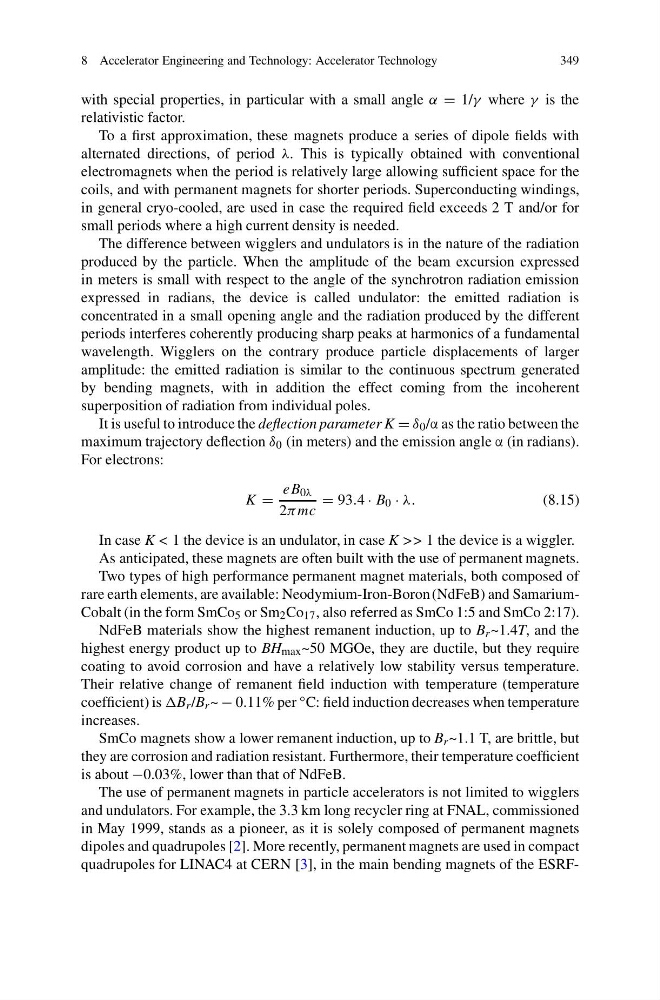
It is useful to introduce the deflection parameter K = δ 0 /α as the ratio between the
maximum trajectory deflection δ 0 (in meters) and the emission angle α (in radians).
For electrons:
K =
eB 0λ
2πmc
= 93.4 · B 0 · λ.
(8.15)
In case K < 1 the device is an undulator, in case K >> 1 the device is a wiggler.
As anticipated, these magnets are often built with the use of permanent magnets.
Two types of high performance permanent magnet materials, both composed of
rare earth elements, are available: Neodymium-Iron-Boron (NdFeB) and SamariumCobalt (in the form SmCo 5 or Sm 2 Co 17 , also referred as SmCo 1:5 and SmCo 2:17).
NdFeB materials show the highest remanent induction, up to B r ~1.4T, and the
highest energy product up to BH max ~50 MGOe, they are ductile, but they require
coating to avoid corrosion and have a relatively low stability versus temperature.
Their relative change of remanent field induction with temperature (temperature
coefficient) is r /B r ~ − 0.11% per ◦ C: field induction decreases when temperature
increases.
SmCo magnets show a lower remanent induction, up to B r ~1.1 T, are brittle, but
they are corrosion and radiation resistant. Furthermore, their temperature coefficient
is about −0.03%, lower than that of NdFeB.
The use of permanent magnets in particle accelerators is not limited to wigglers
and undulators. For example, the 3.3 km long recycler ring at FNAL, commissioned
in May 1999, stands as a pioneer, as it is solely composed of permanent magnets
dipoles and quadrupoles [2]. More recently, permanent magnets are used in compact
quadrupoles for LINAC4 at CERN [3], in the main bending magnets of the ESRF-
349
with special properties, in particular with a small angle α = 1/γ where γ is the
relativistic factor.
To a first approximation, these magnets produce a series of dipole fields with
alternated directions, of period λ. This is typically obtained with conventional
electromagnets when the period is relatively large allowing sufficient space for the
coils, and with permanent magnets for shorter periods. Superconducting windings,
in general cryo-cooled, are used in case the required field exceeds 2 T and/or for
small periods where a high current density is needed.
The difference between wigglers and undulators is in the nature of the radiation
produced by the particle. When the amplitude of the beam excursion expressed
in meters is small with respect to the angle of the synchrotron radiation emission
expressed in radians, the device is called undulator: the emitted radiation is
concentrated in a small opening angle and the radiation produced by the different
periods interferes coherently producing sharp peaks at harmonics of a fundamental
wavelength. Wigglers on the contrary produce particle displacements of larger
amplitude: the emitted radiation is similar to the continuous spectrum generated
by bending magnets, with in addition the effect coming from the incoherent
superposition of radiation from individual poles.
It is useful to introduce the deflection parameter K = δ 0 /α as the ratio between the
maximum trajectory deflection δ 0 (in meters) and the emission angle α (in radians).
For electrons:
K =
eB 0λ
2πmc
= 93.4 · B 0 · λ.
(8.15)
In case K < 1 the device is an undulator, in case K >> 1 the device is a wiggler.
As anticipated, these magnets are often built with the use of permanent magnets.
Two types of high performance permanent magnet materials, both composed of
rare earth elements, are available: Neodymium-Iron-Boron (NdFeB) and SamariumCobalt (in the form SmCo 5 or Sm 2 Co 17 , also referred as SmCo 1:5 and SmCo 2:17).
NdFeB materials show the highest remanent induction, up to B r ~1.4T, and the
highest energy product up to BH max ~50 MGOe, they are ductile, but they require
coating to avoid corrosion and have a relatively low stability versus temperature.
Their relative change of remanent field induction with temperature (temperature
coefficient) is r /B r ~ − 0.11% per ◦ C: field induction decreases when temperature
increases.
SmCo magnets show a lower remanent induction, up to B r ~1.1 T, are brittle, but
they are corrosion and radiation resistant. Furthermore, their temperature coefficient
is about −0.03%, lower than that of NdFeB.
The use of permanent magnets in particle accelerators is not limited to wigglers
and undulators. For example, the 3.3 km long recycler ring at FNAL, commissioned
in May 1999, stands as a pioneer, as it is solely composed of permanent magnets
dipoles and quadrupoles [2]. More recently, permanent magnets are used in compact
quadrupoles for LINAC4 at CERN [3], in the main bending magnets of the ESRF-