

348
F. Bordry et al.
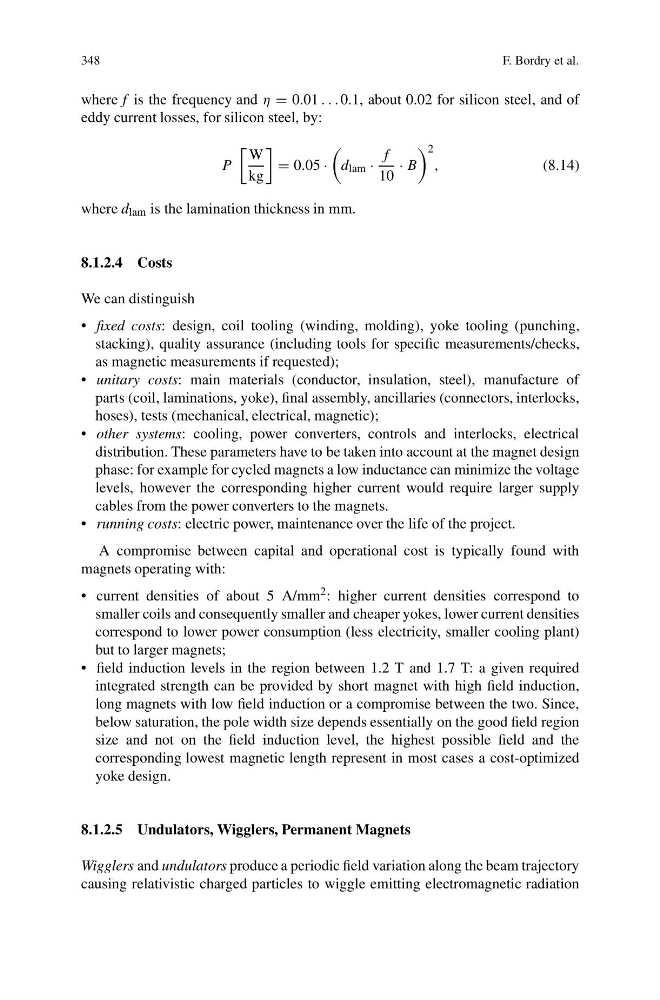
where f is the frequency and η = 0.01 . . . 0.1, about 0.02 for silicon steel, and of
eddy current losses, for silicon steel, by:
P
W
kg
= 0.05 ·
d lam ·
f
10
· B
2
,
(8.14)
where d lam is the lamination thickness in mm.
8.1.2.4 Costs
We can distinguish
• fixed costs: design, coil tooling (winding, molding), yoke tooling (punching,
stacking), quality assurance (including tools for specific measurements/checks,
as magnetic measurements if requested);
• unitary costs: main materials (conductor, insulation, steel), manufacture of
parts (coil, laminations, yoke), final assembly, ancillaries (connectors, interlocks,
hoses), tests (mechanical, electrical, magnetic);
• other systems: cooling, power converters, controls and interlocks, electrical
distribution. These parameters have to be taken into account at the magnet design
phase: for example for cycled magnets a low inductance can minimize the voltage
levels, however the corresponding higher current would require larger supply
cables from the power converters to the magnets.
• running costs: electric power, maintenance over the life of the project.
A compromise between capital and operational cost is typically found with
magnets operating with:
• current densities of about 5 A/mm 2 : higher current densities correspond to
smaller coils and consequently smaller and cheaper yokes, lower current densities
correspond to lower power consumption (less electricity, smaller cooling plant)
but to larger magnets;
• field induction levels in the region between 1.2 T and 1.7 T: a given required
integrated strength can be provided by short magnet with high field induction,
long magnets with low field induction or a compromise between the two. Since,
below saturation, the pole width size depends essentially on the good field region
size and not on the field induction level, the highest possible field and the
corresponding lowest magnetic length represent in most cases a cost-optimized
yoke design.
8.1.2.5 Undulators, Wigglers, Permanent Magnets
Wigglers and undulators produce a periodic field variation along the beam trajectory
causing relativistic charged particles to wiggle emitting electromagnetic radiation
F. Bordry et al.
where f is the frequency and η = 0.01 . . . 0.1, about 0.02 for silicon steel, and of
eddy current losses, for silicon steel, by:
P
W
kg
= 0.05 ·
d lam ·
f
10
· B
2
,
(8.14)
where d lam is the lamination thickness in mm.
8.1.2.4 Costs
We can distinguish
• fixed costs: design, coil tooling (winding, molding), yoke tooling (punching,
stacking), quality assurance (including tools for specific measurements/checks,
as magnetic measurements if requested);
• unitary costs: main materials (conductor, insulation, steel), manufacture of
parts (coil, laminations, yoke), final assembly, ancillaries (connectors, interlocks,
hoses), tests (mechanical, electrical, magnetic);
• other systems: cooling, power converters, controls and interlocks, electrical
distribution. These parameters have to be taken into account at the magnet design
phase: for example for cycled magnets a low inductance can minimize the voltage
levels, however the corresponding higher current would require larger supply
cables from the power converters to the magnets.
• running costs: electric power, maintenance over the life of the project.
A compromise between capital and operational cost is typically found with
magnets operating with:
• current densities of about 5 A/mm 2 : higher current densities correspond to
smaller coils and consequently smaller and cheaper yokes, lower current densities
correspond to lower power consumption (less electricity, smaller cooling plant)
but to larger magnets;
• field induction levels in the region between 1.2 T and 1.7 T: a given required
integrated strength can be provided by short magnet with high field induction,
long magnets with low field induction or a compromise between the two. Since,
below saturation, the pole width size depends essentially on the good field region
size and not on the field induction level, the highest possible field and the
corresponding lowest magnetic length represent in most cases a cost-optimized
yoke design.
8.1.2.5 Undulators, Wigglers, Permanent Magnets
Wigglers and undulators produce a periodic field variation along the beam trajectory
causing relativistic charged particles to wiggle emitting electromagnetic radiation