

8 Accelerator Engineering and Technology: Accelerator Technology
345
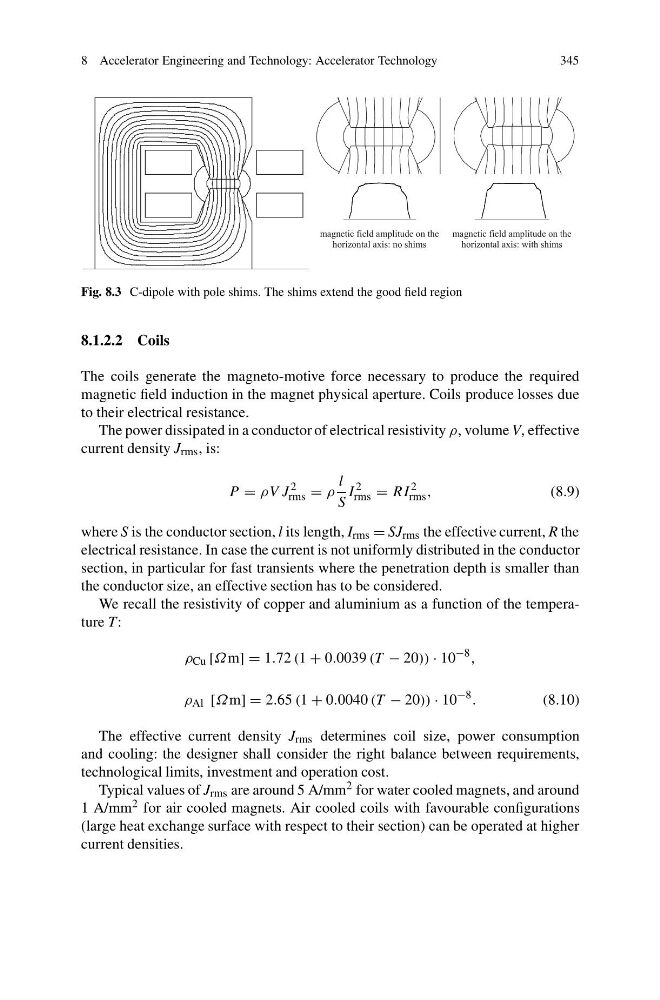
magnetic field amplitude on the
horizontal axis: no shims
magnetic field amplitude on the
horizontal axis: with shims
Fig. 8.3 C-dipole with pole shims. The shims extend the good field region
8.1.2.2 Coils
The coils generate the magneto-motive force necessary to produce the required
magnetic field induction in the magnet physical aperture. Coils produce losses due
to their electrical resistance.
The power dissipated in a conductor of electrical resistivity ρ, volume V, effective
current density J rms , is:
P = ρV J
2
rms = ρ
l
S
I
2
rms = RI
2
rms ,
(8.9)
where S is the conductor section, l its length, I rms = SJ rms the effective current, R the
electrical resistance. In case the current is not uniformly distributed in the conductor
section, in particular for fast transients where the penetration depth is smaller than
the conductor size, an effective section has to be considered.
We recall the resistivity of copper and aluminium as a function of the temperature T:
ρ Cu [Ωm] = 1.72 (1 + 0.0039 (T − 20)) · 10
−8 ,
ρ Al [Ωm] = 2.65 (1 + 0.0040 (T − 20)) · 10
−8 .
(8.10)
The effective current density J rms determines coil size, power consumption
and cooling: the designer shall consider the right balance between requirements,
technological limits, investment and operation cost.
Typical values of J rms are around 5 A/mm 2 for water cooled magnets, and around
1 A/mm 2 for air cooled magnets. Air cooled coils with favourable configurations
(large heat exchange surface with respect to their section) can be operated at higher
current densities.
345
magnetic field amplitude on the
horizontal axis: no shims
magnetic field amplitude on the
horizontal axis: with shims
Fig. 8.3 C-dipole with pole shims. The shims extend the good field region
8.1.2.2 Coils
The coils generate the magneto-motive force necessary to produce the required
magnetic field induction in the magnet physical aperture. Coils produce losses due
to their electrical resistance.
The power dissipated in a conductor of electrical resistivity ρ, volume V, effective
current density J rms , is:
P = ρV J
2
rms = ρ
l
S
I
2
rms = RI
2
rms ,
(8.9)
where S is the conductor section, l its length, I rms = SJ rms the effective current, R the
electrical resistance. In case the current is not uniformly distributed in the conductor
section, in particular for fast transients where the penetration depth is smaller than
the conductor size, an effective section has to be considered.
We recall the resistivity of copper and aluminium as a function of the temperature T:
ρ Cu [Ωm] = 1.72 (1 + 0.0039 (T − 20)) · 10
−8 ,
ρ Al [Ωm] = 2.65 (1 + 0.0040 (T − 20)) · 10
−8 .
(8.10)
The effective current density J rms determines coil size, power consumption
and cooling: the designer shall consider the right balance between requirements,
technological limits, investment and operation cost.
Typical values of J rms are around 5 A/mm 2 for water cooled magnets, and around
1 A/mm 2 for air cooled magnets. Air cooled coils with favourable configurations
(large heat exchange surface with respect to their section) can be operated at higher
current densities.