

342
F. Bordry et al.
NI/2
+
NI/2
l air
l iron
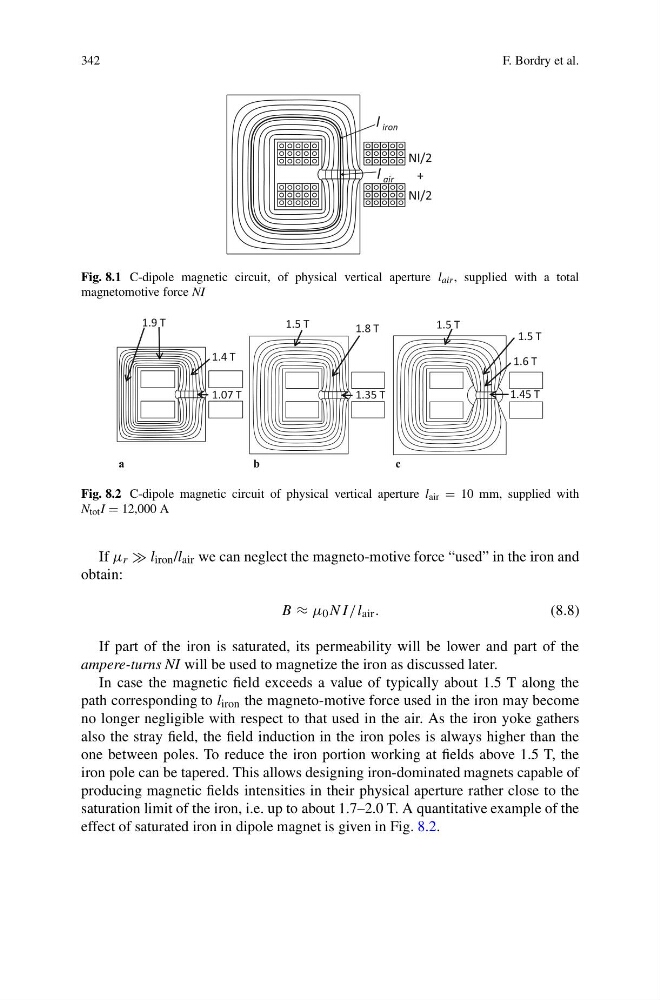
Fig. 8.1 C-dipole magnetic circuit, of physical vertical aperture l air , supplied with a total
magnetomotive force NI
a
b
c
1.9 T
1.4 T
1.07 T
1.35 T
1.45 T
1.5 T
1.8 T
1.5 T
1.5 T
1.6 T
Fig. 8.2 C-dipole magnetic circuit of physical vertical aperture l air = 10 mm, supplied with
N tot I = 12,000 A
If μ r l iron /l air we can neglect the magneto-motive force “used” in the iron and
obtain:
B ≈ μ 0 NI/l air .
(8.8)
If part of the iron is saturated, its permeability will be lower and part of the
ampere-turns NI will be used to magnetize the iron as discussed later.
In case the magnetic field exceeds a value of typically about 1.5 T along the
path corresponding to l iron the magneto-motive force used in the iron may become
no longer negligible with respect to that used in the air. As the iron yoke gathers
also the stray field, the field induction in the iron poles is always higher than the
one between poles. To reduce the iron portion working at fields above 1.5 T, the
iron pole can be tapered. This allows designing iron-dominated magnets capable of
producing magnetic fields intensities in their physical aperture rather close to the
saturation limit of the iron, i.e. up to about 1.7–2.0 T. A quantitative example of the
effect of saturated iron in dipole magnet is given in Fig. 8.2.
F. Bordry et al.
NI/2
+
NI/2
l air
l iron
Fig. 8.1 C-dipole magnetic circuit, of physical vertical aperture l air , supplied with a total
magnetomotive force NI
a
b
c
1.9 T
1.4 T
1.07 T
1.35 T
1.45 T
1.5 T
1.8 T
1.5 T
1.5 T
1.6 T
Fig. 8.2 C-dipole magnetic circuit of physical vertical aperture l air = 10 mm, supplied with
N tot I = 12,000 A
If μ r l iron /l air we can neglect the magneto-motive force “used” in the iron and
obtain:
B ≈ μ 0 NI/l air .
(8.8)
If part of the iron is saturated, its permeability will be lower and part of the
ampere-turns NI will be used to magnetize the iron as discussed later.
In case the magnetic field exceeds a value of typically about 1.5 T along the
path corresponding to l iron the magneto-motive force used in the iron may become
no longer negligible with respect to that used in the air. As the iron yoke gathers
also the stray field, the field induction in the iron poles is always higher than the
one between poles. To reduce the iron portion working at fields above 1.5 T, the
iron pole can be tapered. This allows designing iron-dominated magnets capable of
producing magnetic fields intensities in their physical aperture rather close to the
saturation limit of the iron, i.e. up to about 1.7–2.0 T. A quantitative example of the
effect of saturated iron in dipole magnet is given in Fig. 8.2.