

8 Accelerator Engineering and Technology: Accelerator Technology
341
form, the field quality of accelerator magnets is generally requested to be in the
range of few 10 −4 . To maintain practical orders of magnitude, field errors are then
quoted in relative units of 1 × 10 −4 of the main field, or simply units.
Gradient magnets (i.e. quadrupole and higher order) are also characterised by
a magnetic axis, which is usually taken as the locus of the points in the magnet
aperture where the field is zero. Magnets are aligned with respect to their axis
(or an average of the locus when it deviates from a straight line) to the specified
beam trajectory to avoid unwanted feed-down effects. Typical alignment tolerances
in circular machines range from few tens of μm in synchrotron light sources
to fractions of mm in large colliders (e.g. the LHC). Linear colliders are more
demanding, with typical tolerances at the sub-μm level.
Dipoles and quadrupoles are the main elements of the linear optics in modern synchrotrons. Depending on the beam specifications, any residual field and
alignment imperfections, as well as drift in magnet properties, may require active
correction to ensure stable and efficient operation. This is done using corrector
magnets that are powered using information established from previous knowledge
on the main magnets, or parameters measured on the beam, or both. Corrector
magnets are often designed to generate a single multipole, so to act on the beam
as an orthogonal knob, thus making the correction easier to execute.
8.1.2 Normal Conducting Magnets
“Normal conducting”, and alternatively “resistive”, “warm” or “conventional”
magnets, are electro-magnets in which the magnetic field is generated by conductors
like copper or aluminium, which oppose an electrical resistance to the flow of
current. The magnetic field induction provided in the physical aperture of these
magnets rarely exceeds 1.7 to 2.0 T, such that the working point of the ferromagnetic
yoke remains below saturation. In these conditions, the yoke provides a closure
of the magnetic path with small use of magneto-motive force, and its pole profile
determines the magnetic field quality.
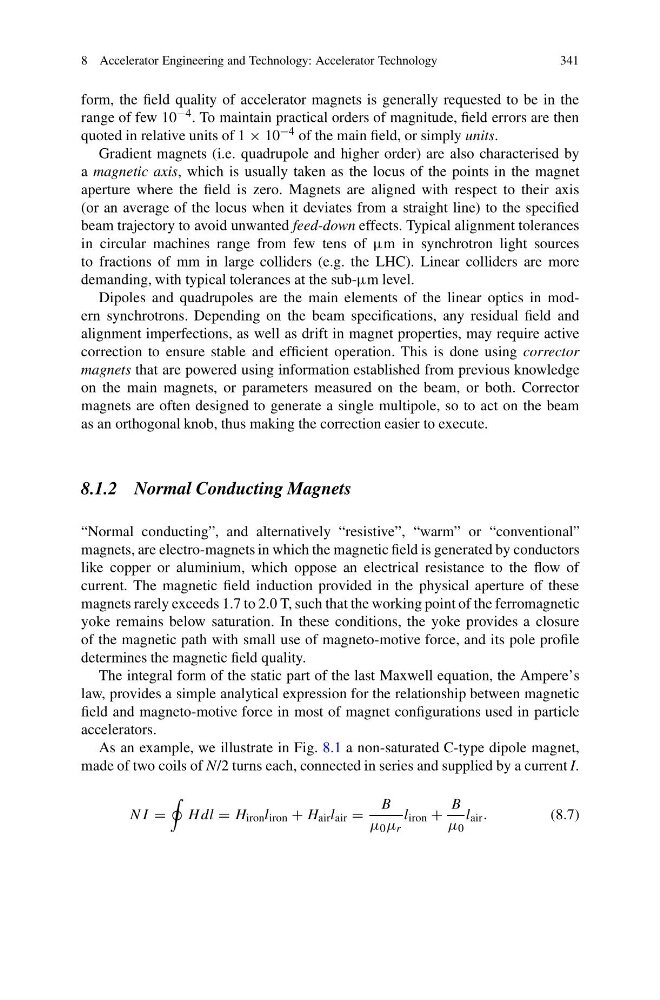
The integral form of the static part of the last Maxwell equation, the Ampere’s
law, provides a simple analytical expression for the relationship between magnetic
field and magneto-motive force in most of magnet configurations used in particle
accelerators.
As an example, we illustrate in Fig. 8.1 a non-saturated C-type dipole magnet,
made of two coils of N/2 turns each, connected in series and supplied by a current I.
NI =
H dl = H iron l iron + H air l air =
B
μ 0 μ r
l iron +
B
μ 0
l air .
(8.7)
341
form, the field quality of accelerator magnets is generally requested to be in the
range of few 10 −4 . To maintain practical orders of magnitude, field errors are then
quoted in relative units of 1 × 10 −4 of the main field, or simply units.
Gradient magnets (i.e. quadrupole and higher order) are also characterised by
a magnetic axis, which is usually taken as the locus of the points in the magnet
aperture where the field is zero. Magnets are aligned with respect to their axis
(or an average of the locus when it deviates from a straight line) to the specified
beam trajectory to avoid unwanted feed-down effects. Typical alignment tolerances
in circular machines range from few tens of μm in synchrotron light sources
to fractions of mm in large colliders (e.g. the LHC). Linear colliders are more
demanding, with typical tolerances at the sub-μm level.
Dipoles and quadrupoles are the main elements of the linear optics in modern synchrotrons. Depending on the beam specifications, any residual field and
alignment imperfections, as well as drift in magnet properties, may require active
correction to ensure stable and efficient operation. This is done using corrector
magnets that are powered using information established from previous knowledge
on the main magnets, or parameters measured on the beam, or both. Corrector
magnets are often designed to generate a single multipole, so to act on the beam
as an orthogonal knob, thus making the correction easier to execute.
8.1.2 Normal Conducting Magnets
“Normal conducting”, and alternatively “resistive”, “warm” or “conventional”
magnets, are electro-magnets in which the magnetic field is generated by conductors
like copper or aluminium, which oppose an electrical resistance to the flow of
current. The magnetic field induction provided in the physical aperture of these
magnets rarely exceeds 1.7 to 2.0 T, such that the working point of the ferromagnetic
yoke remains below saturation. In these conditions, the yoke provides a closure
of the magnetic path with small use of magneto-motive force, and its pole profile
determines the magnetic field quality.
The integral form of the static part of the last Maxwell equation, the Ampere’s
law, provides a simple analytical expression for the relationship between magnetic
field and magneto-motive force in most of magnet configurations used in particle
accelerators.
As an example, we illustrate in Fig. 8.1 a non-saturated C-type dipole magnet,
made of two coils of N/2 turns each, connected in series and supplied by a current I.
NI =
H dl = H iron l iron + H air l air =
B
μ 0 μ r
l iron +
B
μ 0
l air .
(8.7)