

308
J. Seeman et al.
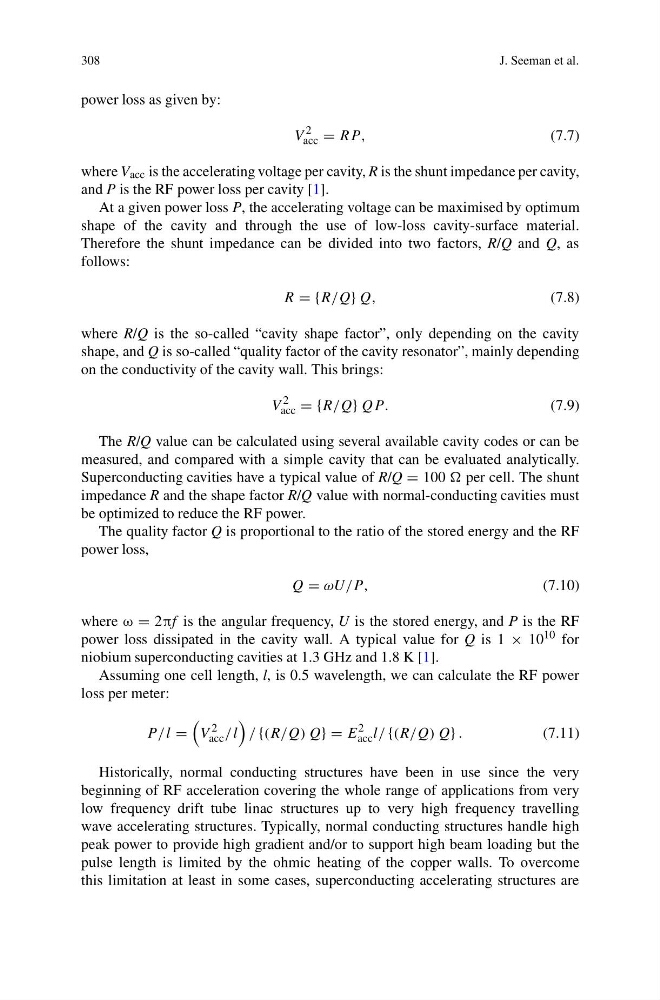
power loss as given by:
V
2
acc = RP ,
(7.7)
where V acc is the accelerating voltage per cavity, R is the shunt impedance per cavity,
and P is the RF power loss per cavity [1].
At a given power loss P, the accelerating voltage can be maximised by optimum
shape of the cavity and through the use of low-loss cavity-surface material.
Therefore the shunt impedance can be divided into two factors, R/Q and Q, as
follows:
R = {R/Q} Q,
(7.8)
where R/Q is the so-called “cavity shape factor”, only depending on the cavity
shape, and Q is so-called “quality factor of the cavity resonator”, mainly depending
on the conductivity of the cavity wall. This brings:
V
2
acc = {R/Q} QP .
(7.9)
The R/Q value can be calculated using several available cavity codes or can be
measured, and compared with a simple cavity that can be evaluated analytically.
Superconducting cavities have a typical value of R/Q = 100 per cell. The shunt
impedance R and the shape factor R/Q value with normal-conducting cavities must
be optimized to reduce the RF power.
The quality factor Q is proportional to the ratio of the stored energy and the RF
power loss,
Q = ωU/P ,
(7.10)
where ω = 2πf is the angular frequency, U is the stored energy, and P is the RF
power loss dissipated in the cavity wall. A typical value for Q is 1 × 10 10 for
niobium superconducting cavities at 1.3 GHz and 1.8 K [1].
Assuming one cell length, l, is 0.5 wavelength, we can calculate the RF power
loss per meter:
P /l =
V
2
acc /l
/ {(R/Q) Q} = E
2
acc l/ {(R/Q) Q} .
(7.11)
Historically, normal conducting structures have been in use since the very
beginning of RF acceleration covering the whole range of applications from very
low frequency drift tube linac structures up to very high frequency travelling
wave accelerating structures. Typically, normal conducting structures handle high
peak power to provide high gradient and/or to support high beam loading but the
pulse length is limited by the ohmic heating of the copper walls. To overcome
this limitation at least in some cases, superconducting accelerating structures are
J. Seeman et al.
power loss as given by:
V
2
acc = RP ,
(7.7)
where V acc is the accelerating voltage per cavity, R is the shunt impedance per cavity,
and P is the RF power loss per cavity [1].
At a given power loss P, the accelerating voltage can be maximised by optimum
shape of the cavity and through the use of low-loss cavity-surface material.
Therefore the shunt impedance can be divided into two factors, R/Q and Q, as
follows:
R = {R/Q} Q,
(7.8)
where R/Q is the so-called “cavity shape factor”, only depending on the cavity
shape, and Q is so-called “quality factor of the cavity resonator”, mainly depending
on the conductivity of the cavity wall. This brings:
V
2
acc = {R/Q} QP .
(7.9)
The R/Q value can be calculated using several available cavity codes or can be
measured, and compared with a simple cavity that can be evaluated analytically.
Superconducting cavities have a typical value of R/Q = 100 per cell. The shunt
impedance R and the shape factor R/Q value with normal-conducting cavities must
be optimized to reduce the RF power.
The quality factor Q is proportional to the ratio of the stored energy and the RF
power loss,
Q = ωU/P ,
(7.10)
where ω = 2πf is the angular frequency, U is the stored energy, and P is the RF
power loss dissipated in the cavity wall. A typical value for Q is 1 × 10 10 for
niobium superconducting cavities at 1.3 GHz and 1.8 K [1].
Assuming one cell length, l, is 0.5 wavelength, we can calculate the RF power
loss per meter:
P /l =
V
2
acc /l
/ {(R/Q) Q} = E
2
acc l/ {(R/Q) Q} .
(7.11)
Historically, normal conducting structures have been in use since the very
beginning of RF acceleration covering the whole range of applications from very
low frequency drift tube linac structures up to very high frequency travelling
wave accelerating structures. Typically, normal conducting structures handle high
peak power to provide high gradient and/or to support high beam loading but the
pulse length is limited by the ohmic heating of the copper walls. To overcome
this limitation at least in some cases, superconducting accelerating structures are