

306
J. Seeman et al.
include civil engineering studies including surface installations, as well as studies
of local infrastructure and capabilities.
R&D is continuing on various non-linac related subsystem technologies, such
as the positron source, damping rings, and beam delivery/final focus. Many of
these R&D topics are common with the CLIC studies and are performed in close
collaboration with CLIC teams.
7.3.4.2 CLIC Specific
The feasibility of the novel two-beam scheme has been addressed in the CLIC
Test Facility (CTF3) which consists of a complex of accelerators for drive beam
generation and experimental studies [49]. The drive beam is used to test the Two
Beam Acceleration scheme accelerating a probe beam with a gradient well above
100 MV/m. The stability of the drive-beam itself has been another major verification study in CTF3, as well as studies of prototype RF structures, quadrupoles,
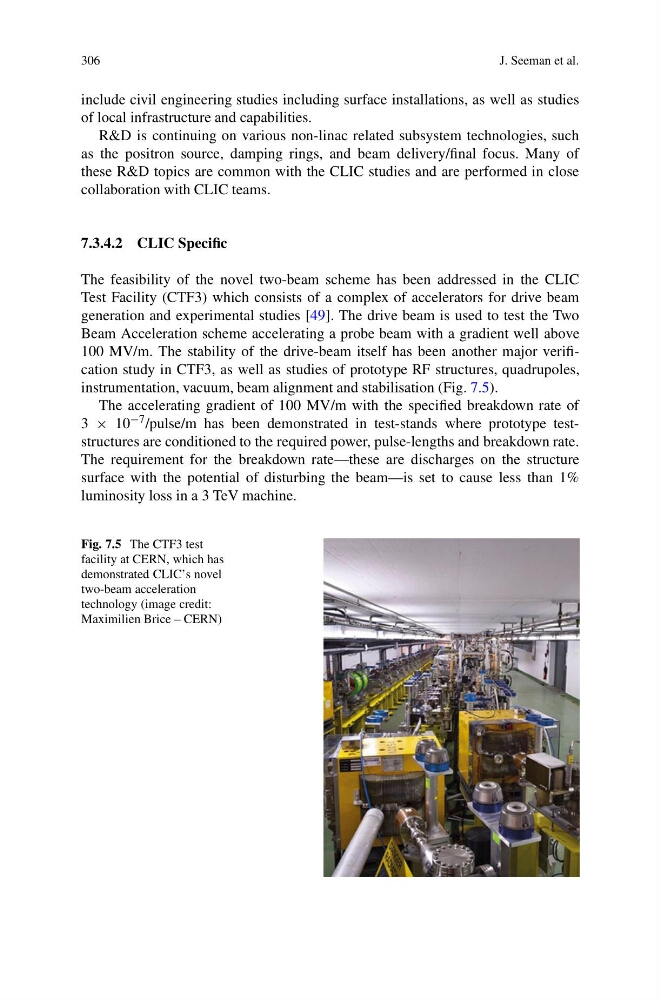
instrumentation, vacuum, beam alignment and stabilisation (Fig. 7.5).
The accelerating gradient of 100 MV/m with the specified breakdown rate of
3 × 10 −7 /pulse/m has been demonstrated in test-stands where prototype teststructures are conditioned to the required power, pulse-lengths and breakdown rate.
The requirement for the breakdown rate—these are discharges on the structure
surface with the potential of disturbing the beam—is set to cause less than 1%
luminosity loss in a 3 TeV machine.
Fig. 7.5 The CTF3 test
facility at CERN, which has
demonstrated CLIC’s novel
two-beam acceleration
technology (image credit:
Maximilien Brice – CERN)
J. Seeman et al.
include civil engineering studies including surface installations, as well as studies
of local infrastructure and capabilities.
R&D is continuing on various non-linac related subsystem technologies, such
as the positron source, damping rings, and beam delivery/final focus. Many of
these R&D topics are common with the CLIC studies and are performed in close
collaboration with CLIC teams.
7.3.4.2 CLIC Specific
The feasibility of the novel two-beam scheme has been addressed in the CLIC
Test Facility (CTF3) which consists of a complex of accelerators for drive beam
generation and experimental studies [49]. The drive beam is used to test the Two
Beam Acceleration scheme accelerating a probe beam with a gradient well above
100 MV/m. The stability of the drive-beam itself has been another major verification study in CTF3, as well as studies of prototype RF structures, quadrupoles,
instrumentation, vacuum, beam alignment and stabilisation (Fig. 7.5).
The accelerating gradient of 100 MV/m with the specified breakdown rate of
3 × 10 −7 /pulse/m has been demonstrated in test-stands where prototype teststructures are conditioned to the required power, pulse-lengths and breakdown rate.
The requirement for the breakdown rate—these are discharges on the structure
surface with the potential of disturbing the beam—is set to cause less than 1%
luminosity loss in a 3 TeV machine.
Fig. 7.5 The CTF3 test
facility at CERN, which has
demonstrated CLIC’s novel
two-beam acceleration
technology (image credit:
Maximilien Brice – CERN)