

20
E. Wilson and B. J. Holzer
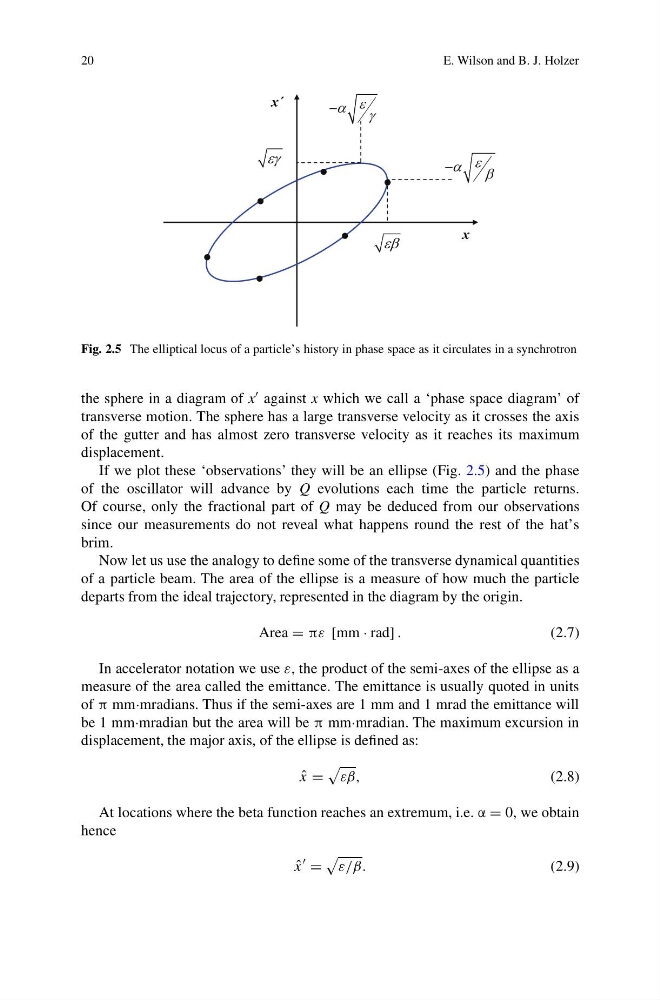
Fig. 2.5 The elliptical locus of a particle’s history in phase space as it circulates in a synchrotron
the sphere in a diagram of x against x which we call a ‘phase space diagram’ of
transverse motion. The sphere has a large transverse velocity as it crosses the axis
of the gutter and has almost zero transverse velocity as it reaches its maximum
displacement.
If we plot these ‘observations’ they will be an ellipse (Fig. 2.5) and the phase
of the oscillator will advance by Q evolutions each time the particle returns.
Of course, only the fractional part of Q may be deduced from our observations
since our measurements do not reveal what happens round the rest of the hat’s
brim.
Now let us use the analogy to define some of the transverse dynamical quantities
of a particle beam. The area of the ellipse is a measure of how much the particle
departs from the ideal trajectory, represented in the diagram by the origin.
Area = πε [mm · rad] .
(2.7)
In accelerator notation we use ε, the product of the semi-axes of the ellipse as a
measure of the area called the emittance. The emittance is usually quoted in units
of π mm·mradians. Thus if the semi-axes are 1 mm and 1 mrad the emittance will
be 1 mm·mradian but the area will be π mm·mradian. The maximum excursion in
displacement, the major axis, of the ellipse is defined as:
ˆ
x =
εβ,
(2.8)
At locations where the beta function reaches an extremum, i.e. α = 0, we obtain
hence
ˆ
x
=
ε/β.
(2.9)
E. Wilson and B. J. Holzer
Fig. 2.5 The elliptical locus of a particle’s history in phase space as it circulates in a synchrotron
the sphere in a diagram of x against x which we call a ‘phase space diagram’ of
transverse motion. The sphere has a large transverse velocity as it crosses the axis
of the gutter and has almost zero transverse velocity as it reaches its maximum
displacement.
If we plot these ‘observations’ they will be an ellipse (Fig. 2.5) and the phase
of the oscillator will advance by Q evolutions each time the particle returns.
Of course, only the fractional part of Q may be deduced from our observations
since our measurements do not reveal what happens round the rest of the hat’s
brim.
Now let us use the analogy to define some of the transverse dynamical quantities
of a particle beam. The area of the ellipse is a measure of how much the particle
departs from the ideal trajectory, represented in the diagram by the origin.
Area = πε [mm · rad] .
(2.7)
In accelerator notation we use ε, the product of the semi-axes of the ellipse as a
measure of the area called the emittance. The emittance is usually quoted in units
of π mm·mradians. Thus if the semi-axes are 1 mm and 1 mrad the emittance will
be 1 mm·mradian but the area will be π mm·mradian. The maximum excursion in
displacement, the major axis, of the ellipse is defined as:
ˆ
x =
εβ,
(2.8)
At locations where the beta function reaches an extremum, i.e. α = 0, we obtain
hence
ˆ
x
=
ε/β.
(2.9)