

2 Beam Dynamics
19
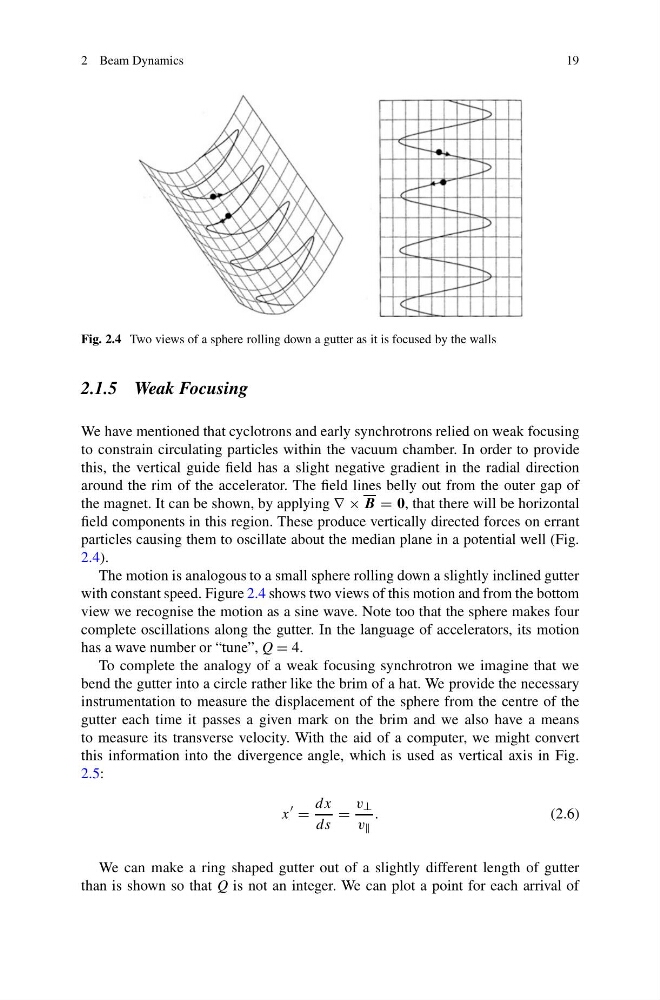
Fig. 2.4 Two views of a sphere rolling down a gutter as it is focused by the walls
2.1.5 Weak Focusing
We have mentioned that cyclotrons and early synchrotrons relied on weak focusing
to constrain circulating particles within the vacuum chamber. In order to provide
this, the vertical guide field has a slight negative gradient in the radial direction
around the rim of the accelerator. The field lines belly out from the outer gap of
the magnet. It can be shown, by applying ∇ × B = 0, that there will be horizontal
field components in this region. These produce vertically directed forces on errant
particles causing them to oscillate about the median plane in a potential well (Fig.
2.4).
The motion is analogous to a small sphere rolling down a slightly inclined gutter
with constant speed. Figure 2.4 shows two views of this motion and from the bottom
view we recognise the motion as a sine wave. Note too that the sphere makes four
complete oscillations along the gutter. In the language of accelerators, its motion
has a wave number or “tune”, Q = 4.
To complete the analogy of a weak focusing synchrotron we imagine that we
bend the gutter into a circle rather like the brim of a hat. We provide the necessary
instrumentation to measure the displacement of the sphere from the centre of the
gutter each time it passes a given mark on the brim and we also have a means
to measure its transverse velocity. With the aid of a computer, we might convert
this information into the divergence angle, which is used as vertical axis in Fig.
2.5:
x
=
dx
ds
=
v ⊥
v
.
(2.6)
We can make a ring shaped gutter out of a slightly different length of gutter
than is shown so that Q is not an integer. We can plot a point for each arrival of
19
Fig. 2.4 Two views of a sphere rolling down a gutter as it is focused by the walls
2.1.5 Weak Focusing
We have mentioned that cyclotrons and early synchrotrons relied on weak focusing
to constrain circulating particles within the vacuum chamber. In order to provide
this, the vertical guide field has a slight negative gradient in the radial direction
around the rim of the accelerator. The field lines belly out from the outer gap of
the magnet. It can be shown, by applying ∇ × B = 0, that there will be horizontal
field components in this region. These produce vertically directed forces on errant
particles causing them to oscillate about the median plane in a potential well (Fig.
2.4).
The motion is analogous to a small sphere rolling down a slightly inclined gutter
with constant speed. Figure 2.4 shows two views of this motion and from the bottom
view we recognise the motion as a sine wave. Note too that the sphere makes four
complete oscillations along the gutter. In the language of accelerators, its motion
has a wave number or “tune”, Q = 4.
To complete the analogy of a weak focusing synchrotron we imagine that we
bend the gutter into a circle rather like the brim of a hat. We provide the necessary
instrumentation to measure the displacement of the sphere from the centre of the
gutter each time it passes a given mark on the brim and we also have a means
to measure its transverse velocity. With the aid of a computer, we might convert
this information into the divergence angle, which is used as vertical axis in Fig.
2.5:
x
=
dx
ds
=
v ⊥
v
.
(2.6)
We can make a ring shaped gutter out of a slightly different length of gutter
than is shown so that Q is not an integer. We can plot a point for each arrival of