

280
B. J. Holzer et al.
predicted in this model: τ ∝ β 4 γ 5 , with all other parameters (including the electron
current density j) kept constant [159].
Neglected in the simple theory are the ‘flattened distribution’, the ‘magnetisation’
and the ‘electron space-charge’ effects, all three (also) discovered and explained
at Novosibirsk [159, 160]. In essence the flattened distribution effect takes into
account that (due to the acceleration) the electron velocity spread is not isotropic but
contracted (by [E cathode /E final ] 1/2 ) in the longitudinal direction. The magnetisation
effect is due to the spiraling (Larmor-) motion of the electrons in the magnetic
field of the solenoid that is used to guide the electron beam. Then for electronion encounters with long ‘collision times’ (impact parameter Larmor radius),
the transverse electron velocity spread averages to zero. Finally the electron spacecharge induces a potential that leads to a parabolic velocity profile v(r) over the
beam whereas the ions exhibit a linear dependence v(x) and v(y) given by the storage
ring lattice. Hence the difficulty arises to match the ion and electron velocities.
Flattening and magnetisation can have a beneficial outcome, whereas space-charge
has a hampering influence on the cooling process. All three effects complicate the
theory, spoil the hope for simple analytical formulae and obscure the comparison
between measurements at different machines, and even different situations at the
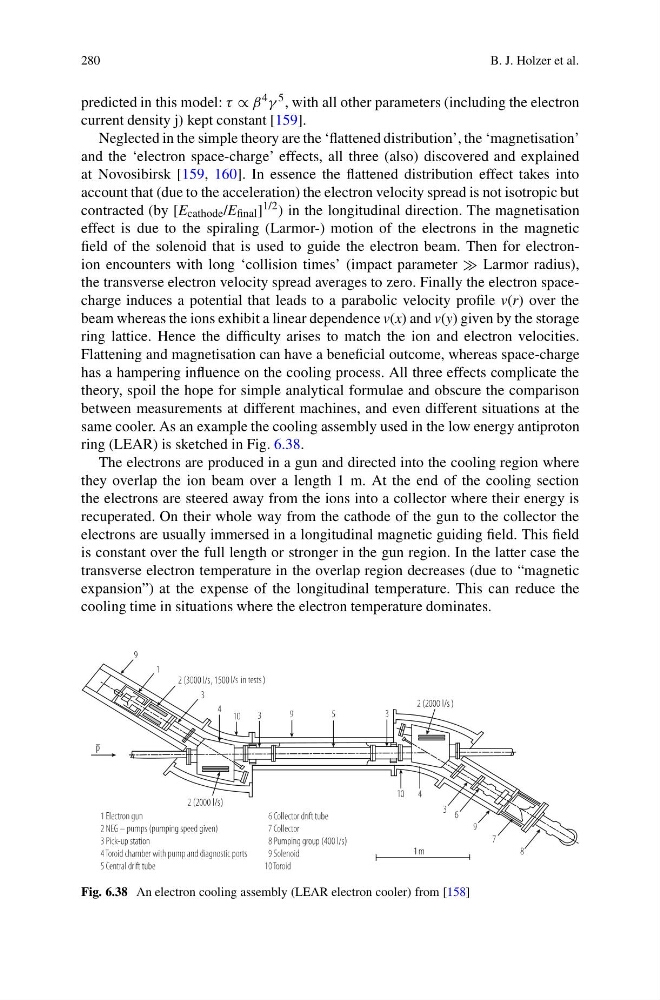
same cooler. As an example the cooling assembly used in the low energy antiproton
ring (LEAR) is sketched in Fig. 6.38.
The electrons are produced in a gun and directed into the cooling region where
they overlap the ion beam over a length 1 m. At the end of the cooling section
the electrons are steered away from the ions into a collector where their energy is
recuperated. On their whole way from the cathode of the gun to the collector the
electrons are usually immersed in a longitudinal magnetic guiding field. This field
is constant over the full length or stronger in the gun region. In the latter case the
transverse electron temperature in the overlap region decreases (due to “magnetic
expansion”) at the expense of the longitudinal temperature. This can reduce the
cooling time in situations where the electron temperature dominates.
Fig. 6.38 An electron cooling assembly (LEAR electron cooler) from [158]
B. J. Holzer et al.
predicted in this model: τ ∝ β 4 γ 5 , with all other parameters (including the electron
current density j) kept constant [159].
Neglected in the simple theory are the ‘flattened distribution’, the ‘magnetisation’
and the ‘electron space-charge’ effects, all three (also) discovered and explained
at Novosibirsk [159, 160]. In essence the flattened distribution effect takes into
account that (due to the acceleration) the electron velocity spread is not isotropic but
contracted (by [E cathode /E final ] 1/2 ) in the longitudinal direction. The magnetisation
effect is due to the spiraling (Larmor-) motion of the electrons in the magnetic
field of the solenoid that is used to guide the electron beam. Then for electronion encounters with long ‘collision times’ (impact parameter Larmor radius),
the transverse electron velocity spread averages to zero. Finally the electron spacecharge induces a potential that leads to a parabolic velocity profile v(r) over the
beam whereas the ions exhibit a linear dependence v(x) and v(y) given by the storage
ring lattice. Hence the difficulty arises to match the ion and electron velocities.
Flattening and magnetisation can have a beneficial outcome, whereas space-charge
has a hampering influence on the cooling process. All three effects complicate the
theory, spoil the hope for simple analytical formulae and obscure the comparison
between measurements at different machines, and even different situations at the
same cooler. As an example the cooling assembly used in the low energy antiproton
ring (LEAR) is sketched in Fig. 6.38.
The electrons are produced in a gun and directed into the cooling region where
they overlap the ion beam over a length 1 m. At the end of the cooling section
the electrons are steered away from the ions into a collector where their energy is
recuperated. On their whole way from the cathode of the gun to the collector the
electrons are usually immersed in a longitudinal magnetic guiding field. This field
is constant over the full length or stronger in the gun region. In the latter case the
transverse electron temperature in the overlap region decreases (due to “magnetic
expansion”) at the expense of the longitudinal temperature. This can reduce the
cooling time in situations where the electron temperature dominates.
Fig. 6.38 An electron cooling assembly (LEAR electron cooler) from [158]