

6 Design and Principles of Synchrotrons and Circular Colliders
279
6.10.2.3 Electron Cooling
The concept of cooling a “hot” beam of ions by mixing it over a short distance in
a circular machine with a cold electron beam had been developed by Budker [156]
in 1966. It was first tested in 1974 with 68 MeV protons at the NAP-M storage
ring at in Novosibirsk. The notions of ‘beam temperature’ and ‘beam cooling’ were
introduced and become lucid in the context of electron cooling, which is readily
viewed as temperature relaxation in the mixture of a hot ion beam with a comoving cold electron ‘fluid’. The equilibrium emittances, obtainable when other
‘heating mechanisms’ are negligible, can easily be estimated from this analogy,
assuming equalisation of the temperatures ((M 2 )/ ion → (m 2 )/ electron ). For a
simple estimate of the cooling time, another resemblance, namely the analogy with
slowing down of swift particles in matter, can be helpful. A nice presentation of
this subject is given in Jackson’s book [157]: the energy loss in matter is due to
the interaction with the shell electrons and in first approximation these electrons are
regarded as free rather than bound. Results for this case can be directly applied to the
‘stopping of the heavy particles in the co-moving electron plasma’. The calculations
are performed assuming ‘binary collisions’ involving only one ion and one electron
at a time.
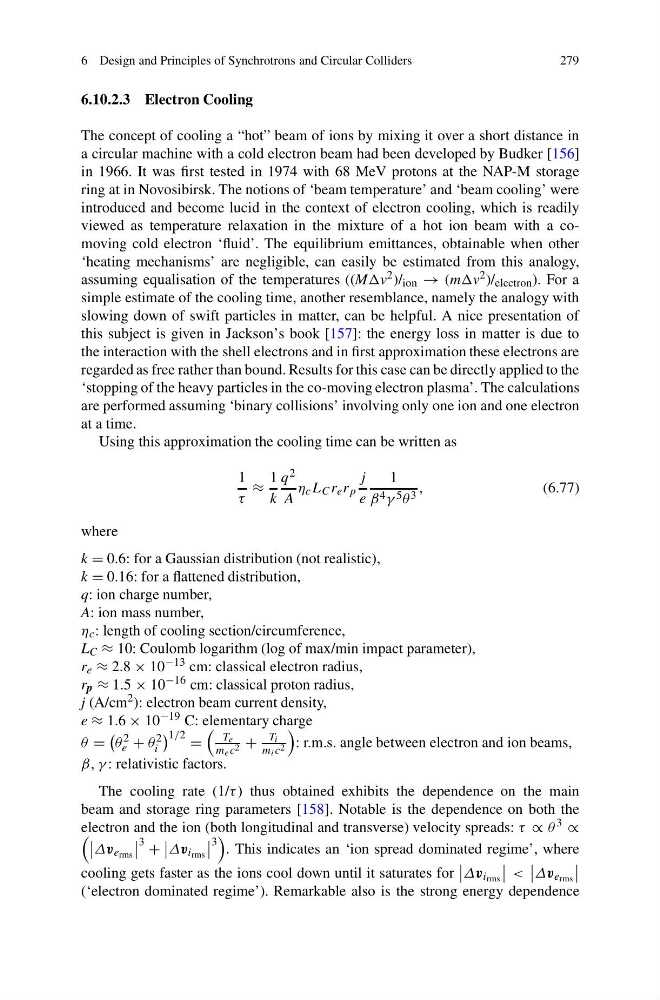
Using this approximation the cooling time can be written as
1
τ
≈
1
k
q 2
A
η c L C r e r p
j
e
1
β 4 γ 5 θ 3 ,
(6.77)
where
k = 0.6: for a Gaussian distribution (not realistic),
k = 0.16: for a flattened distribution,
q: ion charge number,
A: ion mass number,
η c : length of cooling section/circumference,
L C ≈ 10: Coulomb logarithm (log of max/min impact parameter),
r e ≈ 2.8 × 10 −13 cm: classical electron radius,
r p ≈ 1.5 × 10 −16 cm: classical proton radius,
j (A/cm 2 ): electron beam current density,
e ≈ 1.6 × 10 −19 C: elementary charge
θ =
θ 2
e + θ 2
i
1/2 =
T e
m e c 2 +
T i
m i c 2
: r.m.s. angle between electron and ion beams,
β, γ : relativistic factors.
The cooling rate (1/τ ) thus obtained exhibits the dependence on the main
beam and storage ring parameters [158]. Notable is the dependence on both the
electron and the ion (both longitudinal and transverse) velocity spreads: τ ∝ θ 3 ∝
Δv e rms
3 +
Δv i rms
3
. This indicates an ‘ion spread dominated regime’, where
cooling gets faster as the ions cool down until it saturates for
Δv i rms
<
Δv e rms
(‘electron dominated regime’). Remarkable also is the strong energy dependence
279
6.10.2.3 Electron Cooling
The concept of cooling a “hot” beam of ions by mixing it over a short distance in
a circular machine with a cold electron beam had been developed by Budker [156]
in 1966. It was first tested in 1974 with 68 MeV protons at the NAP-M storage
ring at in Novosibirsk. The notions of ‘beam temperature’ and ‘beam cooling’ were
introduced and become lucid in the context of electron cooling, which is readily
viewed as temperature relaxation in the mixture of a hot ion beam with a comoving cold electron ‘fluid’. The equilibrium emittances, obtainable when other
‘heating mechanisms’ are negligible, can easily be estimated from this analogy,
assuming equalisation of the temperatures ((M 2 )/ ion → (m 2 )/ electron ). For a
simple estimate of the cooling time, another resemblance, namely the analogy with
slowing down of swift particles in matter, can be helpful. A nice presentation of
this subject is given in Jackson’s book [157]: the energy loss in matter is due to
the interaction with the shell electrons and in first approximation these electrons are
regarded as free rather than bound. Results for this case can be directly applied to the
‘stopping of the heavy particles in the co-moving electron plasma’. The calculations
are performed assuming ‘binary collisions’ involving only one ion and one electron
at a time.
Using this approximation the cooling time can be written as
1
τ
≈
1
k
q 2
A
η c L C r e r p
j
e
1
β 4 γ 5 θ 3 ,
(6.77)
where
k = 0.6: for a Gaussian distribution (not realistic),
k = 0.16: for a flattened distribution,
q: ion charge number,
A: ion mass number,
η c : length of cooling section/circumference,
L C ≈ 10: Coulomb logarithm (log of max/min impact parameter),
r e ≈ 2.8 × 10 −13 cm: classical electron radius,
r p ≈ 1.5 × 10 −16 cm: classical proton radius,
j (A/cm 2 ): electron beam current density,
e ≈ 1.6 × 10 −19 C: elementary charge
θ =
θ 2
e + θ 2
i
1/2 =
T e
m e c 2 +
T i
m i c 2
: r.m.s. angle between electron and ion beams,
β, γ : relativistic factors.
The cooling rate (1/τ ) thus obtained exhibits the dependence on the main
beam and storage ring parameters [158]. Notable is the dependence on both the
electron and the ion (both longitudinal and transverse) velocity spreads: τ ∝ θ 3 ∝
Δv e rms
3 +
Δv i rms
3
. This indicates an ‘ion spread dominated regime’, where
cooling gets faster as the ions cool down until it saturates for
Δv i rms
<
Δv e rms
(‘electron dominated regime’). Remarkable also is the strong energy dependence