

2 Beam Dynamics
17
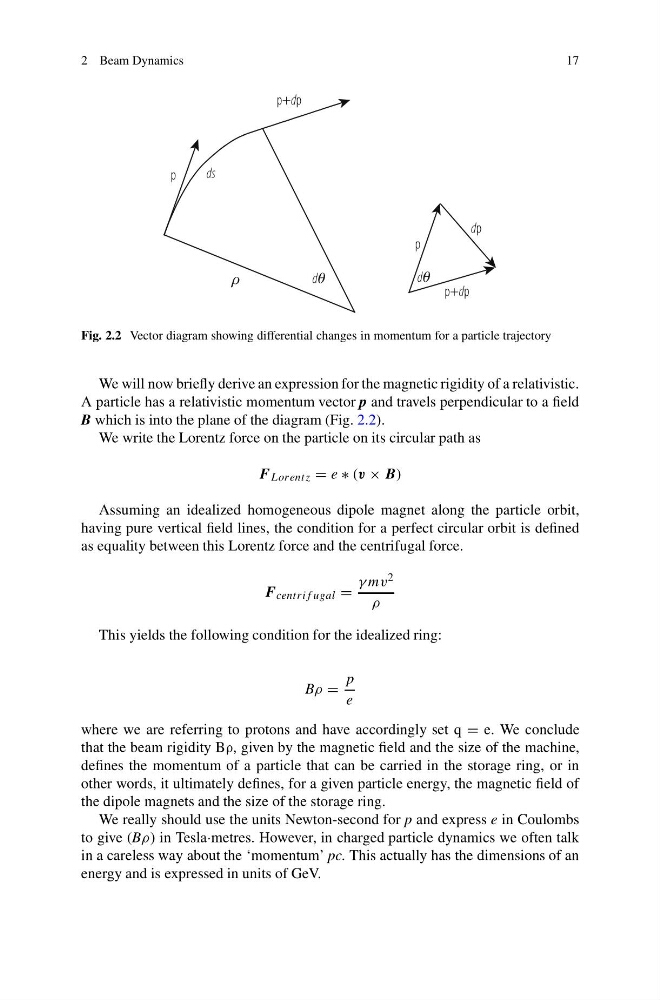
Fig. 2.2 Vector diagram showing differential changes in momentum for a particle trajectory
We will now briefly derive an expression for the magnetic rigidity of a relativistic.
A particle has a relativistic momentum vector p and travels perpendicular to a field
B which is into the plane of the diagram (Fig. 2.2).
We write the Lorentz force on the particle on its circular path as
F Lorent z = e ∗ (v × B)
Assuming an idealized homogeneous dipole magnet along the particle orbit,
having pure vertical field lines, the condition for a perfect circular orbit is defined
as equality between this Lorentz force and the centrifugal force.
F cent rif ugal =
γ mv 2
ρ
This yields the following condition for the idealized ring:
Bρ =
p
e
where we are referring to protons and have accordingly set q = e. We conclude
that the beam rigidity Bρ, given by the magnetic field and the size of the machine,
defines the momentum of a particle that can be carried in the storage ring, or in
other words, it ultimately defines, for a given particle energy, the magnetic field of
the dipole magnets and the size of the storage ring.
We really should use the units Newton-second for p and express e in Coulombs
to give (Bρ) in Tesla·metres. However, in charged particle dynamics we often talk
in a careless way about the ‘momentum’ pc. This actually has the dimensions of an
energy and is expressed in units of GeV.
17
Fig. 2.2 Vector diagram showing differential changes in momentum for a particle trajectory
We will now briefly derive an expression for the magnetic rigidity of a relativistic.
A particle has a relativistic momentum vector p and travels perpendicular to a field
B which is into the plane of the diagram (Fig. 2.2).
We write the Lorentz force on the particle on its circular path as
F Lorent z = e ∗ (v × B)
Assuming an idealized homogeneous dipole magnet along the particle orbit,
having pure vertical field lines, the condition for a perfect circular orbit is defined
as equality between this Lorentz force and the centrifugal force.
F cent rif ugal =
γ mv 2
ρ
This yields the following condition for the idealized ring:
Bρ =
p
e
where we are referring to protons and have accordingly set q = e. We conclude
that the beam rigidity Bρ, given by the magnetic field and the size of the machine,
defines the momentum of a particle that can be carried in the storage ring, or in
other words, it ultimately defines, for a given particle energy, the magnetic field of
the dipole magnets and the size of the storage ring.
We really should use the units Newton-second for p and express e in Coulombs
to give (Bρ) in Tesla·metres. However, in charged particle dynamics we often talk
in a careless way about the ‘momentum’ pc. This actually has the dimensions of an
energy and is expressed in units of GeV.