

260
B. J. Holzer et al.
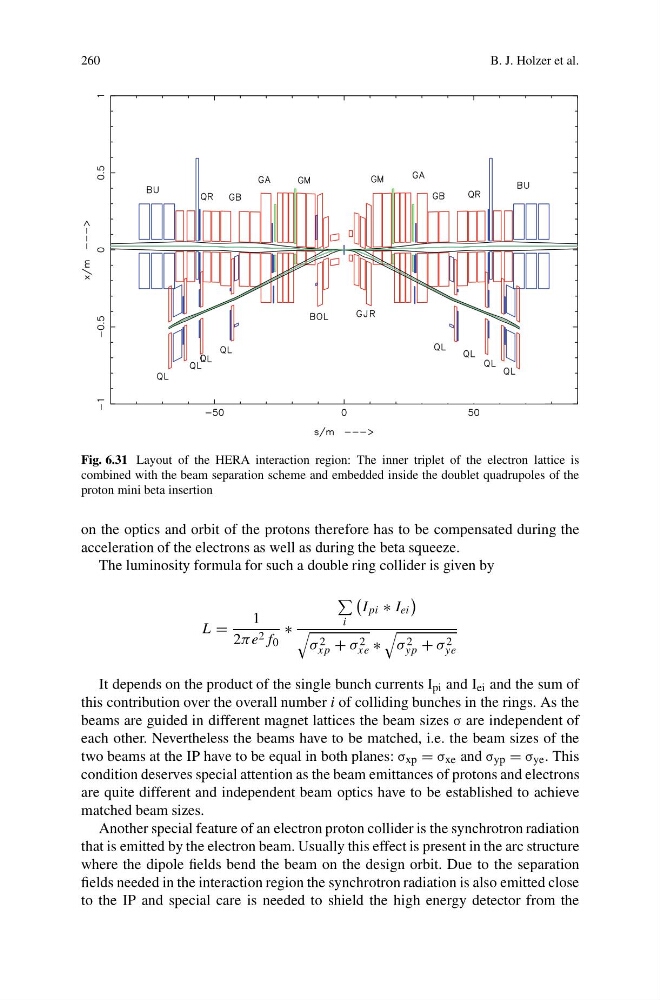
Fig. 6.31 Layout of the HERA interaction region: The inner triplet of the electron lattice is
combined with the beam separation scheme and embedded inside the doublet quadrupoles of the
proton mini beta insertion
on the optics and orbit of the protons therefore has to be compensated during the
acceleration of the electrons as well as during the beta squeeze.
The luminosity formula for such a double ring collider is given by
L =
1
2πe 2 f 0
∗
i
I pi ∗ I ei
σ 2
xp + σ 2
xe ∗
σ 2
yp + σ 2
ye
It depends on the product of the single bunch currents I pi and I ei and the sum of
this contribution over the overall number i of colliding bunches in the rings. As the
beams are guided in different magnet lattices the beam sizes σ are independent of
each other. Nevertheless the beams have to be matched, i.e. the beam sizes of the
two beams at the IP have to be equal in both planes: σ xp = σ xe and σ yp = σ ye . This
condition deserves special attention as the beam emittances of protons and electrons
are quite different and independent beam optics have to be established to achieve
matched beam sizes.
Another special feature of an electron proton collider is the synchrotron radiation
that is emitted by the electron beam. Usually this effect is present in the arc structure
where the dipole fields bend the beam on the design orbit. Due to the separation
fields needed in the interaction region the synchrotron radiation is also emitted close
to the IP and special care is needed to shield the high energy detector from the
B. J. Holzer et al.
Fig. 6.31 Layout of the HERA interaction region: The inner triplet of the electron lattice is
combined with the beam separation scheme and embedded inside the doublet quadrupoles of the
proton mini beta insertion
on the optics and orbit of the protons therefore has to be compensated during the
acceleration of the electrons as well as during the beta squeeze.
The luminosity formula for such a double ring collider is given by
L =
1
2πe 2 f 0
∗
i
I pi ∗ I ei
σ 2
xp + σ 2
xe ∗
σ 2
yp + σ 2
ye
It depends on the product of the single bunch currents I pi and I ei and the sum of
this contribution over the overall number i of colliding bunches in the rings. As the
beams are guided in different magnet lattices the beam sizes σ are independent of
each other. Nevertheless the beams have to be matched, i.e. the beam sizes of the
two beams at the IP have to be equal in both planes: σ xp = σ xe and σ yp = σ ye . This
condition deserves special attention as the beam emittances of protons and electrons
are quite different and independent beam optics have to be established to achieve
matched beam sizes.
Another special feature of an electron proton collider is the synchrotron radiation
that is emitted by the electron beam. Usually this effect is present in the arc structure
where the dipole fields bend the beam on the design orbit. Due to the separation
fields needed in the interaction region the synchrotron radiation is also emitted close
to the IP and special care is needed to shield the high energy detector from the