

256
B. J. Holzer et al.
of the collider. Moreover beam-beam simulations showed that beam tails are very
much reduced and the beam-beam blow-up is also suppressed.
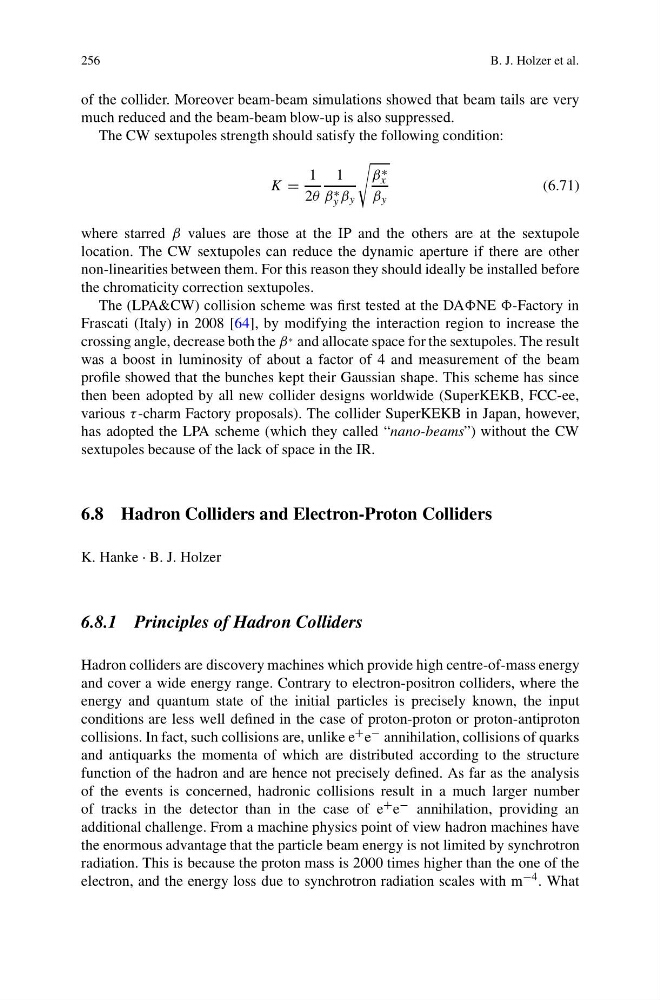
The CW sextupoles strength should satisfy the following condition:
K =
1
2θ
1
β ∗
y β y
β ∗
x
β y
(6.71)
where starred β values are those at the IP and the others are at the sextupole
location. The CW sextupoles can reduce the dynamic aperture if there are other
non-linearities between them. For this reason they should ideally be installed before
the chromaticity correction sextupoles.
The (LPA&CW) collision scheme was first tested at the DANE -Factory in
Frascati (Italy) in 2008 [64], by modifying the interaction region to increase the
crossing angle, decrease both the β ∗ and allocate space for the sextupoles. The result
was a boost in luminosity of about a factor of 4 and measurement of the beam
profile showed that the bunches kept their Gaussian shape. This scheme has since
then been adopted by all new collider designs worldwide (SuperKEKB, FCC-ee,
various τ -charm Factory proposals). The collider SuperKEKB in Japan, however,
has adopted the LPA scheme (which they called “nano-beams”) without the CW
sextupoles because of the lack of space in the IR.
6.8 Hadron Colliders and Electron-Proton Colliders
K. Hanke · B. J. Holzer
6.8.1 Principles of Hadron Colliders
Hadron colliders are discovery machines which provide high centre-of-mass energy
and cover a wide energy range. Contrary to electron-positron colliders, where the
energy and quantum state of the initial particles is precisely known, the input
conditions are less well defined in the case of proton-proton or proton-antiproton
collisions. In fact, such collisions are, unlike e + e − annihilation, collisions of quarks
and antiquarks the momenta of which are distributed according to the structure
function of the hadron and are hence not precisely defined. As far as the analysis
of the events is concerned, hadronic collisions result in a much larger number
of tracks in the detector than in the case of e + e − annihilation, providing an
additional challenge. From a machine physics point of view hadron machines have
the enormous advantage that the particle beam energy is not limited by synchrotron
radiation. This is because the proton mass is 2000 times higher than the one of the
electron, and the energy loss due to synchrotron radiation scales with m −4 . What
B. J. Holzer et al.
of the collider. Moreover beam-beam simulations showed that beam tails are very
much reduced and the beam-beam blow-up is also suppressed.
The CW sextupoles strength should satisfy the following condition:
K =
1
2θ
1
β ∗
y β y
β ∗
x
β y
(6.71)
where starred β values are those at the IP and the others are at the sextupole
location. The CW sextupoles can reduce the dynamic aperture if there are other
non-linearities between them. For this reason they should ideally be installed before
the chromaticity correction sextupoles.
The (LPA&CW) collision scheme was first tested at the DANE -Factory in
Frascati (Italy) in 2008 [64], by modifying the interaction region to increase the
crossing angle, decrease both the β ∗ and allocate space for the sextupoles. The result
was a boost in luminosity of about a factor of 4 and measurement of the beam
profile showed that the bunches kept their Gaussian shape. This scheme has since
then been adopted by all new collider designs worldwide (SuperKEKB, FCC-ee,
various τ -charm Factory proposals). The collider SuperKEKB in Japan, however,
has adopted the LPA scheme (which they called “nano-beams”) without the CW
sextupoles because of the lack of space in the IR.
6.8 Hadron Colliders and Electron-Proton Colliders
K. Hanke · B. J. Holzer
6.8.1 Principles of Hadron Colliders
Hadron colliders are discovery machines which provide high centre-of-mass energy
and cover a wide energy range. Contrary to electron-positron colliders, where the
energy and quantum state of the initial particles is precisely known, the input
conditions are less well defined in the case of proton-proton or proton-antiproton
collisions. In fact, such collisions are, unlike e + e − annihilation, collisions of quarks
and antiquarks the momenta of which are distributed according to the structure
function of the hadron and are hence not precisely defined. As far as the analysis
of the events is concerned, hadronic collisions result in a much larger number
of tracks in the detector than in the case of e + e − annihilation, providing an
additional challenge. From a machine physics point of view hadron machines have
the enormous advantage that the particle beam energy is not limited by synchrotron
radiation. This is because the proton mass is 2000 times higher than the one of the
electron, and the energy loss due to synchrotron radiation scales with m −4 . What