

254
B. J. Holzer et al.
ξ y ∝
N
2θσ z
β ∗
y / y
(6.66)
ξ x ∝
N
(2θσ z )
2
(6.67)
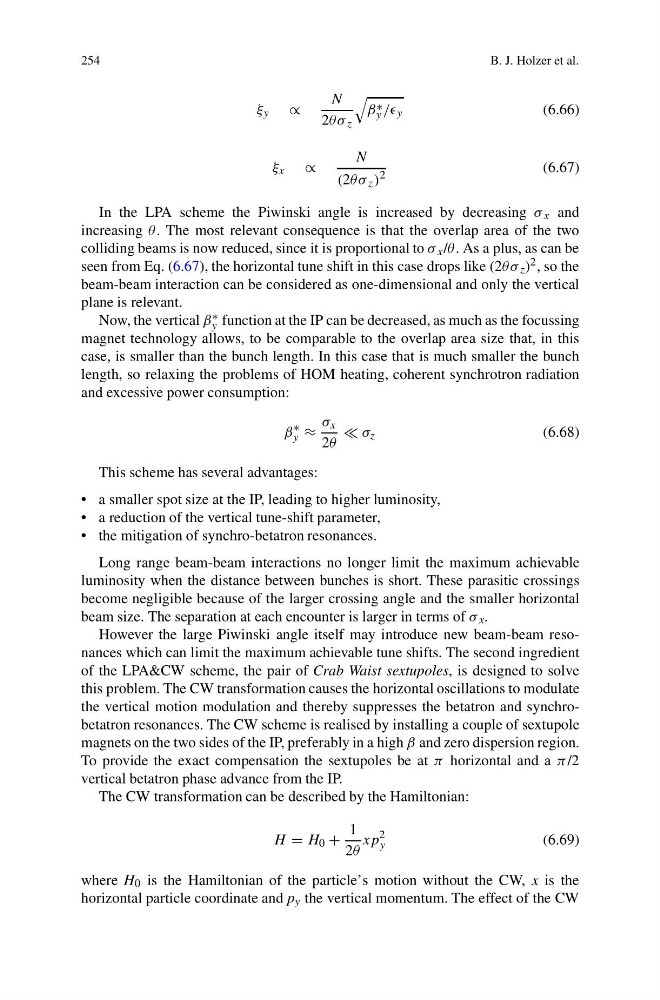
In the LPA scheme the Piwinski angle is increased by decreasing σ x and
increasing θ . The most relevant consequence is that the overlap area of the two
colliding beams is now reduced, since it is proportional to σ x /θ . As a plus, as can be
seen from Eq. (6.67), the horizontal tune shift in this case drops like (2θσ z ) 2 , so the
beam-beam interaction can be considered as one-dimensional and only the vertical
plane is relevant.
Now, the vertical β ∗
y function at the IP can be decreased, as much as the focussing
magnet technology allows, to be comparable to the overlap area size that, in this
case, is smaller than the bunch length. In this case that is much smaller the bunch
length, so relaxing the problems of HOM heating, coherent synchrotron radiation
and excessive power consumption:
β
∗
y ≈
σ x
2θ
σ z
(6.68)
This scheme has several advantages:
• a smaller spot size at the IP, leading to higher luminosity,
• a reduction of the vertical tune-shift parameter,
• the mitigation of synchro-betatron resonances.
Long range beam-beam interactions no longer limit the maximum achievable
luminosity when the distance between bunches is short. These parasitic crossings
become negligible because of the larger crossing angle and the smaller horizontal
beam size. The separation at each encounter is larger in terms of σ x .
However the large Piwinski angle itself may introduce new beam-beam resonances which can limit the maximum achievable tune shifts. The second ingredient
of the LPA&CW scheme, the pair of Crab Waist sextupoles, is designed to solve
this problem. The CW transformation causes the horizontal oscillations to modulate
the vertical motion modulation and thereby suppresses the betatron and synchrobetatron resonances. The CW scheme is realised by installing a couple of sextupole
magnets on the two sides of the IP, preferably in a high β and zero dispersion region.
To provide the exact compensation the sextupoles be at π horizontal and a π/2
vertical betatron phase advance from the IP.
The CW transformation can be described by the Hamiltonian:
H = H 0 +
1
2θ
xp
2
y
(6.69)
where H 0 is the Hamiltonian of the particle’s motion without the CW, x is the
horizontal particle coordinate and p y the vertical momentum. The effect of the CW
B. J. Holzer et al.
ξ y ∝
N
2θσ z
β ∗
y / y
(6.66)
ξ x ∝
N
(2θσ z )
2
(6.67)
In the LPA scheme the Piwinski angle is increased by decreasing σ x and
increasing θ . The most relevant consequence is that the overlap area of the two
colliding beams is now reduced, since it is proportional to σ x /θ . As a plus, as can be
seen from Eq. (6.67), the horizontal tune shift in this case drops like (2θσ z ) 2 , so the
beam-beam interaction can be considered as one-dimensional and only the vertical
plane is relevant.
Now, the vertical β ∗
y function at the IP can be decreased, as much as the focussing
magnet technology allows, to be comparable to the overlap area size that, in this
case, is smaller than the bunch length. In this case that is much smaller the bunch
length, so relaxing the problems of HOM heating, coherent synchrotron radiation
and excessive power consumption:
β
∗
y ≈
σ x
2θ
σ z
(6.68)
This scheme has several advantages:
• a smaller spot size at the IP, leading to higher luminosity,
• a reduction of the vertical tune-shift parameter,
• the mitigation of synchro-betatron resonances.
Long range beam-beam interactions no longer limit the maximum achievable
luminosity when the distance between bunches is short. These parasitic crossings
become negligible because of the larger crossing angle and the smaller horizontal
beam size. The separation at each encounter is larger in terms of σ x .
However the large Piwinski angle itself may introduce new beam-beam resonances which can limit the maximum achievable tune shifts. The second ingredient
of the LPA&CW scheme, the pair of Crab Waist sextupoles, is designed to solve
this problem. The CW transformation causes the horizontal oscillations to modulate
the vertical motion modulation and thereby suppresses the betatron and synchrobetatron resonances. The CW scheme is realised by installing a couple of sextupole
magnets on the two sides of the IP, preferably in a high β and zero dispersion region.
To provide the exact compensation the sextupoles be at π horizontal and a π/2
vertical betatron phase advance from the IP.
The CW transformation can be described by the Hamiltonian:
H = H 0 +
1
2θ
xp
2
y
(6.69)
where H 0 is the Hamiltonian of the particle’s motion without the CW, x is the
horizontal particle coordinate and p y the vertical momentum. The effect of the CW