

250
B. J. Holzer et al.
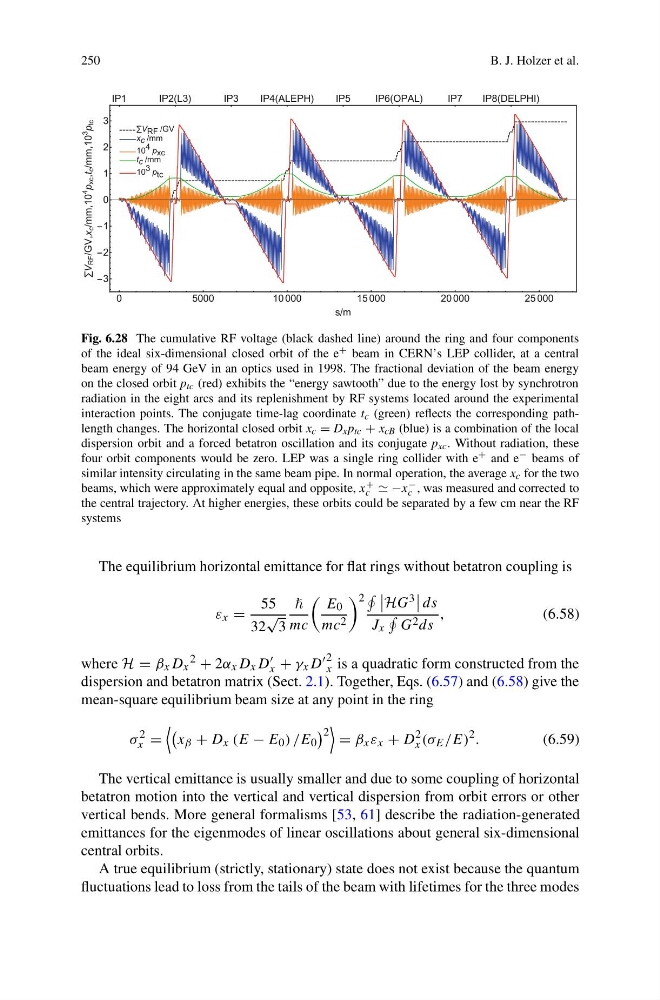
Fig. 6.28 The cumulative RF voltage (black dashed line) around the ring and four components
of the ideal six-dimensional closed orbit of the e + beam in CERN’s LEP collider, at a central
beam energy of 94 GeV in an optics used in 1998. The fractional deviation of the beam energy
on the closed orbit p tc (red) exhibits the “energy sawtooth” due to the energy lost by synchrotron
radiation in the eight arcs and its replenishment by RF systems located around the experimental
interaction points. The conjugate time-lag coordinate t c (green) reflects the corresponding pathlength changes. The horizontal closed orbit x c = D x p tc + x cB (blue) is a combination of the local
dispersion orbit and a forced betatron oscillation and its conjugate p xc . Without radiation, these
four orbit components would be zero. LEP was a single ring collider with e + and e − beams of
similar intensity circulating in the same beam pipe. In normal operation, the average x c for the two
beams, which were approximately equal and opposite, x +
c −x −
c , was measured and corrected to
the central trajectory. At higher energies, these orbits could be separated by a few cm near the RF
systems
The equilibrium horizontal emittance for flat rings without betatron coupling is
ε x =
55
32
√
3
mc
E 0
mc 2
2
HG 3
ds
J x
G 2 ds
,
(6.58)
where H = β x D x
2
+ 2α x D x D
x + γ x D 2
x is a quadratic form constructed from the
dispersion and betatron matrix (Sect. 2.1). Together, Eqs. (6.57) and (6.58) give the
mean-square equilibrium beam size at any point in the ring
σ
2
x =
x β + D x (E − E 0 ) /E 0
2
= β x ε x + D
2
x (σ E /E)
2 .
(6.59)
The vertical emittance is usually smaller and due to some coupling of horizontal
betatron motion into the vertical and vertical dispersion from orbit errors or other
vertical bends. More general formalisms [53, 61] describe the radiation-generated
emittances for the eigenmodes of linear oscillations about general six-dimensional
central orbits.
A true equilibrium (strictly, stationary) state does not exist because the quantum
fluctuations lead to loss from the tails of the beam with lifetimes for the three modes
B. J. Holzer et al.
Fig. 6.28 The cumulative RF voltage (black dashed line) around the ring and four components
of the ideal six-dimensional closed orbit of the e + beam in CERN’s LEP collider, at a central
beam energy of 94 GeV in an optics used in 1998. The fractional deviation of the beam energy
on the closed orbit p tc (red) exhibits the “energy sawtooth” due to the energy lost by synchrotron
radiation in the eight arcs and its replenishment by RF systems located around the experimental
interaction points. The conjugate time-lag coordinate t c (green) reflects the corresponding pathlength changes. The horizontal closed orbit x c = D x p tc + x cB (blue) is a combination of the local
dispersion orbit and a forced betatron oscillation and its conjugate p xc . Without radiation, these
four orbit components would be zero. LEP was a single ring collider with e + and e − beams of
similar intensity circulating in the same beam pipe. In normal operation, the average x c for the two
beams, which were approximately equal and opposite, x +
c −x −
c , was measured and corrected to
the central trajectory. At higher energies, these orbits could be separated by a few cm near the RF
systems
The equilibrium horizontal emittance for flat rings without betatron coupling is
ε x =
55
32
√
3
mc
E 0
mc 2
2
HG 3
ds
J x
G 2 ds
,
(6.58)
where H = β x D x
2
+ 2α x D x D
x + γ x D 2
x is a quadratic form constructed from the
dispersion and betatron matrix (Sect. 2.1). Together, Eqs. (6.57) and (6.58) give the
mean-square equilibrium beam size at any point in the ring
σ
2
x =
x β + D x (E − E 0 ) /E 0
2
= β x ε x + D
2
x (σ E /E)
2 .
(6.59)
The vertical emittance is usually smaller and due to some coupling of horizontal
betatron motion into the vertical and vertical dispersion from orbit errors or other
vertical bends. More general formalisms [53, 61] describe the radiation-generated
emittances for the eigenmodes of linear oscillations about general six-dimensional
central orbits.
A true equilibrium (strictly, stationary) state does not exist because the quantum
fluctuations lead to loss from the tails of the beam with lifetimes for the three modes