

6 Design and Principles of Synchrotrons and Circular Colliders
249
curvature ρ(s). The orbits and optical functions (β x, y (s), dispersion D x, y (s), etc.,
Chap. 2) of such hypothetical, non-radiating particles are a construct useful in the
description of e ± dynamics. Real, radiating, e + of energy E =
p 2 c 2 + m 2 c 4
pc p 0 c can circulate in a phase-space neighbourhood of O xy provided RF cavities
of a proper frequency and sufficient voltage are added to compensate the average
radiative energy loss and provide longitudinal phase stability (e − can circulate in
the opposite direction). In a semi-classical picture [49, 53, 57, 58], e ± emit photons
at random times according to the classical synchrotron radiation spectrum [47,
48] and make stochastic transitions between betatron trajectories corresponding to
their instantaneous momenta. This picture can be understood [59] by recognising
that a storage ring differs from an atom in that changes, = n u/E, in orbital
quantum number, n, corresponding to typical photon emissions of energy u, satisfy
n 1.
There is no deterministic closed orbit but the full 6D central orbit, O xyz of a bunch
of many electrons normally coincides with the attractive stable orbit calculated by
averaging over photon emissions to include only the classical deterministic part
of the synchrotron radiation (this includes the stable phase with respect to the RF
system). If the domain of attraction of this orbit is large enough, the beam can have
a good lifetime (Eq. 6.60 below). Because of the energy variation round the ring
(localised RF cavities giving “energy-sawtooth”), the transverse projection of O xyz
does not coincide with O xy . Figure 6.28 shows an example.
Neglecting intensity-dependent phenomena, the equilibrium dimensions of the
beam are macroscopic quantum effects determined by the balance between radiation
damping (the dependence of the classical radiation lost in magnetic fields on the
energy, [49, 57, 58] and Sect. 6.5), and the quantum fluctuations (discrete photon
nature) of the synchrotron radiation [57, 58]. Generally, the effects are linear enough
that the core of the distribution is gaussian in each normal mode coordinate.
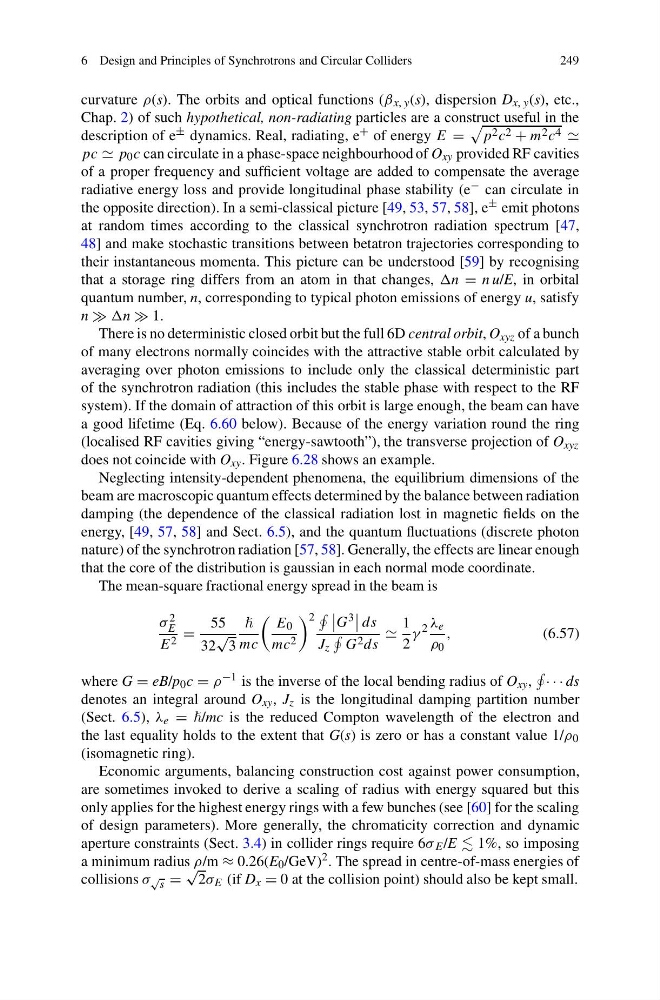
The mean-square fractional energy spread in the beam is
σ 2
E
E 2 =
55
32
√
3
mc
E 0
mc 2
2
G 3
ds
J z
G 2 ds
1
2
γ
2 λ e
ρ 0
,
(6.57)
where G = eB/p 0 c = ρ −1 is the inverse of the local bending radius of O xy ,
· · · ds
denotes an integral around O xy , J z is the longitudinal damping partition number
(Sect. 6.5), λ e = is the reduced Compton wavelength of the electron and
the last equality holds to the extent that G(s) is zero or has a constant value 1/ρ 0
(isomagnetic ring).
Economic arguments, balancing construction cost against power consumption,
are sometimes invoked to derive a scaling of radius with energy squared but this
only applies for the highest energy rings with a few bunches (see [60] for the scaling
of design parameters). More generally, the chromaticity correction and dynamic
aperture constraints (Sect. 3.4) in collider rings require 6σ E /E 1%, so imposing
a minimum radius ρ/m ≈ 0.26(E 0 /GeV) 2 . The spread in centre-of-mass energies of
collisions σ √
s =
√
2σ E (if D x = 0 at the collision point) should also be kept small.
249
curvature ρ(s). The orbits and optical functions (β x, y (s), dispersion D x, y (s), etc.,
Chap. 2) of such hypothetical, non-radiating particles are a construct useful in the
description of e ± dynamics. Real, radiating, e + of energy E =
p 2 c 2 + m 2 c 4
pc p 0 c can circulate in a phase-space neighbourhood of O xy provided RF cavities
of a proper frequency and sufficient voltage are added to compensate the average
radiative energy loss and provide longitudinal phase stability (e − can circulate in
the opposite direction). In a semi-classical picture [49, 53, 57, 58], e ± emit photons
at random times according to the classical synchrotron radiation spectrum [47,
48] and make stochastic transitions between betatron trajectories corresponding to
their instantaneous momenta. This picture can be understood [59] by recognising
that a storage ring differs from an atom in that changes, = n u/E, in orbital
quantum number, n, corresponding to typical photon emissions of energy u, satisfy
n 1.
There is no deterministic closed orbit but the full 6D central orbit, O xyz of a bunch
of many electrons normally coincides with the attractive stable orbit calculated by
averaging over photon emissions to include only the classical deterministic part
of the synchrotron radiation (this includes the stable phase with respect to the RF
system). If the domain of attraction of this orbit is large enough, the beam can have
a good lifetime (Eq. 6.60 below). Because of the energy variation round the ring
(localised RF cavities giving “energy-sawtooth”), the transverse projection of O xyz
does not coincide with O xy . Figure 6.28 shows an example.
Neglecting intensity-dependent phenomena, the equilibrium dimensions of the
beam are macroscopic quantum effects determined by the balance between radiation
damping (the dependence of the classical radiation lost in magnetic fields on the
energy, [49, 57, 58] and Sect. 6.5), and the quantum fluctuations (discrete photon
nature) of the synchrotron radiation [57, 58]. Generally, the effects are linear enough
that the core of the distribution is gaussian in each normal mode coordinate.
The mean-square fractional energy spread in the beam is
σ 2
E
E 2 =
55
32
√
3
mc
E 0
mc 2
2
G 3
ds
J z
G 2 ds
1
2
γ
2 λ e
ρ 0
,
(6.57)
where G = eB/p 0 c = ρ −1 is the inverse of the local bending radius of O xy ,
· · · ds
denotes an integral around O xy , J z is the longitudinal damping partition number
(Sect. 6.5), λ e = is the reduced Compton wavelength of the electron and
the last equality holds to the extent that G(s) is zero or has a constant value 1/ρ 0
(isomagnetic ring).
Economic arguments, balancing construction cost against power consumption,
are sometimes invoked to derive a scaling of radius with energy squared but this
only applies for the highest energy rings with a few bunches (see [60] for the scaling
of design parameters). More generally, the chromaticity correction and dynamic
aperture constraints (Sect. 3.4) in collider rings require 6σ E /E 1%, so imposing
a minimum radius ρ/m ≈ 0.26(E 0 /GeV) 2 . The spread in centre-of-mass energies of
collisions σ √
s =
√
2σ E (if D x = 0 at the collision point) should also be kept small.