

244
B. J. Holzer et al.
rates [50] the damping time can be written as
1
τ ε
=
U 0
2ET 0
(2 + D) , and
1
τ x
=
U 0
2ET 0
(1 − D) , where D ≡
D
ρ
2k+
1
ρ 2
ds
ds
ρ 2
.
(6.55)
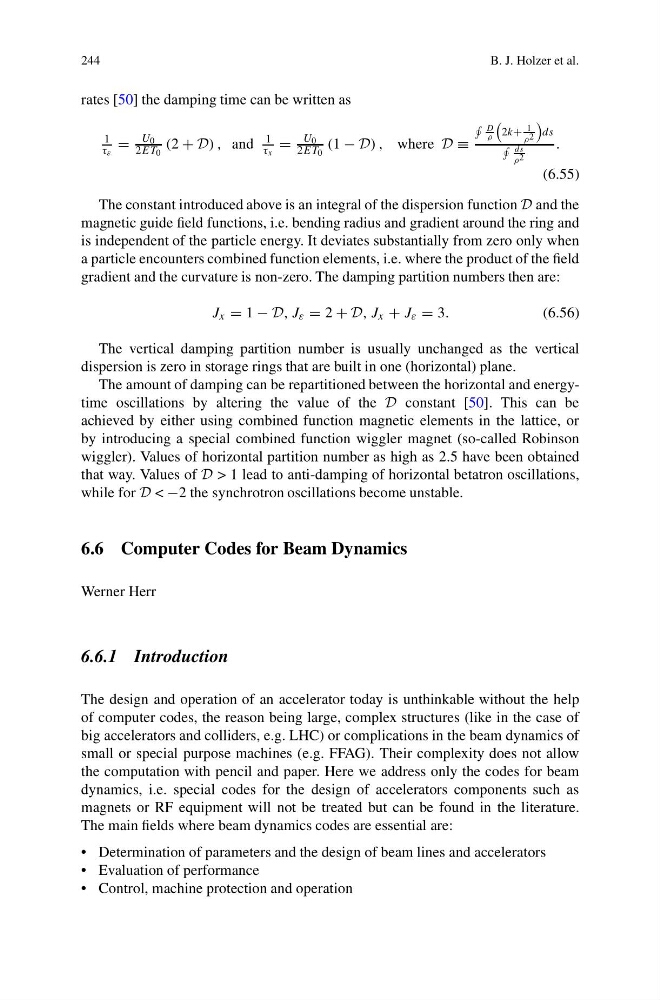
The constant introduced above is an integral of the dispersion function D and the
magnetic guide field functions, i.e. bending radius and gradient around the ring and
is independent of the particle energy. It deviates substantially from zero only when
a particle encounters combined function elements, i.e. where the product of the field
gradient and the curvature is non-zero. The damping partition numbers then are:
J x = 1 − D, J ε = 2 + D, J x + J ε = 3.
(6.56)
The vertical damping partition number is usually unchanged as the vertical
dispersion is zero in storage rings that are built in one (horizontal) plane.
The amount of damping can be repartitioned between the horizontal and energytime oscillations by altering the value of the D constant [50]. This can be
achieved by either using combined function magnetic elements in the lattice, or
by introducing a special combined function wiggler magnet (so-called Robinson
wiggler). Values of horizontal partition number as high as 2.5 have been obtained
that way. Values of D > 1 lead to anti-damping of horizontal betatron oscillations,
while for D < −2 the synchrotron oscillations become unstable.
6.6 Computer Codes for Beam Dynamics
Werner Herr
6.6.1 Introduction
The design and operation of an accelerator today is unthinkable without the help
of computer codes, the reason being large, complex structures (like in the case of
big accelerators and colliders, e.g. LHC) or complications in the beam dynamics of
small or special purpose machines (e.g. FFAG). Their complexity does not allow
the computation with pencil and paper. Here we address only the codes for beam
dynamics, i.e. special codes for the design of accelerators components such as
magnets or RF equipment will not be treated but can be found in the literature.
The main fields where beam dynamics codes are essential are:
• Determination of parameters and the design of beam lines and accelerators
• Evaluation of performance
• Control, machine protection and operation
B. J. Holzer et al.
rates [50] the damping time can be written as
1
τ ε
=
U 0
2ET 0
(2 + D) , and
1
τ x
=
U 0
2ET 0
(1 − D) , where D ≡
D
ρ
2k+
1
ρ 2
ds
ds
ρ 2
.
(6.55)
The constant introduced above is an integral of the dispersion function D and the
magnetic guide field functions, i.e. bending radius and gradient around the ring and
is independent of the particle energy. It deviates substantially from zero only when
a particle encounters combined function elements, i.e. where the product of the field
gradient and the curvature is non-zero. The damping partition numbers then are:
J x = 1 − D, J ε = 2 + D, J x + J ε = 3.
(6.56)
The vertical damping partition number is usually unchanged as the vertical
dispersion is zero in storage rings that are built in one (horizontal) plane.
The amount of damping can be repartitioned between the horizontal and energytime oscillations by altering the value of the D constant [50]. This can be
achieved by either using combined function magnetic elements in the lattice, or
by introducing a special combined function wiggler magnet (so-called Robinson
wiggler). Values of horizontal partition number as high as 2.5 have been obtained
that way. Values of D > 1 lead to anti-damping of horizontal betatron oscillations,
while for D < −2 the synchrotron oscillations become unstable.
6.6 Computer Codes for Beam Dynamics
Werner Herr
6.6.1 Introduction
The design and operation of an accelerator today is unthinkable without the help
of computer codes, the reason being large, complex structures (like in the case of
big accelerators and colliders, e.g. LHC) or complications in the beam dynamics of
small or special purpose machines (e.g. FFAG). Their complexity does not allow
the computation with pencil and paper. Here we address only the codes for beam
dynamics, i.e. special codes for the design of accelerators components such as
magnets or RF equipment will not be treated but can be found in the literature.
The main fields where beam dynamics codes are essential are:
• Determination of parameters and the design of beam lines and accelerators
• Evaluation of performance
• Control, machine protection and operation