

6 Design and Principles of Synchrotrons and Circular Colliders
231
N particles bunch
/
ρ
1
2
(x,y,s,s )
0
ρ(x,y,s,−s )
0
0
s
1
2
N
N
ρ density = const.
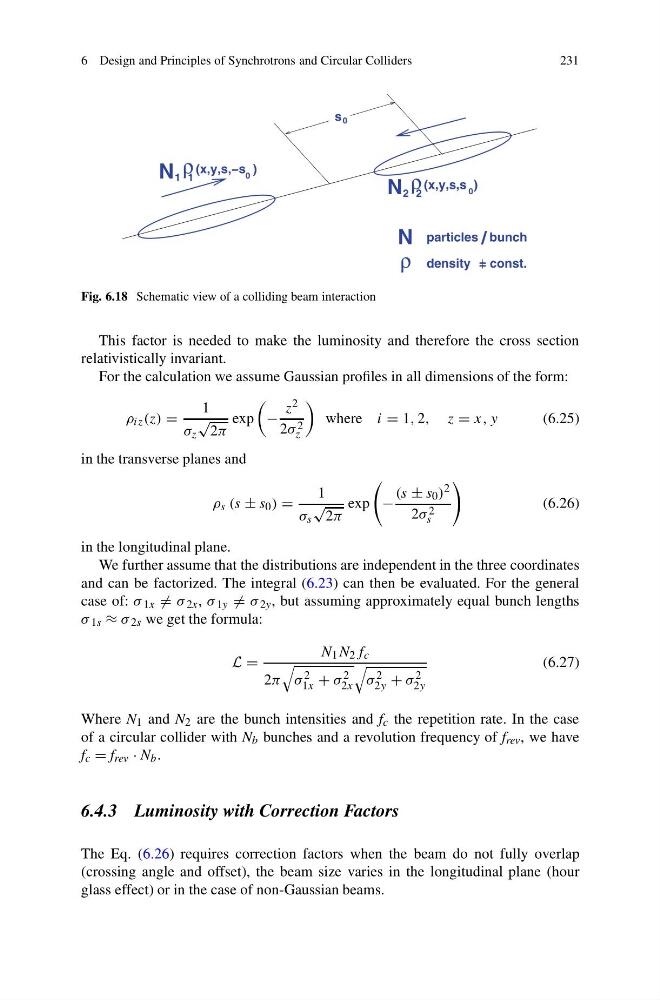
Fig. 6.18 Schematic view of a colliding beam interaction
This factor is needed to make the luminosity and therefore the cross section
relativistically invariant.
For the calculation we assume Gaussian profiles in all dimensions of the form:
ρ iz (z) =
1
σ z
√
2π
exp
−
z 2
2σ 2
z
where i = 1, 2, z = x, y
(6.25)
in the transverse planes and
ρ s (s ± s 0 ) =
1
σ s
√
2π
exp
−
(s ± s 0 )
2
2σ 2
s
(6.26)
in the longitudinal plane.
We further assume that the distributions are independent in the three coordinates
and can be factorized. The integral (6.23) can then be evaluated. For the general
case of: σ 1x = σ 2x , σ 1y = σ 2y , but assuming approximately equal bunch lengths
σ 1s ≈ σ 2s we get the formula:
L =
N 1 N 2 f c
2π
σ 2
1x + σ 2
2x
σ 2
2y + σ 2
2y
(6.27)
Where N 1 and N 2 are the bunch intensities and f c the repetition rate. In the case
of a circular collider with N b bunches and a revolution frequency of f rev , we have
f c = f rev · N b .
6.4.3 Luminosity with Correction Factors
The Eq. (6.26) requires correction factors when the beam do not fully overlap
(crossing angle and offset), the beam size varies in the longitudinal plane (hour
glass effect) or in the case of non-Gaussian beams.
231
N particles bunch
/
ρ
1
2
(x,y,s,s )
0
ρ(x,y,s,−s )
0
0
s
1
2
N
N
ρ density = const.
Fig. 6.18 Schematic view of a colliding beam interaction
This factor is needed to make the luminosity and therefore the cross section
relativistically invariant.
For the calculation we assume Gaussian profiles in all dimensions of the form:
ρ iz (z) =
1
σ z
√
2π
exp
−
z 2
2σ 2
z
where i = 1, 2, z = x, y
(6.25)
in the transverse planes and
ρ s (s ± s 0 ) =
1
σ s
√
2π
exp
−
(s ± s 0 )
2
2σ 2
s
(6.26)
in the longitudinal plane.
We further assume that the distributions are independent in the three coordinates
and can be factorized. The integral (6.23) can then be evaluated. For the general
case of: σ 1x = σ 2x , σ 1y = σ 2y , but assuming approximately equal bunch lengths
σ 1s ≈ σ 2s we get the formula:
L =
N 1 N 2 f c
2π
σ 2
1x + σ 2
2x
σ 2
2y + σ 2
2y
(6.27)
Where N 1 and N 2 are the bunch intensities and f c the repetition rate. In the case
of a circular collider with N b bunches and a revolution frequency of f rev , we have
f c = f rev · N b .
6.4.3 Luminosity with Correction Factors
The Eq. (6.26) requires correction factors when the beam do not fully overlap
(crossing angle and offset), the beam size varies in the longitudinal plane (hour
glass effect) or in the case of non-Gaussian beams.