

222
B. J. Holzer et al.
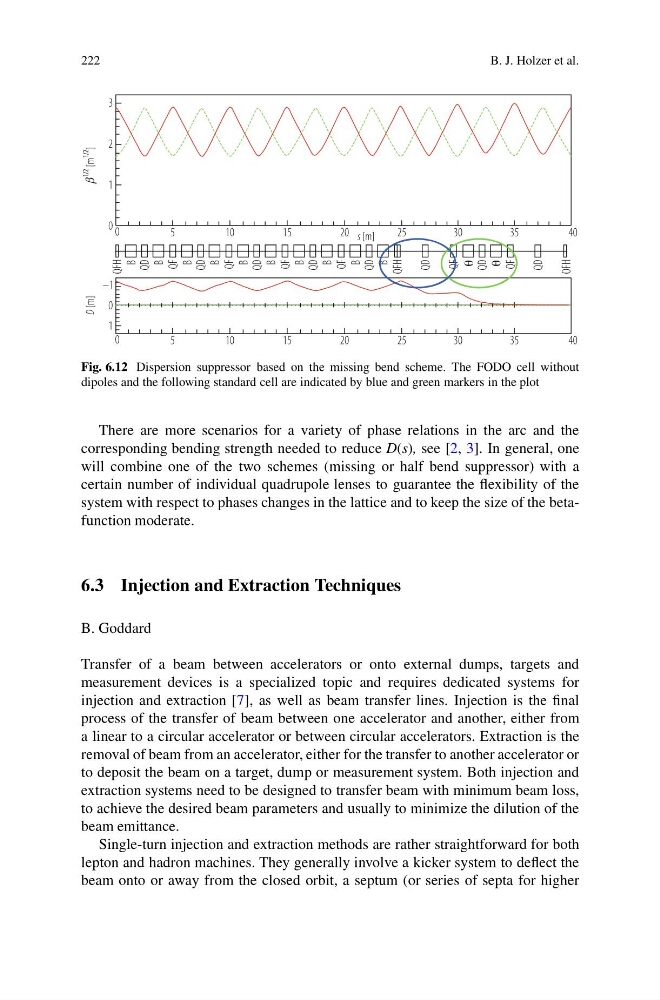
Fig. 6.12 Dispersion suppressor based on the missing bend scheme. The FODO cell without
dipoles and the following standard cell are indicated by blue and green markers in the plot
There are more scenarios for a variety of phase relations in the arc and the
corresponding bending strength needed to reduce D(s), see [2, 3]. In general, one
will combine one of the two schemes (missing or half bend suppressor) with a
certain number of individual quadrupole lenses to guarantee the flexibility of the
system with respect to phases changes in the lattice and to keep the size of the betafunction moderate.
6.3 Injection and Extraction Techniques
B. Goddard
Transfer of a beam between accelerators or onto external dumps, targets and
measurement devices is a specialized topic and requires dedicated systems for
injection and extraction [7], as well as beam transfer lines. Injection is the final
process of the transfer of beam between one accelerator and another, either from
a linear to a circular accelerator or between circular accelerators. Extraction is the
removal of beam from an accelerator, either for the transfer to another accelerator or
to deposit the beam on a target, dump or measurement system. Both injection and
extraction systems need to be designed to transfer beam with minimum beam loss,
to achieve the desired beam parameters and usually to minimize the dilution of the
beam emittance.
Single-turn injection and extraction methods are rather straightforward for both
lepton and hadron machines. They generally involve a kicker system to deflect the
beam onto or away from the closed orbit, a septum (or series of septa for higher
B. J. Holzer et al.
Fig. 6.12 Dispersion suppressor based on the missing bend scheme. The FODO cell without
dipoles and the following standard cell are indicated by blue and green markers in the plot
There are more scenarios for a variety of phase relations in the arc and the
corresponding bending strength needed to reduce D(s), see [2, 3]. In general, one
will combine one of the two schemes (missing or half bend suppressor) with a
certain number of individual quadrupole lenses to guarantee the flexibility of the
system with respect to phases changes in the lattice and to keep the size of the betafunction moderate.
6.3 Injection and Extraction Techniques
B. Goddard
Transfer of a beam between accelerators or onto external dumps, targets and
measurement devices is a specialized topic and requires dedicated systems for
injection and extraction [7], as well as beam transfer lines. Injection is the final
process of the transfer of beam between one accelerator and another, either from
a linear to a circular accelerator or between circular accelerators. Extraction is the
removal of beam from an accelerator, either for the transfer to another accelerator or
to deposit the beam on a target, dump or measurement system. Both injection and
extraction systems need to be designed to transfer beam with minimum beam loss,
to achieve the desired beam parameters and usually to minimize the dilution of the
beam emittance.
Single-turn injection and extraction methods are rather straightforward for both
lepton and hadron machines. They generally involve a kicker system to deflect the
beam onto or away from the closed orbit, a septum (or series of septa for higher