

196
M. Brugger et al.
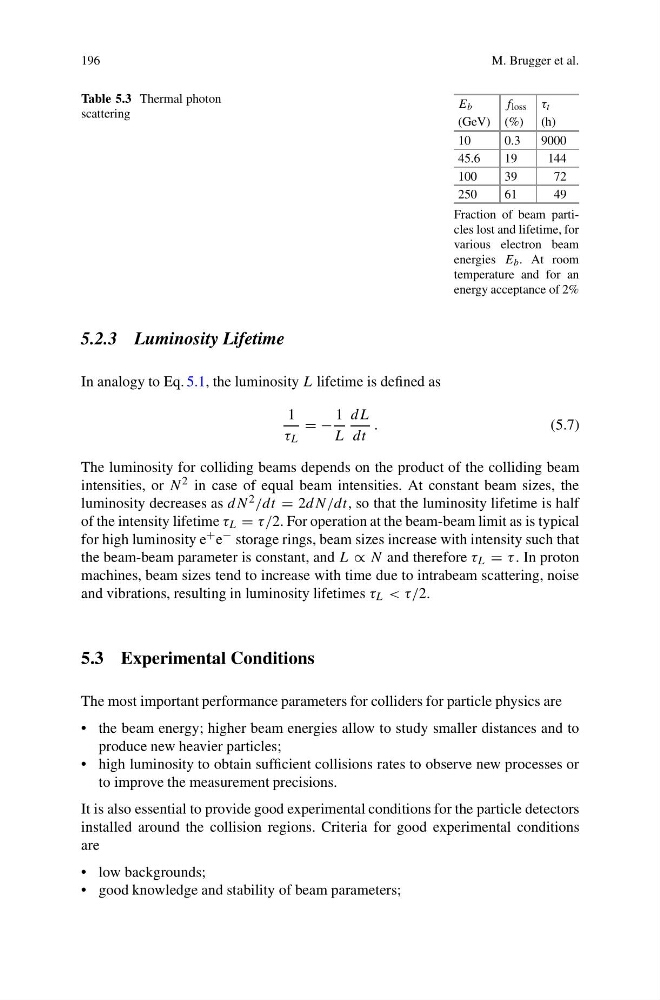
Table 5.3 Thermal photon
scattering
E b
f loss τ t
(GeV) (%) (h)
10
0.3
9000
45.6
19
144
100
39
72
250
61
49
Fraction of beam particles lost and lifetime, for
various electron beam
energies E b . At room
temperature and for an
energy acceptance of 2%
5.2.3 Luminosity Lifetime
In analogy to Eq. 5.1, the luminosity L lifetime is defined as
1
τ L
= −
1
L
dL
dt
.
(5.7)
The luminosity for colliding beams depends on the product of the colliding beam
intensities, or N 2 in case of equal beam intensities. At constant beam sizes, the
luminosity decreases as dN 2 /dt = 2dN/dt, so that the luminosity lifetime is half
of the intensity lifetime τ L = τ/2. For operation at the beam-beam limit as is typical
for high luminosity e + e − storage rings, beam sizes increase with intensity such that
the beam-beam parameter is constant, and L ∝ N and therefore τ L = τ . In proton
machines, beam sizes tend to increase with time due to intrabeam scattering, noise
and vibrations, resulting in luminosity lifetimes τ L < τ/2.
5.3 Experimental Conditions
The most important performance parameters for colliders for particle physics are
• the beam energy; higher beam energies allow to study smaller distances and to
produce new heavier particles;
• high luminosity to obtain sufficient collisions rates to observe new processes or
to improve the measurement precisions.
It is also essential to provide good experimental conditions for the particle detectors
installed around the collision regions. Criteria for good experimental conditions
are
• low backgrounds;
• good knowledge and stability of beam parameters;
M. Brugger et al.
Table 5.3 Thermal photon
scattering
E b
f loss τ t
(GeV) (%) (h)
10
0.3
9000
45.6
19
144
100
39
72
250
61
49
Fraction of beam particles lost and lifetime, for
various electron beam
energies E b . At room
temperature and for an
energy acceptance of 2%
5.2.3 Luminosity Lifetime
In analogy to Eq. 5.1, the luminosity L lifetime is defined as
1
τ L
= −
1
L
dL
dt
.
(5.7)
The luminosity for colliding beams depends on the product of the colliding beam
intensities, or N 2 in case of equal beam intensities. At constant beam sizes, the
luminosity decreases as dN 2 /dt = 2dN/dt, so that the luminosity lifetime is half
of the intensity lifetime τ L = τ/2. For operation at the beam-beam limit as is typical
for high luminosity e + e − storage rings, beam sizes increase with intensity such that
the beam-beam parameter is constant, and L ∝ N and therefore τ L = τ . In proton
machines, beam sizes tend to increase with time due to intrabeam scattering, noise
and vibrations, resulting in luminosity lifetimes τ L < τ/2.
5.3 Experimental Conditions
The most important performance parameters for colliders for particle physics are
• the beam energy; higher beam energies allow to study smaller distances and to
produce new heavier particles;
• high luminosity to obtain sufficient collisions rates to observe new processes or
to improve the measurement precisions.
It is also essential to provide good experimental conditions for the particle detectors
installed around the collision regions. Criteria for good experimental conditions
are
• low backgrounds;
• good knowledge and stability of beam parameters;