

154
E. Metral et al.
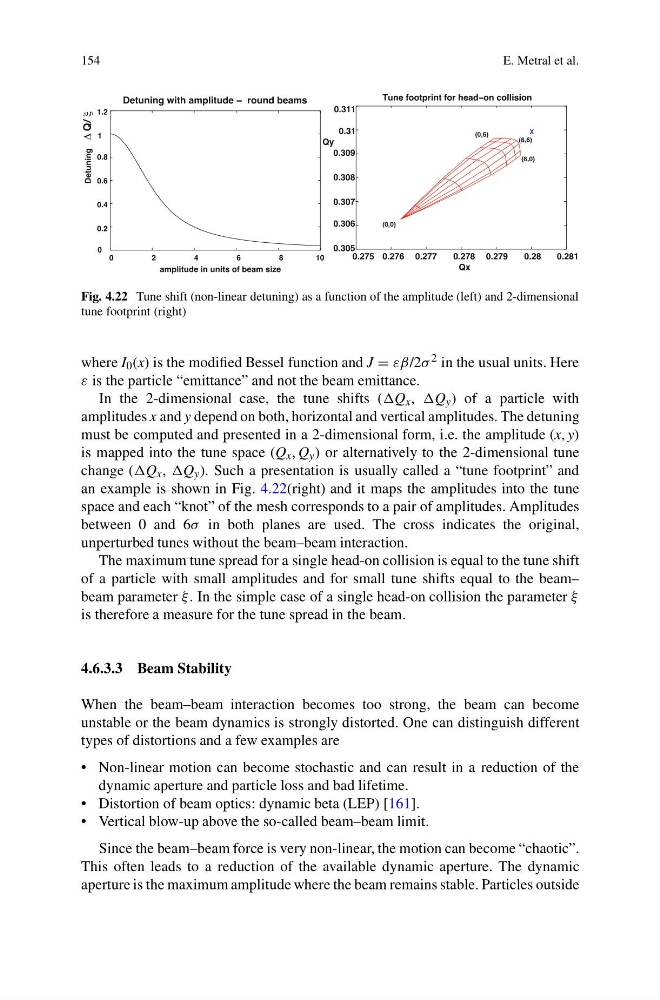
Fig. 4.22 Tune shift (non-linear detuning) as a function of the amplitude (left) and 2-dimensional
tune footprint (right)
where I 0 (x) is the modified Bessel function and J = εβ/2σ 2 in the usual units. Here
ε is the particle “emittance” and not the beam emittance.
In the 2-dimensional case, the tune shifts (Q x , Q y ) of a particle with
amplitudes x and y depend on both, horizontal and vertical amplitudes. The detuning
must be computed and presented in a 2-dimensional form, i.e. the amplitude (x, y)
is mapped into the tune space (Q x , Q y ) or alternatively to the 2-dimensional tune
change (Q x , Q y ). Such a presentation is usually called a “tune footprint” and
an example is shown in Fig. 4.22(right) and it maps the amplitudes into the tune
space and each “knot” of the mesh corresponds to a pair of amplitudes. Amplitudes
between 0 and 6σ in both planes are used. The cross indicates the original,
unperturbed tunes without the beam–beam interaction.
The maximum tune spread for a single head-on collision is equal to the tune shift
of a particle with small amplitudes and for small tune shifts equal to the beam–
beam parameter ξ . In the simple case of a single head-on collision the parameter ξ
is therefore a measure for the tune spread in the beam.
4.6.3.3 Beam Stability
When the beam–beam interaction becomes too strong, the beam can become
unstable or the beam dynamics is strongly distorted. One can distinguish different
types of distortions and a few examples are
• Non-linear motion can become stochastic and can result in a reduction of the
dynamic aperture and particle loss and bad lifetime.
• Distortion of beam optics: dynamic beta (LEP) [161].
• Vertical blow-up above the so-called beam–beam limit.
Since the beam–beam force is very non-linear, the motion can become “chaotic”.
This often leads to a reduction of the available dynamic aperture. The dynamic
aperture is the maximum amplitude where the beam remains stable. Particles outside
E. Metral et al.
Fig. 4.22 Tune shift (non-linear detuning) as a function of the amplitude (left) and 2-dimensional
tune footprint (right)
where I 0 (x) is the modified Bessel function and J = εβ/2σ 2 in the usual units. Here
ε is the particle “emittance” and not the beam emittance.
In the 2-dimensional case, the tune shifts (Q x , Q y ) of a particle with
amplitudes x and y depend on both, horizontal and vertical amplitudes. The detuning
must be computed and presented in a 2-dimensional form, i.e. the amplitude (x, y)
is mapped into the tune space (Q x , Q y ) or alternatively to the 2-dimensional tune
change (Q x , Q y ). Such a presentation is usually called a “tune footprint” and
an example is shown in Fig. 4.22(right) and it maps the amplitudes into the tune
space and each “knot” of the mesh corresponds to a pair of amplitudes. Amplitudes
between 0 and 6σ in both planes are used. The cross indicates the original,
unperturbed tunes without the beam–beam interaction.
The maximum tune spread for a single head-on collision is equal to the tune shift
of a particle with small amplitudes and for small tune shifts equal to the beam–
beam parameter ξ . In the simple case of a single head-on collision the parameter ξ
is therefore a measure for the tune spread in the beam.
4.6.3.3 Beam Stability
When the beam–beam interaction becomes too strong, the beam can become
unstable or the beam dynamics is strongly distorted. One can distinguish different
types of distortions and a few examples are
• Non-linear motion can become stochastic and can result in a reduction of the
dynamic aperture and particle loss and bad lifetime.
• Distortion of beam optics: dynamic beta (LEP) [161].
• Vertical blow-up above the so-called beam–beam limit.
Since the beam–beam force is very non-linear, the motion can become “chaotic”.
This often leads to a reduction of the available dynamic aperture. The dynamic
aperture is the maximum amplitude where the beam remains stable. Particles outside