

134
E. Metral et al.
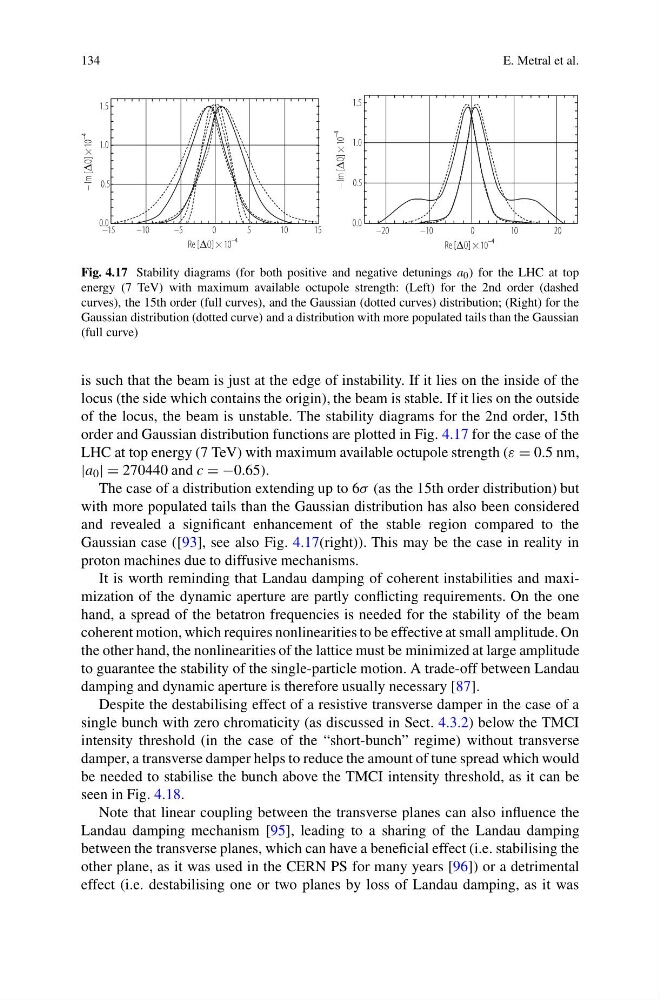
Fig. 4.17 Stability diagrams (for both positive and negative detunings a 0 ) for the LHC at top
energy (7 TeV) with maximum available octupole strength: (Left) for the 2nd order (dashed
curves), the 15th order (full curves), and the Gaussian (dotted curves) distribution; (Right) for the
Gaussian distribution (dotted curve) and a distribution with more populated tails than the Gaussian
(full curve)
is such that the beam is just at the edge of instability. If it lies on the inside of the
locus (the side which contains the origin), the beam is stable. If it lies on the outside
of the locus, the beam is unstable. The stability diagrams for the 2nd order, 15th
order and Gaussian distribution functions are plotted in Fig. 4.17 for the case of the
LHC at top energy (7 TeV) with maximum available octupole strength (ε = 0.5 nm,
|a 0 | = 270440 and c = −0.65).
The case of a distribution extending up to 6σ (as the 15th order distribution) but
with more populated tails than the Gaussian distribution has also been considered
and revealed a significant enhancement of the stable region compared to the
Gaussian case ([93], see also Fig. 4.17(right)). This may be the case in reality in
proton machines due to diffusive mechanisms.
It is worth reminding that Landau damping of coherent instabilities and maximization of the dynamic aperture are partly conflicting requirements. On the one
hand, a spread of the betatron frequencies is needed for the stability of the beam
coherent motion, which requires nonlinearities to be effective at small amplitude. On
the other hand, the nonlinearities of the lattice must be minimized at large amplitude
to guarantee the stability of the single-particle motion. A trade-off between Landau
damping and dynamic aperture is therefore usually necessary [87].
Despite the destabilising effect of a resistive transverse damper in the case of a
single bunch with zero chromaticity (as discussed in Sect. 4.3.2) below the TMCI
intensity threshold (in the case of the “short-bunch” regime) without transverse
damper, a transverse damper helps to reduce the amount of tune spread which would
be needed to stabilise the bunch above the TMCI intensity threshold, as it can be
seen in Fig. 4.18.
Note that linear coupling between the transverse planes can also influence the
Landau damping mechanism [95], leading to a sharing of the Landau damping
between the transverse planes, which can have a beneficial effect (i.e. stabilising the
other plane, as it was used in the CERN PS for many years [96]) or a detrimental
effect (i.e. destabilising one or two planes by loss of Landau damping, as it was
E. Metral et al.
Fig. 4.17 Stability diagrams (for both positive and negative detunings a 0 ) for the LHC at top
energy (7 TeV) with maximum available octupole strength: (Left) for the 2nd order (dashed
curves), the 15th order (full curves), and the Gaussian (dotted curves) distribution; (Right) for the
Gaussian distribution (dotted curve) and a distribution with more populated tails than the Gaussian
(full curve)
is such that the beam is just at the edge of instability. If it lies on the inside of the
locus (the side which contains the origin), the beam is stable. If it lies on the outside
of the locus, the beam is unstable. The stability diagrams for the 2nd order, 15th
order and Gaussian distribution functions are plotted in Fig. 4.17 for the case of the
LHC at top energy (7 TeV) with maximum available octupole strength (ε = 0.5 nm,
|a 0 | = 270440 and c = −0.65).
The case of a distribution extending up to 6σ (as the 15th order distribution) but
with more populated tails than the Gaussian distribution has also been considered
and revealed a significant enhancement of the stable region compared to the
Gaussian case ([93], see also Fig. 4.17(right)). This may be the case in reality in
proton machines due to diffusive mechanisms.
It is worth reminding that Landau damping of coherent instabilities and maximization of the dynamic aperture are partly conflicting requirements. On the one
hand, a spread of the betatron frequencies is needed for the stability of the beam
coherent motion, which requires nonlinearities to be effective at small amplitude. On
the other hand, the nonlinearities of the lattice must be minimized at large amplitude
to guarantee the stability of the single-particle motion. A trade-off between Landau
damping and dynamic aperture is therefore usually necessary [87].
Despite the destabilising effect of a resistive transverse damper in the case of a
single bunch with zero chromaticity (as discussed in Sect. 4.3.2) below the TMCI
intensity threshold (in the case of the “short-bunch” regime) without transverse
damper, a transverse damper helps to reduce the amount of tune spread which would
be needed to stabilise the bunch above the TMCI intensity threshold, as it can be
seen in Fig. 4.18.
Note that linear coupling between the transverse planes can also influence the
Landau damping mechanism [95], leading to a sharing of the Landau damping
between the transverse planes, which can have a beneficial effect (i.e. stabilising the
other plane, as it was used in the CERN PS for many years [96]) or a detrimental
effect (i.e. destabilising one or two planes by loss of Landau damping, as it was